No user accounts required for your recipients -
Start your 7-day free trial now!

How to Plan, Design, and Deploy Digital Certificates That Are Secure, Scalable, and Ready for Growth


Digital certificates have become a vital component in modern education, training, and certification programs. Whether you're a university, a training provider, or a skills-based workshop, issuing verifiable digital credentials is not just a trend but a competitive advantage.
Why organizations are shifting to digital certificates:
Real-life example:
When OMR Education adopted digital certificates, they achieved a significant reduction in manual workload and enhanced brand visibility through LinkedIn shares.
Read the full OMR success story
From static PDF to trusted digital proof:
Our blog article "From PDF to Verified" explains how certificates evolved into secure, shareable, and verifiable digital credentials that empower recipients and build institutional credibility.
Before launching your digital certificate program, it is essential to set a clear foundation. The pre-launch phase determines how successful and scalable your process will be.
Key questions to define early on:
Core preparation tasks before launching:
Essential pre-launch checklist:
Recommended reading:
The blog post Checklist: Making your credentials future-proof outlines how to design and launch scalable, secure, and compliant certificate campaigns using best practices.
Once your strategy and infrastructure are in place, the next step is to design certificates that are visually professional, personalized, and aligned with your brand. This phase ensures that your digital credentials leave a lasting impression.
Best practices for certificate design and customization:
Avoid these common design mistakes:
With your certificates built and tested, the next step is launching a process that is fully automated, efficient, and secure. A strong launch ensures certificates reach recipients reliably and with minimal manual effort.
Automate issuance based on real triggers:
Distribute certificates with professional delivery:
Verification and authenticity checks:

Relevant reading: Learn how to automate this process end-to-end in the blog article "How to Automate Certificate Issuance with Virtualbadge.io", including step-by-step integration tips.
After certificates have been sent out, your work is not done. A successful digital credential program includes ongoing monitoring, optimization, and stakeholder engagement to increase effectiveness over time.
Track performance and recipient engagement:
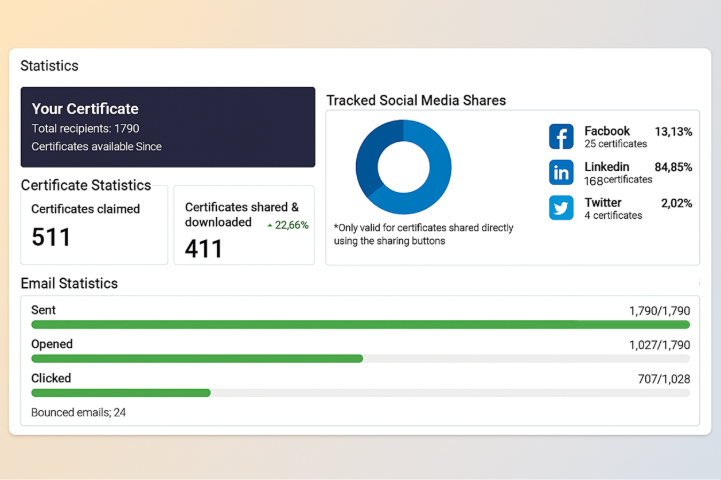
Collect feedback to enhance future campaigns:
Iterate and optimize regularly:
Final Thoughts & Next Steps
Launching digital certificates doesn't have to be complex. With the right tools and strategy in place, you can create a certification process that is professional, automated, and aligned with your goals.
Ready to see it in action?
Book a free, personalized demo and let us show you how Virtualbadge.io can help you launch and scale your digital certificates with ease.
* You can find the organisation ID in the URL when you access your LinkedIn Company page as an admin.


Marketing

Jan 22, 2026

5 min
A note on how we write: we use AI tools to help with research and drafting. Every article is then reviewed, edited and fact-checked by someone on the Virtualbadge.io team before it goes live. The final word is always human.

Use Virtualbadge.io to design and send digital certificates that create trust - in less than 10 minutes.
%20(1).svg)