No user accounts required for your recipients -
Start your 7-day free trial now!

How universities use digital certificates to boost credibility, efficiency, and visibility


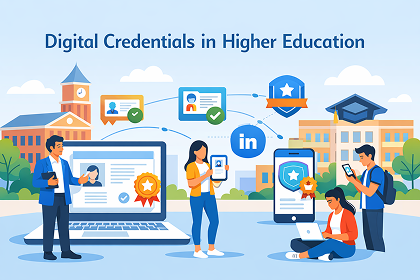
The higher education sector is undergoing rapid transformation. As digitalization reshapes how institutions operate and how students interact with education providers, the way achievements are recognized and verified must also evolve.
Traditional paper certificates are no longer sufficient in a digital-first world. Students, employers, and institutions are demanding faster, verifiable, and more flexible ways to issue and share credentials.
Key drivers behind the rise of digital credentials in higher education:
Digital credentials provide a solution that addresses these needs. They allow universities to modernize their credentialing processes and improve their engagement with students and stakeholders.
Digital credentials are verifiable, secure representations of a learner’s achievements issued in digital form. They come in different formats, most commonly as digital certificates and digital badges. Unlike static PDFs, they include metadata that makes them interactive, verifiable, and traceable.
This chapter draws on two key resources from Virtualbadge.io:
Main types of digital credentials:
Digital Certificates
Digital Badges
Core components of a digital credential:
Benefits of the underlying technology:
Digital credentials not only serve as proof of achievement. They become digital assets that students can carry with them throughout their careers. For institutions, they offer a scalable and modern way to showcase educational impact.
Digital credentials bring measurable advantages for both universities and their students. They enhance operational efficiency while strengthening professional opportunities for learners.
Benefits for Universities
Benefits for Students
Digital credentials support a modern, student-centric approach to learning recognition and communication.
Successful implementation requires clear planning and the right tools. Universities can roll out digital credentials efficiently by following proven strategies.
Based on the article: How to Automate Certificate Issuance
Best practices to follow
By following these steps, institutions can establish digital credentialing as a scalable, reliable, and student-friendly process.
Digital credentials are not a short-term trend. They represent a fundamental shift in how educational achievements are recognized, shared, and trusted. For higher education institutions, adopting digital credentials is not just an upgrade—it’s a strategic move to stay relevant in a digitally connected world.
Key trends shaping the future
Universities that embrace digital credentialing early will benefit from greater visibility, improved student engagement, and stronger connections to the job market.
For further insights, explore:
The Future of Digital Certificates
Ready to modernize your certificate processes and deliver real value to your students?
With Virtualbadge.io, you can:
👉 Book a free live demo.
👉 Or try it free for 7 days — no commitment, and see how it works in action
* You can find the organisation ID in the URL when you access your LinkedIn Company page as an admin.


Marketing

Jan 26, 2026

4 min
A note on how we write: we use AI tools to help with research and drafting. Every article is then reviewed, edited and fact-checked by someone on the Virtualbadge.io team before it goes live. The final word is always human.

Use Virtualbadge.io to design and send digital certificates that create trust - in less than 10 minutes.
%20(1).svg)