No user accounts required for your recipients -
Start your 7-day free trial now!

How digital badges and certificates enhance credibility, employability, and institutional reputation in modern higher education



Digitalization, shifting job market demands and evolving learner expectations are challenging traditional models of academic recognition. While degrees remain important, they are no longer sufficient on their own.
Today’s students and institutions are expected to deliver and validate:
Conventional paper certificates or static PDFs no longer meet these expectations.
Digital credentials, including digital certificates and badges, offer a modern solution. They make learning achievements visible, secure and easy to share. At the same time, they help institutions stay relevant in a competitive academic landscape.
Key benefits include:
This article explains why universities should embrace digital credentials and how they can implement them effectively.
Digital credentials are more than just digital versions of paper certificates. They are secure, data-rich tools that provide verified proof of learning. Each credential represents a specific skill, accomplishment or learning milestone.
Main types of digital credentials:
How they work:
Digital credentials include metadata such as:
These credentials are:
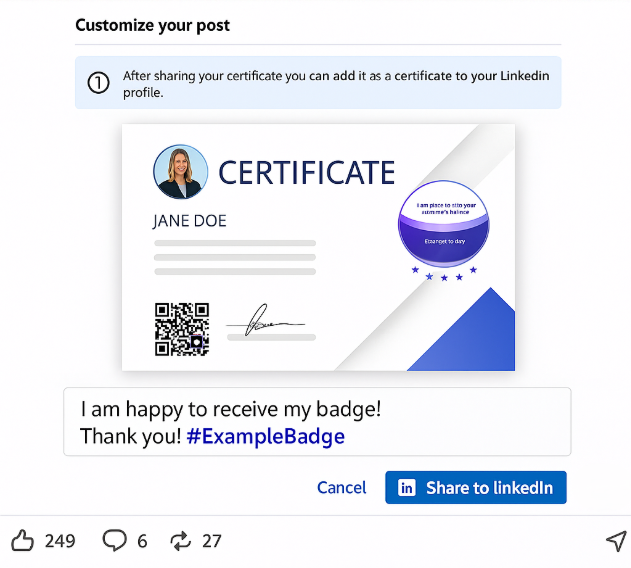
Compared to traditional certificates, digital credentials offer:
A detailed explanation of how digital badges enhance trust and recognition is available in the Virtualbadge.io blog article: Digital Badges Build Trust: Verifiable Credentials Explained.
Digital credentials provide significant advantages for both higher education institutions and their students. They are not only a modern way to recognize learning achievements but also a strategic tool for visibility, efficiency and engagement.
For universities, digital credentials offer:
For students, the benefits include:
A closer look at how digital badges enhance continuing education is provided in the article Digital Badges for Continuing Education.
A practical example of digital credentials in higher education is the success story of EBT Academy, a healthcare training provider that successfully implemented automated digital diplomas using Virtualbadge.io.
With Virtualbadge.io, EBT Academy:
The results:
This case highlights how digital credentials are not just a branding tool but a practical solution for educational efficiency and digital transformation.
Introducing digital credentials at a university may seem like a technical challenge at first. In reality, it can be implemented smoothly and incrementally with the right strategy and tools. Successful integration depends on clear planning, stakeholder alignment and the use of flexible platforms.
Key steps to implement digital badges and certificates in higher education:
Digital credentials are not a trend. They are the future of academic recognition. They improve the student experience, modernize internal processes and showcase the university as an innovative institution.
If you're ready to explore how digital credentials can benefit your university, the next step is simple.
Schedule a free, no-obligation demo with our team at Virtualbadge.io. We’ll walk you through the platform and help you build a digital credentialing system tailored to your needs.
* You can find the organisation ID in the URL when you access your LinkedIn Company page as an admin.


Marketing

Jan 26, 2026

5 min
A note on how we write: we use AI tools to help with research and drafting. Every article is then reviewed, edited and fact-checked by someone on the Virtualbadge.io team before it goes live. The final word is always human.

Use Virtualbadge.io to design and send digital certificates that create trust - in less than 10 minutes.
%20(1).svg)