
Can you detect an AI-generated fake certificate?
Not reliably by looking at it. A good AI-made certificate has the right layout, fonts and seal. What exposes it is everything AI cannot produce: the issuer's digital signature, a record in the issuer's database and a valid status on the issuer's own verification page123.
Key points
- Digital document forgeries rose 244% in a year and made up 57% of all document fraud3.
- FinCEN warned in 2024 that criminals use generative AI to alter or create identity documents4.
- Visual checks fail against good AI fakes. What still works is the issuer's signature and record.
- Issuers make AI fakes fail by sealing credentials and running verification on their own site15.
Image generators and PDF editors have made forgery cheap. A fake certificate that once took hours of design work now takes minutes, with any name, grade and date.
This article shows what the numbers say, why visual checks fall short and which checks AI cannot fake. It also lists what issuers can do so that a perfect-looking fake still fails.
What the numbers say
The identity verification provider Entrust analyzed verifications from September 2023 to August 2024. Digital document forgeries rose 244% year over year. For the first time they made up the majority of document fraud, at 57%. The report also counted a deepfake attempt every five minutes in 20243.
In November 2024, FinCEN alerted financial institutions that criminals use generative AI to alter or create fraudulent identity documents to get past verification4. These numbers concern identity documents, not certificates, but the tools are the same.
Why the eye is not enough
AI-made fakes lack the classic tells of older forgeries, such as blurry logos or mismatched fonts. FinCEN's red flags for identity documents point to inconsistencies instead: details that do not match across documents, photos with signs of alteration and images that match AI-generated faces in a reverse image search4.
For certificates the same logic applies. Compare details across all documents a candidate submits, and treat any mismatch as a reason to verify with the issuer. A clean look is not proof.
What AI cannot fake
| Check | Why AI fails it |
|---|---|
| Digital signature in the PDF | A valid signature needs the issuer's private key1 |
| Record on the issuer's verification page | The fake has no record in the issuer's database2 |
| Live status | The status comes from the issuer, at the time of the check2 |
| Proof in a Verifiable Credential | Verifiers can check that the claims were not tampered with6 |
One route stays open: the fake check. A QR code on the fake can lead to a copied verification page. That is why the domain matters. See Fake verification websites.
What verifiers should do
- Open the issuer's verification page through its official website, not through the code on the document.
- Compare the details and the identification number with the record2.
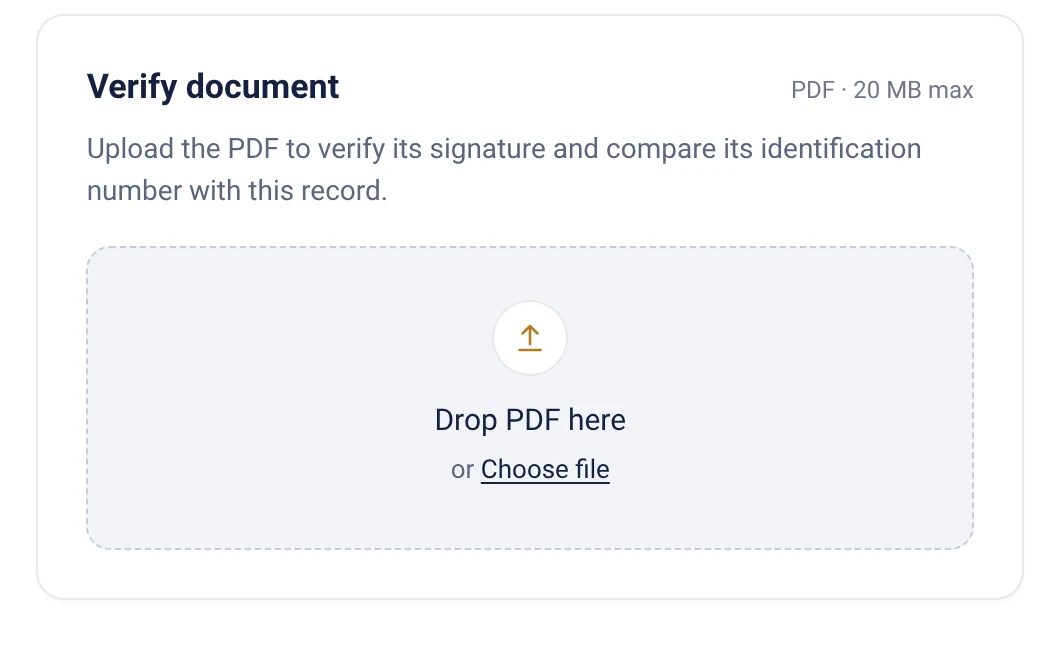
- Upload the PDF where the page allows it. The check covers the signature and whether the file belongs to the record2.
- Check that the holder's name matches the candidate's ID.
What issuers should do
Issuers decide whether an AI fake fails the first check or passes it. Seal every PDF, so that edits break the signature1. Run verification on your own website, so that checks end with you5. And search for copied verification pages, because that is where AI fakes find their confirmation7.
For issuers Make AI fakes of your certificates fail the first check.
Frequently asked questions
Can AI create a fake certificate?
Yes. Image and PDF tools produce convincing documents quickly, and digital document forgeries rose 244% in one year3.
Can software detect AI-generated certificates?
Detection tools look for traces of editing. Treat their result as a reason for a closer look, not as proof. The reliable check is the issuer's signature and record.
Does a digital signature stop AI fakes?
It keeps edited and fabricated documents from passing a signature check, because a valid signature needs the issuer's key1. The verifier still has to check it.
What about a QR code on an AI-made certificate?
It can lead to a copied verification page. Reach the issuer through its official website instead7.
As of Nov 18, 2026. We check the facts regularly. Is something out of date? Tell us, and we will fix it.
Sources
- Virtualbadge.io, how-to guides: Digitally seal PDF certificates and verify the signature accessed November 18, 2026
- Virtualbadge.io, how-to guides: Verify a certificate: by QR code, link or PDF upload accessed November 18, 2026
- Entrust: 2025 Identity Fraud Report: deepfake attacks strike every five minutes amid 244% surge in digital document forgeries, November 19, 2024 accessed November 18, 2026
- Financial Crimes Enforcement Network (FinCEN): FIN-2024-Alert004: fraud schemes involving deepfake media targeting financial institutions, November 13, 2024 accessed November 18, 2026
- Virtualbadge.io, how-to guides: Embed the validation page in your own website accessed November 18, 2026
- World Wide Web Consortium (W3C): W3C publishes Verifiable Credentials 2.0 as a W3C Standard, May 15, 2025 accessed November 18, 2026
- AI Fraud Protect (FutureNext GmbH): AI Fraud Protect: copies of your website, fake verification pages and phishing in your name accessed November 18, 2026