
What types of credential fraud are there?
Seven types cover almost all cases: fabricated certificates, altered real ones, someone else's real certificate, expired or revoked ones still in use, AI-generated fakes, degrees from diploma mills and fakes confirmed by a fake verification site. Each one is exposed by a different check, and almost all of them end with the issuer's own record1.
Key points
- Credential fraud comes in seven types: fabricated, altered, borrowed, expired or revoked, AI-made, mill-issued and confirmed by a fake verification site.
- In Operation Nightingale, more than 7,600 fake nursing diplomas were distributed, and buyers used them to get licensed and hired2.
- Digital document forgeries rose 244% in one year and now make up most document fraud3.
- Every type has a check that exposes it, and almost all of those checks end with the issuer.
A fake certificate used to need a printer, good paper and some skill. Today a PDF editor or an image generator is enough, and the fake looks right3. At the same time, employers check more credentials online than ever, often by clicking the link the candidate sends.
This article sorts credential fraud into seven types, with US cases where they exist. For each type it shows the check that exposes it and what issuers can do so that the check works.
The seven types at a glance
| Type | How it works | What exposes it |
|---|---|---|
| Fabricated | A certificate for a course or degree that never happened, often sold online | No record with the issuer, no valid signature |
| Altered | A real certificate with a changed name, grade, date or title | A broken signature or a mismatch with the issuer's record4 |
| Borrowed | Someone else's real certificate, presented as one's own | The holder's name on the verification page plus an ID check |
| Expired or revoked | A certification that ran out or was withdrawn, still shown as valid | Live status on the issuer's verification page5 |
| AI-generated | A document created or edited with generative AI | The issuer's signature and record, which AI cannot produce6 |
| Diploma mill | A real-looking degree from a provider that sells degrees without study | An accreditation check with the U.S. Department of Education or CHEA78 |
| Fake verification site | A copied or invented verification page that confirms the fake | Reaching the issuer through its official website, plus monitoring9 |
The types often come together. A diploma mill degree may come with its own verification service10. A forged certificate can carry a QR code that leads to a fake verification page9.
Fabricated and altered certificates
Fabricated certificates are made from scratch, often with templates that forgers sell online. Altered certificates start from a real document: a name is swapped, a grade improved or a date moved. On paper and in an unsigned PDF, both are hard to see.
A digital seal changes that. Changing even a single character in a sealed PDF means the signature no longer matches4. Fabricated certificates fail one step earlier, because the issuer has no record of them.
Someone else's real certificate
The hardest case is a real certificate presented by the wrong person. Every technical check passes, because the document is genuine. Only the holder's name and an identity check expose it.
That is why a verification page should show the holder's name next to the credential details1. The verifier then compares it with the candidate's ID, which is part of most hiring checks anyway.
Expired or revoked, but still in use
Certifications expire, and issuers revoke credentials that were issued by mistake or withdrawn for cause. Paper and PDF never show that. A certificate that was valid once looks valid forever.
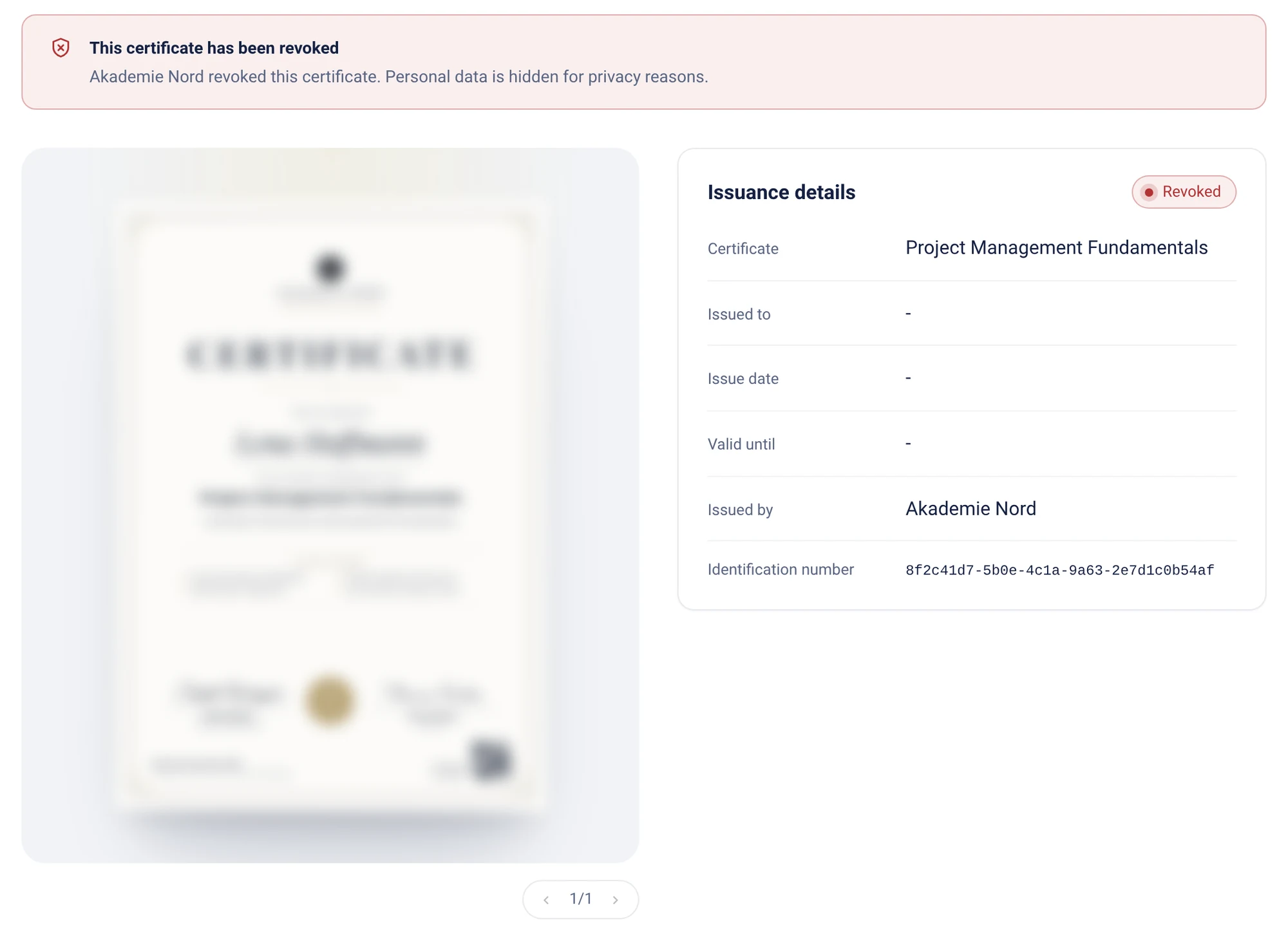
Only a verification page with live status closes the gap. In Virtualbadge.io a revocation shows on the validation page immediately, including for older copies, and the record stays for the audit trail5.
Diploma mills and fake verification sites
Diploma mills sell degrees without real study. The Council for Higher Education Accreditation lists warning signs such as degrees based on experience alone, very short times to a degree and accreditation from questionable agencies8. In 2017 a federal court sentenced an executive of Axact, whose fake online schools sold worthless diplomas to consumers throughout the United States11.
Mills and forgers also fake the check itself. The FTC warns that some diploma mills offer a verification service that sends a phony transcript to employers who call10. Today the same trick runs on copied verification pages and lookalike domains9. Details: Diploma mills and Fake verification websites.
AI-generated fakes
Generative AI turns forgery into a few minutes of typing. The identity verification provider Entrust counted 244% more digital document forgeries than a year earlier. For the first time they made up the majority of document fraud, at 57%3. FinCEN warned in 2024 that criminals use generative AI to alter or create identity documents6.
AI can copy what a certificate looks like. It cannot create the issuer's signature or a record in the issuer's database. More: AI-generated fake certificates.
What issuers can do
- Issue digitally, with a seal on every PDF, so that edits become visible4.
- Run verification on your own website, so that checks end with you12.
- Show live status and revoke when needed5.
- Explain on your website how employers verify your certificates, with one official address.
- Search regularly for copied verification pages and lookalike domains9.
For issuers See what employers see when they check your certificate.
Frequently asked questions
What is credential fraud?
Using a fake, altered, borrowed or invalid credential to claim a qualification. It includes fabricated certificates, diploma mill degrees and fake verification sites that confirm them810.
Is a PDF certificate easy to fake?
An unsigned PDF is easy to edit. A sealed PDF shows any change, because the signature no longer matches4. A verification page with the issuer's record adds the second check.
Can a QR code on a certificate be faked?
Yes. A forger can print a QR code that leads to a copied verification page. Verifiers should reach the issuer through its official website, not through the code alone9.
How common is credential fraud in the US?
There is no national statistic. Federal cases show the scale, such as more than 7,600 fake nursing diplomas in the first phase of Operation Nightingale2.
As of Nov 18, 2026. We check the facts regularly. Is something out of date? Tell us, and we will fix it.
Sources
- Virtualbadge.io, how-to guides: Verify a certificate: by QR code, link or PDF upload accessed November 18, 2026
- U.S. Attorney's Office, Southern District of Florida: Fraudulent nursing diploma scheme leads to federal convictions, September 28, 2023 accessed November 18, 2026
- Entrust: 2025 Identity Fraud Report: deepfake attacks strike every five minutes amid 244% surge in digital document forgeries, November 19, 2024 accessed November 18, 2026
- Virtualbadge.io, how-to guides: Digitally seal PDF certificates and verify the signature accessed November 18, 2026
- Virtualbadge.io, how-to guides: Revoke or replace a certificate accessed November 18, 2026
- Financial Crimes Enforcement Network (FinCEN): FIN-2024-Alert004: fraud schemes involving deepfake media targeting financial institutions, November 13, 2024 accessed November 18, 2026
- U.S. Department of Education: College accreditation: find accredited schools, page reviewed January 8, 2026 accessed November 18, 2026
- Council for Higher Education Accreditation (CHEA): Fact Sheet #6: diploma mills and accreditation mills, May 2003 accessed November 18, 2026
- AI Fraud Protect (FutureNext GmbH): AI Fraud Protect: copies of your website, fake verification pages and phishing in your name accessed November 18, 2026
- Federal Trade Commission: Avoid fake-degree burns by researching academic credentials (guidance for business) accessed November 18, 2026
- U.S. Attorney's Office, Southern District of New York: Pakistani man sentenced to 21 months in prison for Axact diploma mill scam, August 28, 2017 accessed November 18, 2026
- Virtualbadge.io, how-to guides: Embed the validation page in your own website accessed November 18, 2026
Note: This article is for general information only and is not legal advice.