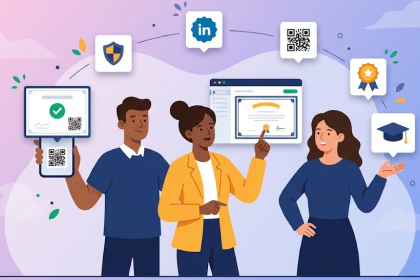
No user accounts required for your recipients -
Start your 7-day free trial now!

How open standards and automated issuance relieve examination offices of administrative work and give students verifiable digital credentials.


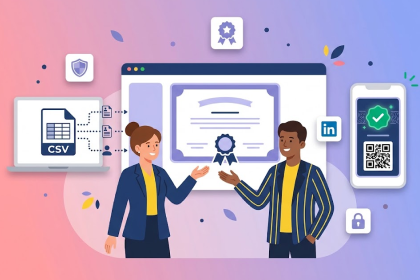
Open Badges are digital badges that function as an image file with embedded metadata. This metadata contains structured information about the issuing institution, the documented competencies, and the award criteria. The 1EdTech standard (formerly IMS Global) defines the format in a binding way, so that badges from different issuers remain mutually readable and verifiable. The technical foundation is the JSON-LD format, which stores all relevant data in a machine-readable way.
The current version, Open Badge 3.0, builds on the W3C Verifiable Credentials Data Model. Every issued badge is therefore a digital credential whose authenticity can be independently verified at any time. The issuer digitally seals the badge, so that any subsequent changes are immediately detectable. For universities, this standardization offers a decisive advantage: badges created according to the 1EdTech standard work across platforms. Students can share their credentials on social media platforms or present them directly to employers for verification.
Independently of this, Open Badge 2.0 remains the most widely used version in practice. Many universities and education providers have been using it productively for years, for example with basic metadata on issuer, recipient, and award criteria, along with verification through a public validator. While migration to Open Badge 3.0 is increasingly accelerating, 2.0 will remain in parallel use for the foreseeable future, partly because many existing systems are built on it. For universities, this means that a badge platform should ideally support both versions, in order to remain compatible with both established and newer systems.
For more information, read: Open Badges 3.0: What Is the Status in 2026?
Integrating Open Badges into learning management systems solves several challenges at once:
The technical connection of a badge system to a university LMS typically happens in two ways: a REST API or a CSV import.
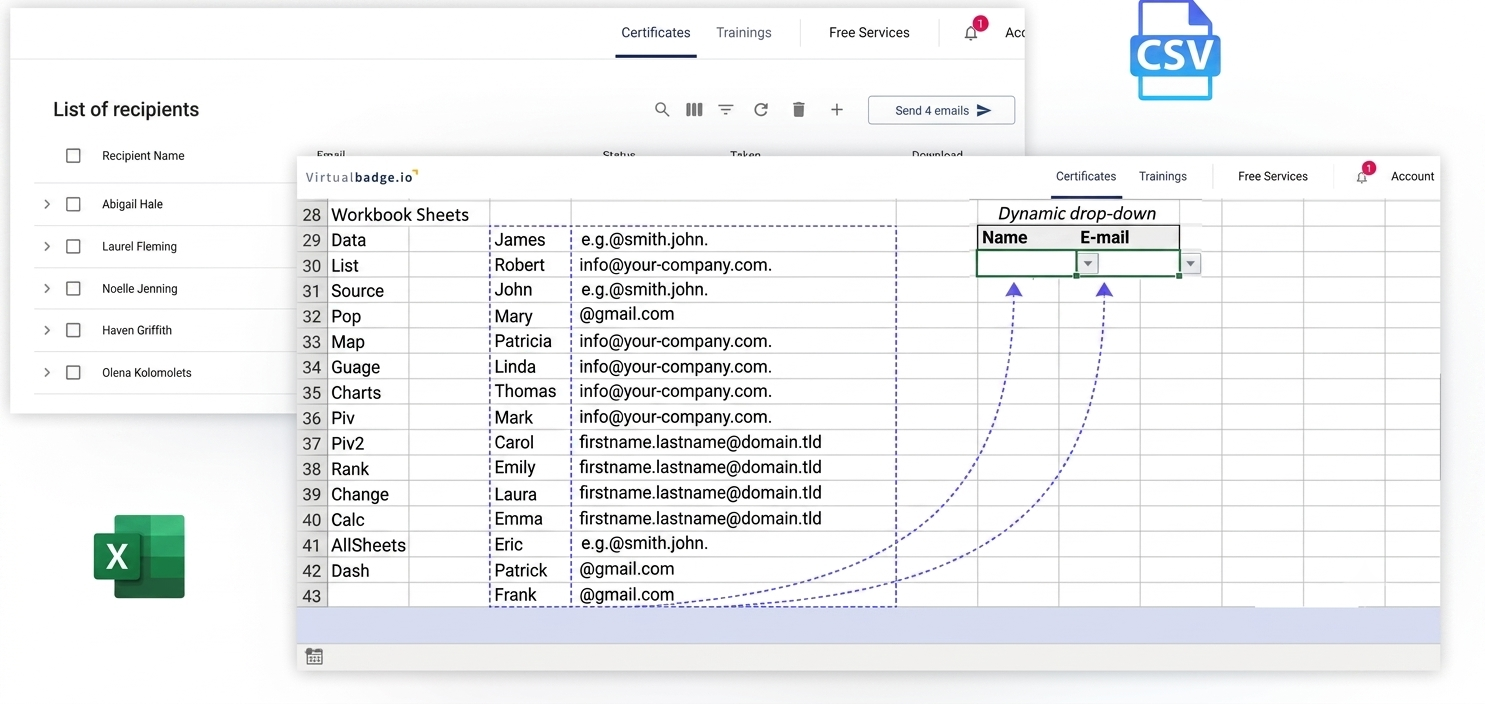
Virtualbadge.io supports both options and can therefore be integrated into existing campus management systems. Through the API, universities can connect their own systems directly to the badge platform, so that badge creation is triggered automatically as soon as the examination office releases results. For larger cohorts, such as entire semester classes, the CSV import is well suited: result lists are exported from the campus management system and uploaded in bulk.
An often overlooked aspect: with Virtualbadge.io, students do not need their own user account to receive their badges. They simply get a link to download and share their certificate, which reduces barriers and increases acceptance.
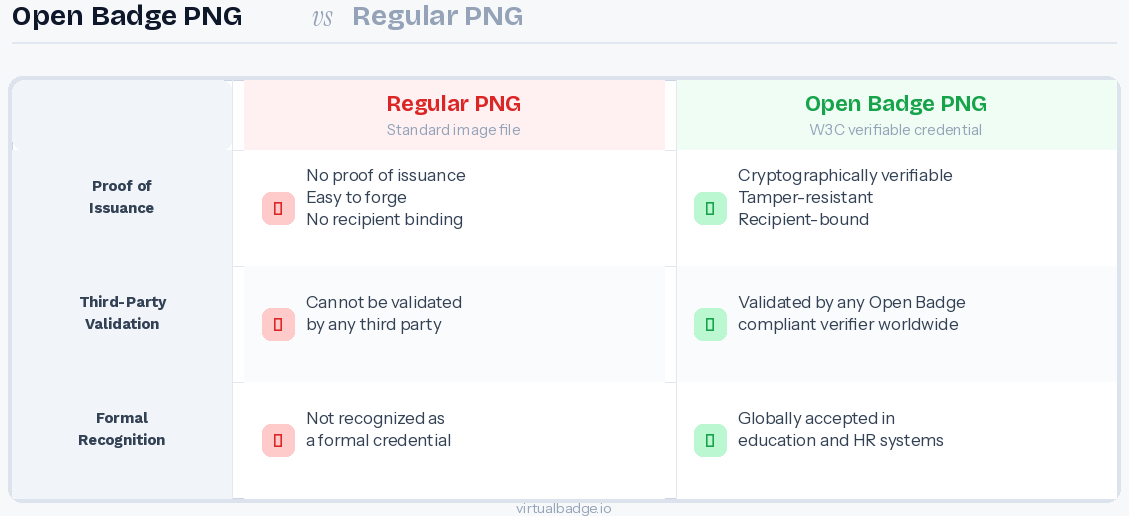
Certificate fraud is a growing problem in education, and paper certificates are relatively easy to forge. Open Badges solve this through cryptographic signatures: each certificate contains a QR code or verification link to a validation page, where the recipient's name, issuing organization, issue date, and the criteria met are displayed.
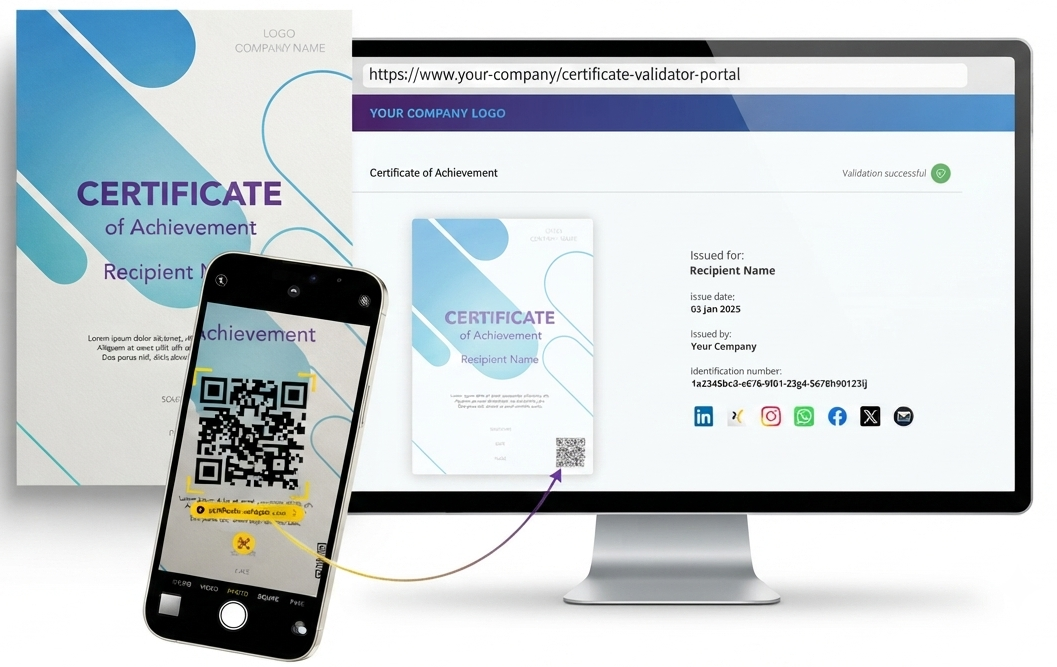
Virtualbadge.io gives universities the option to host these pages on their own domain, so certificates remain cryptographically signed and independently verifiable.
Education providers such as Lisbon Digital School already rely on this approach of automated issuance and permanent verification, as described in their success story.
At the EU level, additional standards for digital learning credentials are emerging that build on the Open Badge format and are intended to make learning outcomes comparable across Europe. German universities must ensure that personal data is processed in compliance with GDPR. Virtualbadge.io stores all data on European servers and has also signed the Bitkom EUDI Wallet Memorandum of Understanding, underscoring its alignment with European trust standards.
Those responsible in examination offices and IT departments should review the following points when selecting a badge solution:
Virtualbadge.io's Organization Hub was developed specifically for institutions that want to combine decentralized issuance with centralized control. Different faculties or examination centers can be integrated as authorized issuers, while university leadership sets uniform standards and designs.
Open Badges standards create the technical foundation for interoperable, tamper-proof, and permanently verifiable digital competency credentials. For universities, this means less administrative work, faster processes, and greater mobility of qualifications across Europe. At the same time, students benefit from credentials they can share with a single click and that employers can verify instantly.
Virtualbadge.io helps universities realize these benefits. See how Open Badges can be integrated into your LMS: Schedule a free demo.
What is the difference between Open Badges and traditional PDF certificates?
Open Badges are image files with embedded metadata in a standardized format. They contain verifiable information about the issuer, criteria, and competencies that can be checked with a single click. PDF certificates lack this standardized data structure and are harder to verify.
Which learning management systems support Open Badges?
Common learning management systems used at universities can be connected to a badge platform via API or CSV import.
Are Open Badges also suitable for micro-credentials?
Yes, Open Badges are particularly well suited for certificate courses and micro-credentials. They document individual competencies without requiring a full degree, making them ideal for continuing academic education.
How long do Open Badges remain valid and verifiable?
The issuer determines the validity period. Depending on the settings, badges can be issued without an expiration date or with one, for example for certifications that require recertification.
* You can find the organisation ID in the URL when you access your LinkedIn Company page as an admin.


Marketing

Aug 10, 2026

6 min
A note on how we write: we use AI tools to help with research and drafting. Every article is then reviewed, edited and fact-checked by someone on the Virtualbadge.io team before it goes live. The final word is always human.

Use Virtualbadge.io to design and send digital certificates that create trust - in less than 10 minutes.
%20(1).svg)