No user accounts required for your recipients -
Start your 7-day free trial now!

Understanding the differences between Open Badges 2.0 and 3.0, and why most digital credential platforms still rely on the 2.0 standard today.


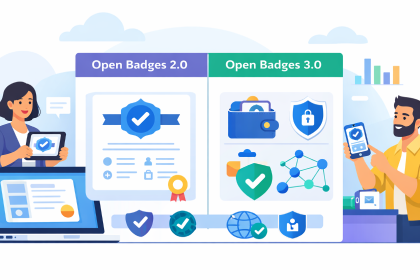
Open Badges are one of the most widely used open standards for digital credentials. They allow organizations to issue badges that contain structured metadata and can be verified online. Instead of sending a simple PDF or PNG file, the credential includes information about the issuer, the recipient, and the achievement itself.
For education providers and training organizations, this is essential. A certificate should not only look professional. It should also be easy to verify and trusted by employers, institutions, and partners.
Typical examples include:
Because Open Badges follow a shared specification, credentials can be understood and verified across different platforms. This interoperability is one of the key reasons why Open Badges became a widely adopted standard for digital credentials.
If you want to understand how metadata, issuance, and validation work in practice, this article provides a deeper explanation: Open Badges 2.0
Open Badges 2.0 has been the dominant standard for many years. It defines how a digital badge stores its metadata and how that information can be validated.
A typical Open Badge 2.0 credential includes structured data such as:
In most implementations, the badge links to a verification page where anyone can check the authenticity of the credential.

For many organizations, this approach works extremely well. A training provider that issues thousands of credentials per year mainly needs three things:
Open Badges 2.0 supports all of these requirements. That is one of the main reasons why it is still the most widely used standard across many credential platforms today.
Open Badges 3.0 introduces a major architectural change. The standard is now aligned with the W3C Verifiable Credentials data model. This connects Open Badges to a broader ecosystem of digital identity and verifiable credential technologies.
The new version focuses on stronger cryptographic verification and improved portability of credentials.
Key improvements include:
In practice, this means that credentials can become more portable and more secure. Instead of relying mainly on hosted verification pages, the credential itself can carry cryptographic proof of authenticity.
This approach is particularly relevant for ecosystems where digital identity, credential wallets, and decentralized verification play a larger role.
From a practical perspective, the difference between the two versions is not about quality. Both standards are designed to support trustworthy digital credentials. The main difference lies in their technical approach.
Open Badges 2.0 focuses on proven issuance and verification workflows.
Typical characteristics include:
Open Badges 3.0 focuses more on the future of digital identity.
Key characteristics include:
For many education providers, the immediate benefits of 3.0 are not always necessary yet. Their primary goal is still reliable credential issuance and easy verification.
Open Badges 3.0 has already been introduced and represents the long-term direction of the standard. However, adoption across the industry is still developing.
In 2026, Open Badges 2.0 remains the most widely used and accepted standard for issuing digital badges and certificates.
There are several reasons for this:
For education providers, this means the following. Open Badges 3.0 is an important technological step and will likely play a larger role in the future. At the same time, Open Badges 2.0 continues to power the majority of real-world credential programs today.
Organizations issuing digital certificates should therefore keep an eye on the evolution of the standard while focusing on what matters most today. Reliable issuance, clear verification, and a good experience for learners and employers.
Open Badges 3.0 is technically the more advanced version of the standard in an ideal world. It builds on everything Open Badges 2.0, but truth is: Digital identity wallets, DID infrastructure, and VC-based verification systems are still maturing. The interoperability 3.0 promises is only as good as the ecosystem around it. In many industries and regions, that ecosystem simply isn't ready yet.
At the same time, in 2026 Open Badges 2.0 is still the most widely used and accepted standard in real-world credential programs. Many education providers continue to rely on it because it already supports reliable issuance, verification, and sharing of digital credentials.
If you want to explore how verifiable digital certificates and badges can work for your organization, you can schedule a free demo with Virtualbadge.io to see how modern credential systems can support your training or education programs.
* You can find the organisation ID in the URL when you access your LinkedIn Company page as an admin.


Marketing

Mar 24, 2026

5 min
A note on how we write: we use AI tools to help with research and drafting. Every article is then reviewed, edited and fact-checked by someone on the Virtualbadge.io team before it goes live. The final word is always human.

Use Virtualbadge.io to design and send digital certificates that create trust - in less than 10 minutes.
%20(1).svg)