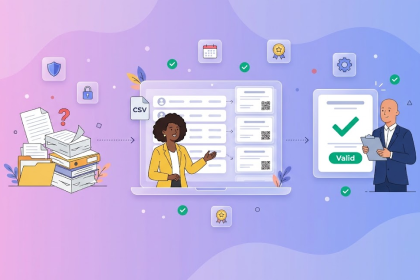
No user accounts required for your recipients -
Start your 7-day free trial now!

Open Badges or Digital Certificates: How Certification Bodies Find the Right Credential Format for Scalable, Verifiable Certification Programs.


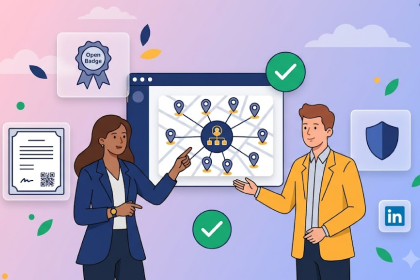
Open Badges are digital badges based on an open standard. They contain structured metadata about the issuer, recipient, and the criteria met, embedded directly in the image file. This makes them ideal for competency-based credentials, such as individual exam modules or recertification levels.
Digital certificates, on the other hand, are more formal documents. They confirm a completed qualification, an issued license, or a full accreditation. For certification bodies, a combination is often the right approach:
With Virtualbadge.io, you can issue both formats on the same platform.
For more information, read: Open Badges 3.0: What Is the Status in 2026?
Certification bodies with high issuance volumes need automation instead of manual, one-by-one issuance. Virtualbadge.io enables bulk issuance via CSV import or REST API, so thousands of certificates are created and sent within minutes.
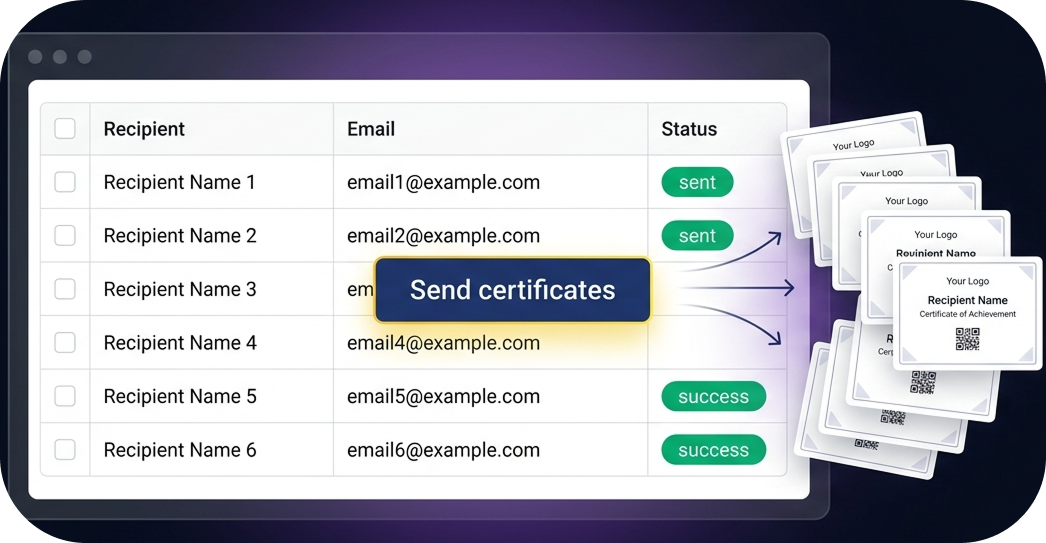
The language testing organization telc gGmbH processes up to 1,500 exam participants per day this way across more than 3,000 authorized issuers, fully paperless and with around 90 percent time savings compared to the previous manual issuance process.
Benefits of automated bulk issuance:
The Swiss education provider SIZ AG has fully digitized its certificate issuance. Read more in the SIZ AG success story.
The credibility of a certification body depends largely on how trustworthy its issued credentials appear. Virtualbadge.io hosts validation pages directly on your own domain, instead of redirecting recipients and verifiers to a third-party platform.
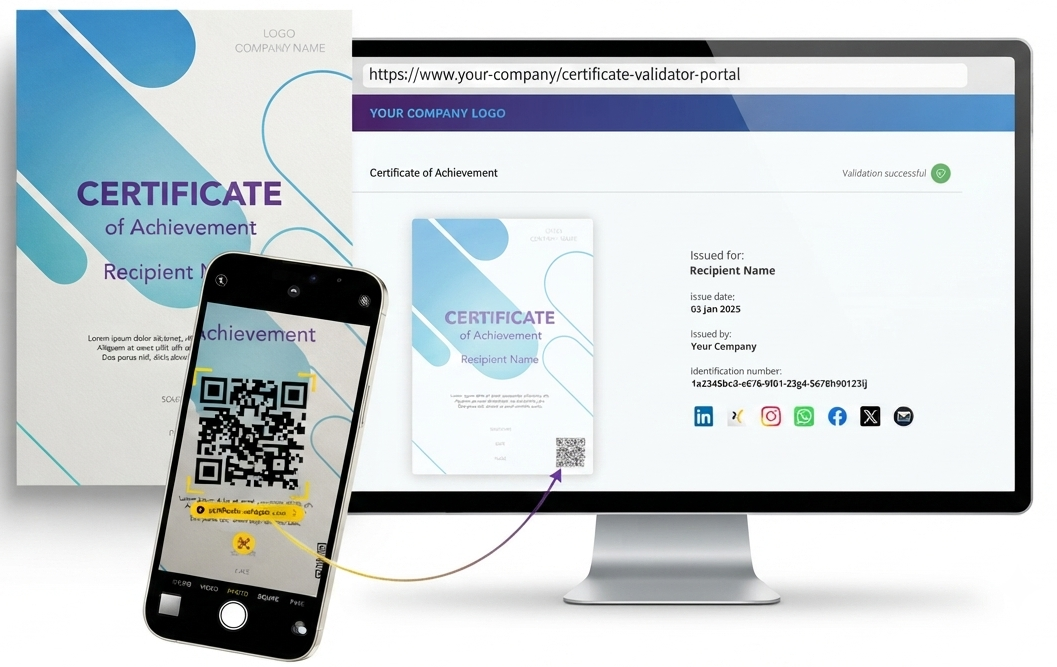
Every certificate contains a unique QR code. When scanned, employers or authorities immediately see the verified information on your branded validation page.
Further benefits for your brand authority:
Many certification bodies operate across multiple locations, testing centers, or authorized partners. Virtualbadge.io's Organization Hub solves exactly this problem: centralized template governance combined with decentralized issuance on site.
This way, you retain control over design, criteria, and data protection, while individual testing centers can issue certificates independently. Every issuance step is logged, which significantly simplifies audits and regulatory documentation requirements.
Additional benefits for multi-location programs:
Whether Open Badges, digital certificates, or a combination of both: Virtualbadge.io gives certification bodies the tools to issue verifiable credentials at scale, securely, and on brand.
Book a free demo or start your 7-day free trial to see how Virtualbadge.io simplifies your certification processes.
What is the difference between Open Badges and digital certificates?
Open Badges are PNG files with embedded metadata about criteria and competencies and are suited for modular credentials. Digital certificates are PDF files, more formal documents for qualifications or licenses. With Virtualbadge.io, you can issue both formats.
Do exam participants need a user account to access their certificate?
No. Recipients receive an email and can access, download, and share their certificate or badge with one click, without creating an account.
How does validation work with Virtualbadge.io?
Every certificate contains a QR code. After scanning, the verified information is displayed on your branded validation page.
Is Virtualbadge.io GDPR compliant?
Yes. Virtualbadge.io is hosted in the EU, all statistics are anonymized, and data processing follows European data protection law.
Can I migrate my existing certificates to Virtualbadge.io?
Yes. The Virtualbadge.io team supports you in migrating existing certificate programs, so your certification body can transition seamlessly to digital credentials.
* You can find the organisation ID in the URL when you access your LinkedIn Company page as an admin.


Marketing

Aug 18, 2026

4 min
A note on how we write: we use AI tools to help with research and drafting. Every article is then reviewed, edited and fact-checked by someone on the Virtualbadge.io team before it goes live. The final word is always human.

Use Virtualbadge.io to design and send digital certificates that create trust - in less than 10 minutes.
%20(1).svg)