No user accounts required for your recipients -
Start your 7-day free trial now!

Practical Steps to Connect Your LMS with Digital Certificate and Badge Issuance for More Efficient Education Workflows


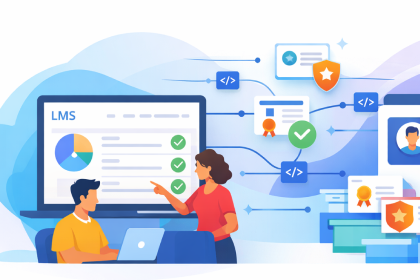
Learning Management Systems play a central role in how educational organizations deliver courses, manage participants and track learning outcomes. However, many training providers and universities still handle certificate issuance outside their LMS. This often leads to manual work, inconsistent data and unnecessary delays.
An LMS integration for digital certificates and badges connects course completion data directly with credential issuance. Once a learner completes a course or meets predefined criteria, a digital certificate or badge can be issued automatically.
If you prefer a practical walkthrough, you can also request a free demo where we show how the software works and how LMS integrations work with Virtualbadge.io.
This approach offers several advantages:
By integrating an LMS with a credentialing platform like Virtualbadge.io, organizations can turn certificates and badges into a seamless part of the learning experience rather than a separate administrative task.
Digital certificates and digital badges are more than digital versions of printed documents. They are verifiable credentials that contain structured metadata about learning achievements, skills or course participation.
Digital certificates typically confirm the successful completion of a course or training program. They often include:
Digital badges focus more strongly on skills and achievements. They are designed to be shared online and can include additional context such as learning outcomes or assessment criteria. Badges are normally used when achieving milestones within longer learning paths.
Key reasons why digital credentials matter in modern education include:
For LMS-based education, digital credentials are a natural extension of the learning journey. Once learning data already exists in the LMS, it makes sense to use this data to trigger certificate and badge issuance automatically.
Virtualbadge.io supports this approach by offering integrations via API and Zapier , allowing LMS platforms to pass completion data directly into the credentialing workflow. This ensures that certificates and badges are issued accurately, consistently and at scale, without manual intervention.
Integrating your LMS with a digital credentialing platform creates a direct connection between learning outcomes and credential delivery. Instead of exporting lists or issuing certificates manually, credentials are triggered automatically based on predefined rules.
The most important benefits include:
From a learner perspective, this integration improves the overall experience. Credentials are delivered faster, are easy to access and can be shared digitally. From an organizational perspective, it ensures that certification processes remain efficient even as course offerings and participant numbers grow.
Virtualbadge.io supports these workflows through API based integrations or no code automations (using supporting software such as Zapier) making it possible to adapt the setup to both technical and non technical teams.
Before connecting your LMS with a digital certificate and badge platform, proper preparation is essential. A structured setup ensures that the integration runs smoothly and produces reliable results.
Key preparation steps include:
Taking the time to prepare your LMS and credential structure upfront reduces friction later. It also makes it easier to scale certification processes across multiple courses, departments or programs.
Once your LMS is prepared, the actual integration can be implemented in a structured and reliable way. The goal is to ensure that learning data flows securely from the LMS into the credentialing process without manual intervention.
A typical integration setup follows these steps:
This step by step approach ensures that certificates and badges are issued automatically, accurately and at scale. It also allows organizations to start small and expand the integration over time as additional courses or programs are added.
Ready to Automate Your LMS Certificates and Badges?
This may sound quite theoretical at first. That is why we invite you to schedule a free 15-minute demo. We will show you the Virtualbadge.io platform, explain LMS integrations in a practical way, and answer all your questions step by step.
* You can find the organisation ID in the URL when you access your LinkedIn Company page as an admin.


Marketing

Jan 22, 2026

5 min
A note on how we write: we use AI tools to help with research and drafting. Every article is then reviewed, edited and fact-checked by someone on the Virtualbadge.io team before it goes live. The final word is always human.

Use Virtualbadge.io to design and send digital certificates that create trust - in less than 10 minutes.
%20(1).svg)