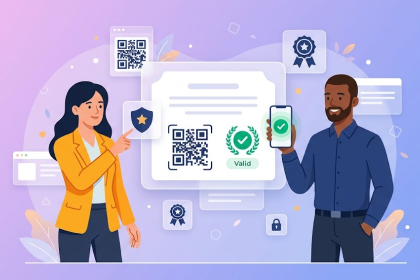
No user accounts required for your recipients -
Start your 7-day free trial now!

How universities are structuring their transition to digital, verifiable certificates in light of eIDAS 2.0 and the EU Digital Identity Wallet.


Paper certificates create a heavy administrative burden at universities. They get lost, are costly to archive, and according to a guidance document from the BSI can hardly be checked for tampering anymore once scanned. With the eIDAS Regulation 2.0 and the upcoming EU Digital Identity Wallet, pressure is mounting across Europe to issue certificates in a verifiable digital form. Those who start now gain a head start on technical integration and process adaptation. Virtualbadge.io already supports universities and education providers today with cryptographically signed, verifiable digital university certificates.
The eIDAS Regulation 2.0 (EU 2024/1183) has governed electronic signatures, seals and the EU Digital Identity Wallet since May 2024. For degree certificates, a qualified electronic signature is recommended, as it is legally equivalent to a handwritten document. Simple and advanced signatures are sufficient for informal confirmations or internal records, respectively.
For digital certificates to be recognized across universities and countries, open standards are essential. The Open Badges standard builds on the W3C Verifiable Credentials Data Model and ensures that certificates remain cryptographically signed, tamper proof and portable between platforms.
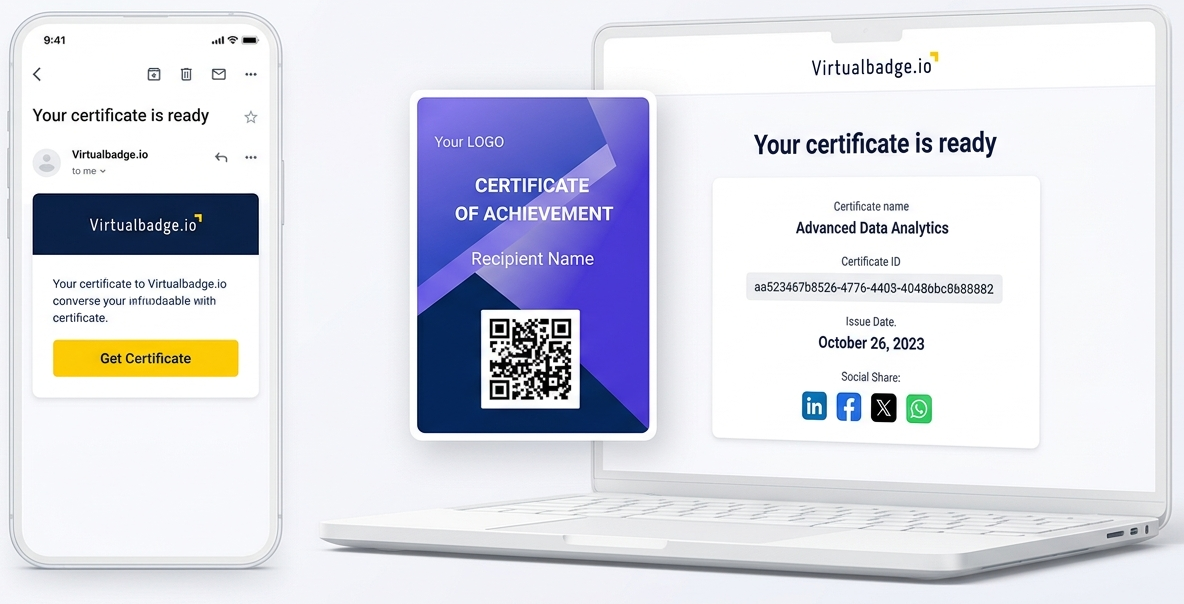
Digital certificates contain personal data such as student ID numbers and exam results. GDPR requires documented storage locations and access rights. Virtualbadge.io hosts all data on EU servers and thereby meets the requirements for tamper proof certificates.
The Europass infrastructure already enables European Digital Credentials for Learning: verifiable certificates based on the European Learning Model, consisting of a title page, authenticity checks and machine readable content. An electronic seal confirms authenticity, and any subsequent change invalidates it.
By the end of 2026, according to eIDAS 2.0, every EU member state must provide at least one compliant EU Digital Identity Wallet, with the rollout planned for 2027 in Germany. From December 2027, banks and other relying parties must accept wallets. There is no automatic obligation to store university certificates there, but compatible formats make later integration easier.
For more information, read: EUDI Wallet Memorandum of Understanding
Start with an inventory of all certificate types and a pilot project for less regulated documents such as continuing education confirmations. Then standardize templates and approval processes, train the examination office, and involve the data protection officer early on. Afterward, gradually extend the system to transcripts of records and finally to degree certificates.
A realistic timeline:
Students benefit from several advantages:

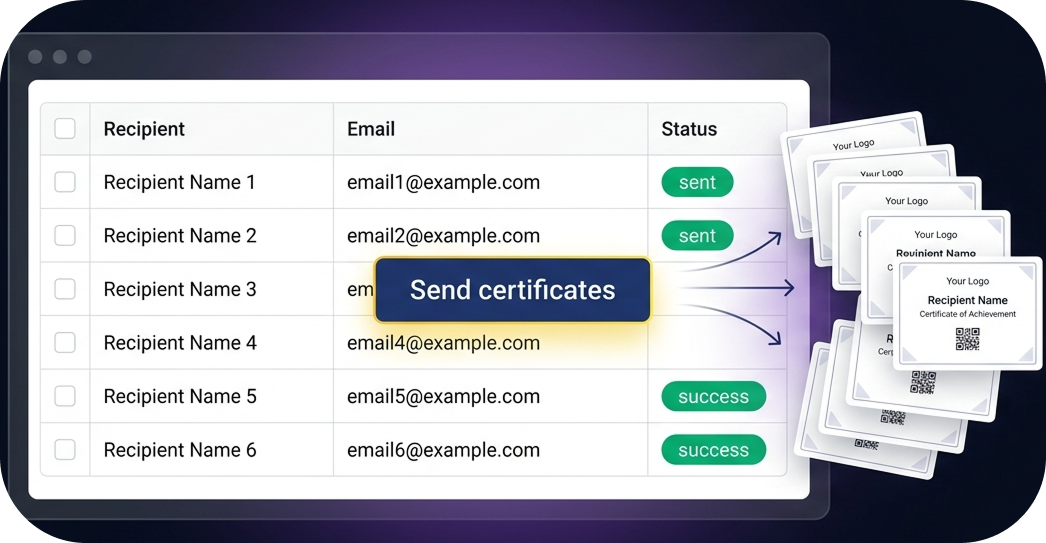
For administration, printing and shipping costs are eliminated, and issuance runs automatically via CSV import or API. Employers can verify authenticity in seconds via the validation page.
Typical hurdles include resistance to change, technical integration gaps and open data protection questions. Clear communication, early training and an EU compliant platform address these points effectively. The Swiss company SIZ AG achieved a 400 percent ROI in the first year after fully digitizing its certificate issuance, as described in the SIZ AG success story.
The European shift toward verifiable digital credentials is noticeably gaining momentum with eIDAS 2.0 and the EU Digital Identity Wallet. Those who start with a pilot project now gain valuable experience under controlled conditions before the pressure to transition increases further. Virtualbadge.io offers cryptographically signed, verifiable credentials with your own validation page on your university's domain, GDPR compliant and without a user account for recipients.
Schedule a free demo and see how your examination office can prepare today.
Do German universities have to switch to digital certificates? There is currently no blanket requirement. However, with eIDAS 2.0 and the EU Digital Identity Wallet, pressure is mounting across Europe to offer verifiable digital credentials.
Which certificate types are suitable for getting started? Less regulated documents such as continuing education confirmations are best suited for a pilot project, before degree certificates follow.
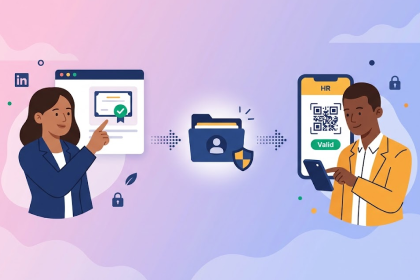
How do employers verify digital university certificates? Via a QR code or a validation page, which with Virtualbadge.io can be hosted on the university's own domain. Any tampering is immediately detectable.
Can students still receive their certificates as a PDF? Yes. Digital certificates can be exported as a PDF with an embedded QR code while remaining verifiable at the same time.
* You can find the organisation ID in the URL when you access your LinkedIn Company page as an admin.


Marketing

Sep 28, 2026

5 min
A note on how we write: we use AI tools to help with research and drafting. Every article is then reviewed, edited and fact-checked by someone on the Virtualbadge.io team before it goes live. The final word is always human.

Use Virtualbadge.io to design and send digital certificates that create trust - in less than 10 minutes.
%20(1).svg)