No user accounts required for your recipients -
Start your 7-day free trial now!

What the European Digital Identity Wallet is, why education credentials are one of the highest impact use cases, and what we will contribute as a practitioner in the ecosystem.


Interoperability in Europe is a powerful idea. But it only works if standards reflect reality.
In education, reality is messy. Exam networks. Approval chains. Multiple stakeholders. Recognition rules. Revocation. Audits. Legal retention. Cross border verification. If these processes are not considered early, the result will be a standard that looks clean on paper but creates friction and cost for education providers later.
Virtualbadge.io signed the EUDI Wallet Memorandum of Understanding because education cannot be an afterthought. We want to help connect the European initiative with the real processes of the organizations that issue, verify, and rely on education credentials every day.
The European Digital Identity Wallet, often called the EUDI Wallet, is part of the updated eIDAS framework. The goal is that citizens can store and share verified digital information securely, directly from a wallet on their device.
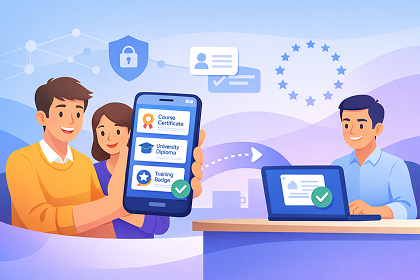
Over time, this can include identity attributes, official documents, professional qualifications, and education credentials. For credential ecosystems, the wallet matters because it changes expectations. Learners will want credentials they can store once and share anywhere. Employers and institutions will want instant verification, without manual checks and without portal logins.
Education and training credentials are issued at scale. They are frequently needed, and often verified under time pressure.
Think of these everyday scenarios:
A learner shares a course completion credential during onboarding.
An employer verifies mandatory safety training.
A professional submits continuing education proof for compliance.
A university credential is checked during international admission.
A certificate is verified for licensing or regulated roles.
Today, much of this happens via PDFs, emails, and manual checks. Even when credentials are digital, verification often depends on proprietary portals and human effort.
A wallet-based approach can change that. A credential can be shared in seconds, and verified instantly, if the issuer is trusted and the credential is verifiable by design.
The EUDI Wallet Memorandum of Understanding is a voluntary commitment to support the development and adoption of the European digital identity ecosystem.
Signing the MoU is not a legal obligation. It is a signal. It shows that an organization is ready to contribute to real world adoption, and to help the ecosystem mature through collaboration.
In practice, this includes:
- Testing real use cases with real stakeholders
- Preparing products and services for wallet relevant flows
- Contributing feedback on interoperability and verification
- Supporting the broader adoption of trusted digital credentials
Virtualbadge.io is focused on digital certificates and badges for education and training. We work with organizations that must issue credentials reliably, at scale, and in ways that stand up to verification and audit requirements.
Our value in the EUDI ecosystem is practical. We bring the perspective of issuers and relying parties who have to make this work in daily operations, not only in pilot environments.
We will contribute in three concrete ways.
Education credentials are not just data. They are processes.
Issuance needs governance.
Verification needs clarity on roles and trust.
Revocation needs to be supported end to end.
Recognition needs to work across organizations and borders.
If standards ignore these elements, education providers will be forced to bend their workflows to fit technology. That slows adoption and creates cost.
Our role is to represent the operational reality of education providers and certification bodies, and to translate that reality into clear requirements.
A credential is only valuable if it can be verified easily by the party that receives it. Employers, universities, authorities, and partner organizations need verification that is fast, predictable, and explainable.
We will advocate for verification flows that:
Work without manual back channels
Are understandable for non technical staff
Support both online and offline scenarios where needed
Provide clear signals on issuer trust, authenticity, and status
Interoperability is not a slogan. It is a set of design choices that must hold under real volume.
That means:
Structured data that stays consistent across issuers
Clear rules for what must be present in a credential
Compatibility with sector models for learning achievements
Practical handling of updates, revocation, and lifecycle events
We will focus on the practical side of making wallet compatible credentials something education organizations can actually roll out.
The EUDI Wallet will not change everything overnight. But it sets a clear direction. Education providers that start preparing early will avoid rushed decisions later.
Three practical steps you can take today:
PDFs are easy to issue, hard to verify, and hard to automate. Start moving towards credentials that are verifiable by design.
Interoperability depends on consistent structures. Define which learning outcomes, identities, and metadata must be included so that verification becomes reliable.
Revocation and updates are not edge cases. They are normal operations. Make sure your credential system supports status changes and that relying parties can trust what they see.
We are participating as a partner because we want to connect a strong European interoperability initiative with the reality of education and training processes.
If you are issuing credentials, verifying them, or relying on them in hiring, admissions, or compliance, let’s talk at the Summit. Bring your use case. We will bring practical guidance and lessons from real implementations.
EUDI Wallet, yes. Not without education.
* You can find the organisation ID in the URL when you access your LinkedIn Company page as an admin.


Marketing

Mar 24, 2026

5 min
A note on how we write: we use AI tools to help with research and drafting. Every article is then reviewed, edited and fact-checked by someone on the Virtualbadge.io team before it goes live. The final word is always human.

Use Virtualbadge.io to design and send digital certificates that create trust - in less than 10 minutes.
%20(1).svg)