No user accounts required for your recipients -
Start your 7-day free trial now!

How software companies and SaaS platforms use digital credentials to turn product training into a measurable driver of adoption, engagement, and long-term retention.


Most SaaS companies invest heavily in onboarding: help centers, video tutorials, webinars, certification tracks. But without a credential at the end, that investment often disappears quietly. Users complete a course, close the browser tab, and move on. There is no moment of recognition, no shareable proof, and no reason to push through the harder modules.
The missing piece is a credibility layer. A digital certificate gives the training a defined endpoint and turns completion into something meaningful. For the user, it is recognition that their time was well spent.

For the company, it is a signal that this person is genuinely invested in using the product well.
Customer education teams that introduce certificates typically see:
The data that customer success teams report consistently points in one direction: certified users behave differently from uncertified ones. They login more frequently, adopt more features, escalate fewer issues, and stay longer.
This is not a coincidence. Certification changes the relationship between a user and a product. It moves them from passive consumer to informed practitioner. They have demonstrated something, received recognition for it, and now have a credential that represents their investment in the platform.
For B2B software in particular, this matters at the account level. When multiple users at a customer organization are certified, the product becomes embedded in how the team works. That kind of depth is extremely difficult to displace at renewal time.
Digital credentials work across the full customer lifecycle, not just at onboarding.

A well-designed certification program creates touchpoints at each stage where engagement tends to drop:
For more on how credentials fit into a broader engagement strategy, read: Digital Badges in the Sales Funnel: From Lead Magnet to Loyalty
A digital certificate does not just benefit the recipient. Every time a certified user shares their credential on LinkedIn, they create organic visibility for the platform and its training program. Their network sees the badge, recognizes the issuing company, and associates it with professional development.

This compounds across a customer base. A SaaS platform with 500 certified users, each with an active LinkedIn presence, generates hundreds of impressions with no additional marketing spend. The certification program becomes a distribution channel.
To make this work, the certificate design and metadata need to be strong enough that recipients want to share them. A well-designed credential with a clear issuer, a descriptive title, and a verification link performs significantly better on social than a generic completion image.
For a closer look at how sharing behavior drives reach, read: How Sharing Digital Badges Boosts Reach and Social Proof
Customer education teams often assume that building a certification program requires a major platform overhaul. In practice, the starting point is much simpler: one credential, one learning path, one moment of recognition.
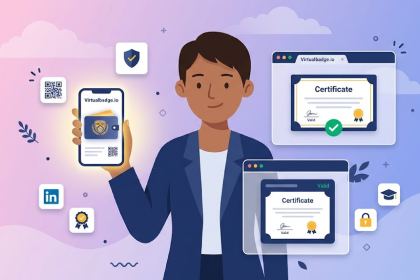
Virtualbadge.io allows teams to design and issue digital certificates without technical overhead. Badges can be triggered automatically via integrations with existing LMS tools or sent in bulk via CSV after a cohort completes training. Recipients receive a personalized credential they can add to LinkedIn, store in Apple or Google Wallet, or share via a unique verification link.
Organizations that have built customer certification programs on Virtualbadge.io have seen measurable improvements in completion rates, feature adoption, and customer satisfaction. You can explore real examples on our Success Stories page.
If you want to see how a customer education certification program could work for your product, book a free demo and we will walk you through what it looks like in practice.
* You can find the organisation ID in the URL when you access your LinkedIn Company page as an admin.


Marketing

May 5, 2026

4 min
A note on how we write: we use AI tools to help with research and drafting. Every article is then reviewed, edited and fact-checked by someone on the Virtualbadge.io team before it goes live. The final word is always human.

Use Virtualbadge.io to design and send digital certificates that create trust - in less than 10 minutes.
%20(1).svg)