No user accounts required for your recipients -
Start your 7-day free trial now!

Why the information inside a digital badge matters as much as the badge itself, and how to get it right from the start.


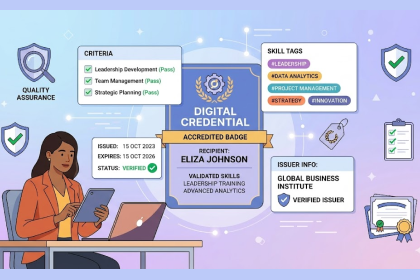
A digital badge that says "Certified" without explaining what that means is not much more useful than a certificate sitting in a downloads folder. The credential itself is just the container. What builds trust with employers, customers, partners, and auditors is the information attached to it.
Badge metadata and criteria are the structured layer of detail that tells anyone looking at a credential exactly what it represents: what the recipient had to demonstrate, who issued it, when it was issued, and what standards were applied. When that information is clear and complete, the badge does its job. When it is vague or missing, even a visually polished credential will not hold up under scrutiny.

Here is what poor metadata costs you in practice:
Most people think of a badge as a name and a logo. In practice, a well-structured badge record contains several distinct fields, each serving a specific function:
For a deeper look at how metadata works at the technical level, read our article: Open Badges 3.0: What Is the Status in 2026?
Badge criteria are the section most issuers skip or treat as an afterthought. That is a mistake, because criteria are what separates a credential from a participation ribbon.
Good criteria answer one specific question: what did this person have to do, demonstrate, or know in order to earn this badge? The answer should be concrete enough that a third party who was not involved in the assessment can understand what standard was applied.
Weak criteria: "Complete the online module and pass the final test."
Strong criteria: "Pass a 40-question assessment covering EU food safety regulations with a minimum score of 80%, following completion of the accredited four-hour training module."
The difference is specificity. The second version tells an employer exactly what the candidate was assessed on, what the threshold was, and what knowledge was required. That transparency is what allows a credential to function as evidence rather than just a claim.
For more complex credentials, criteria should also specify the type of evidence required, such as a work sample, a practical demonstration, or a third-party observation, and whether an independent assessor was involved. The more the criteria reflect a genuine assessment process, the more weight the resulting badge carries.

Want to understand what credible criteria look like from an employer's perspective? Read: Do Employers Trust Digital Badges? How to Make Credentials Count
Before issuing a badge, run through these six points. If the answer to any is no, the badge is not ready:
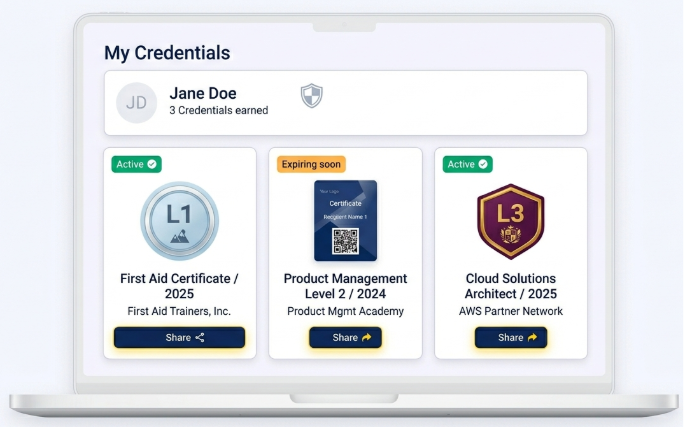
Filling those gaps takes minutes. Rebuilding credibility after issuing underspecified credentials takes considerably longer.
For organizations creating a badge program for the first time, the temptation is to focus on design and issuance workflows before thinking about metadata. The more sustainable approach is to reverse that order: define your criteria and metadata structure first, then build design and issuance around it.
Virtualbadge.io makes it straightforward to configure and preview badge records before issuing anything, so the metadata layer can be finalized and reviewed before a single credential goes out.
If you want to see how credential configuration works in practice, schedule a free demo and explore what a well-structured badge program can look like for your organization.
* You can find the organisation ID in the URL when you access your LinkedIn Company page as an admin.


Marketing

May 5, 2026

4 min
A note on how we write: we use AI tools to help with research and drafting. Every article is then reviewed, edited and fact-checked by someone on the Virtualbadge.io team before it goes live. The final word is always human.

Use Virtualbadge.io to design and send digital certificates that create trust - in less than 10 minutes.
%20(1).svg)