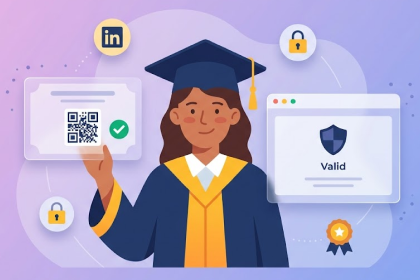
No user accounts required for your recipients -
Start your 7-day free trial now!

How automation, open standards, and LMS integration help organizations certify thousands without increasing administrative overhead.


If your organization certifies hundreds or thousands of training participants each year, manual processes quickly reach their limits. Digital certificate platforms solve exactly this problem by automating the creation, issuance, and verification of certificates.
A digital certificate platform is software that allows you to create, send, and manage training credentials electronically. Unlike paper-based certificates, digital versions are stored in the cloud and can be accessed from anywhere. These platforms offer tools for custom design: your company logo, colors, and metadata such as expiration dates or competency fields can be integrated. Your learners receive professional credentials that reflect your brand identity.
The key advantage lies in automation. Instead of creating each certificate individually and sending it by email, you can issue hundreds of personalized credentials simultaneously with just a few clicks.
Scalable training solutions require processes that grow with the number of participants. Digital certificate platforms enable this through bulk functions and API interfaces.
With bulk issuance, you import a participant list, for example from a CSV file or directly from your learning management system. The platform automatically generates a personalized certificate for each entry, including the name, date, and qualification earned.
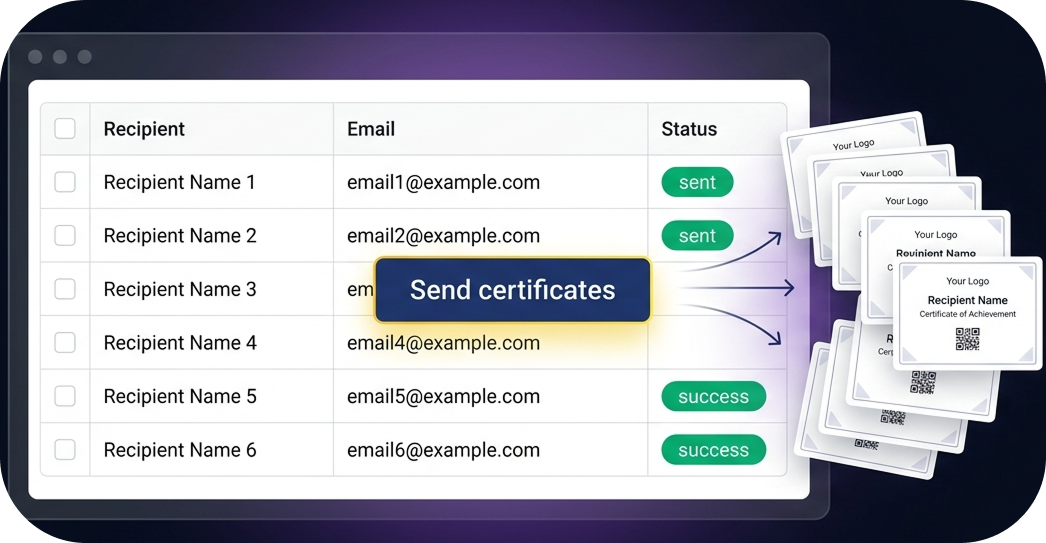
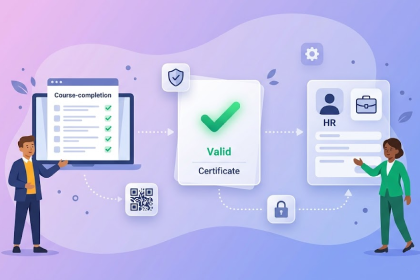
API integrations take this a step further. As soon as a person completes a course in your LMS, the certificate can be automatically created and sent. Learning management systems are the backbone of training administration in many organizations. A digital certificate platform reaches its full potential when it communicates directly with your LMS. Course data flows automatically to the certificate platform, and the corresponding certificate is generated without manual intervention. This reduces administrative effort and minimizes errors.
Virtualbadge.io offers integrations with popular platforms and tools like Zapier that enable this automation without any programming effort.
Open Badges are digital badges that follow an international standard. This standard defines what information a badge must contain so that it can be recognized and verified across different platforms.
An Open Badge contains more than just an image. The metadata includes:
This information remains permanently linked to the badge. For your corporate training, this means: learners can share their badges on LinkedIn, embed them in digital portfolios, or pass them on to potential employers. The badge verifies the qualification and can be validated by third parties at any time.
A digital certificate is only valuable if its authenticity can be verified. Modern platforms solve this through validation pages and QR codes.
Each issued certificate receives a unique link to a validation page. There, third parties can view the certificate data and confirm its authenticity. A QR code printed on the certificate leads directly to this page. This validation is available around the clock and requires no inquiries to your organization. This saves time for everyone involved and builds trust in the credentials you issue.
The integration with Apple Wallet and Google Wallet makes your certificates additionally available on mobile.
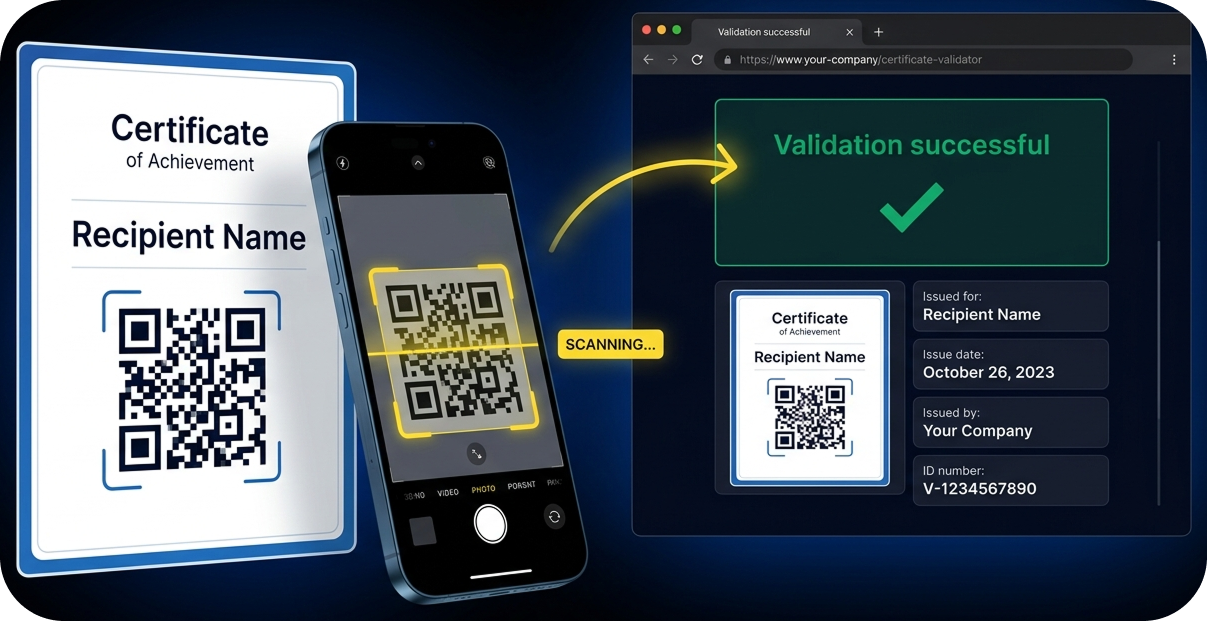
Learners always have their credentials at their fingertips on their smartphone, whether during an inspection, a job interview, or when registering for a follow-up certification. With one click, they can choose to add their certificate to their digital wallet.
Digital certificate platforms take repetitive tasks off your hands and allow you to scale training programs without a proportional increase in administrative effort. When choosing a platform, you should consider the following criteria:
With Virtualbadge.io, you have access to a platform that meets all of these requirements. Book a free demo and discover how you can automate your certification processes in just a few minutes.
What distinguishes digital certificates from traditional paper credentials?
Digital certificates are created, sent, and stored electronically. They contain verifiable metadata and can be checked for authenticity via QR codes. Unlike paper certificates, they cannot be lost and can be retrieved at any time.
Can digital certificate platforms be connected to any LMS?
Digital certificate platforms offer API interfaces that allow certificate issuance to be automated. Whether a direct connection is possible also depends on what API functions your LMS provides. Therefore, check the interface capabilities on both sides beforehand.
How secure are digitally issued certificates against forgery?
Digital certificates contain unique identifiers and are linked to validation pages. Anyone can verify the authenticity of a certificate by scanning the QR code or accessing the validation link.
What are Open Badges and who accepts them?
Open Badges follow an open standard for digital badges. They are accepted by educational institutions, companies, and platforms such as LinkedIn. Any Open Badge validator, wallet, and backpack accepts badges from any issuer, as long as they comply with the Open Badge Standard.
* You can find the organisation ID in the URL when you access your LinkedIn Company page as an admin.


Marketing

Jun 29, 2026

4 min

Use Virtualbadge.io to design and send digital certificates that create trust - in less than 10 minutes.
%20(1).svg)