No user accounts required for your recipients -
Start your 7-day free trial now!

Why modern organizations increasingly rely on digital certificates and how they outperform traditional credentials in building trust


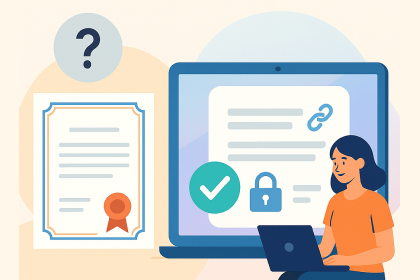
Trust plays a central role in every certification process. When participants complete a course, workshop or academic program, they expect a credible, secure and verifiable proof of their achievement. For many years, traditional paper certificates fulfilled this role. They were handed out in person, stored in folders and used as a physical confirmation of knowledge or skills.
Today the expectations and requirements have changed significantly. Organizations operate digitally, learners prefer online access to their credentials and employers rely on fast and accurate verification instead of visual impressions. In this environment, one question becomes essential. Do traditional certificates still create enough trust, or have digital certificates become the more reliable standard.
This article shows why many institutions are rethinking their certification process. It explains how trust is built in a digital context and what this development means for providers that want to offer secure, transparent and modern credentials.
Traditional certificates are printed documents, often designed with official logos, signatures and decorative elements. While they feel familiar and personal, the format has several weaknesses that have become more apparent in a digital world.
Typical limitations of traditional certificates
These limitations show a clear pattern. Traditional certificates rely heavily on visual design and physical presence. Elements like signatures or watermarks are intended to convey trust, yet none of them provide actual protection against manipulation. Once a certificate leaves the issuing organization, full control is lost.
For providers this creates operational challenges and potential reputational damage. Manual verification takes time and resources. Fraudulent reproductions can harm credibility. Lost certificates lead to repeated requests, which interrupts daily operations.
Modern learners and employers expect a different experience. They want certificates that can be stored securely, verified instantly and shared digitally without the risk of manipulation. Traditional certificates cannot meet these expectations, which is why many organizations are shifting to digital solutions.
Digital certificates are electronic credentials that represent a learner's achievement in a secure and verifiable format. Instead of relying on paper and visual design, digital certificates use technology to ensure authenticity, transparency and long-term accessibility. They can be issued automatically, stored online and shared across professional networks or application platforms.
A digital certificate builds trust through verifiable data. Each certificate includes essential information such as the issuing organization, course details, dates and a unique verification link. Anyone can check the certificate within seconds without contacting the issuer, which eliminates uncertainty and reduces administrative work.
Key characteristics of digital certificates
Digital certificates go beyond visual confirmation. They provide transparent and reliable proof that strengthens trust for learners, employers and issuing organizations. Their digital nature also connects directly with digital badges, which represent skills or achievements in a format optimized for online visibility. The blog article: Digital Badges Explained illustrates how modern credentials support recognition and motivation in digital learning environments.
Trust is a decisive factor when choosing a certification method. Learners expect secure and reliable proof of their achievement. Employers need fast verification. Organizations must protect their credibility. When comparing traditional and digital certificates, several trust related aspects clearly highlight the advantages of digital formats.
Comparison of trust related factors
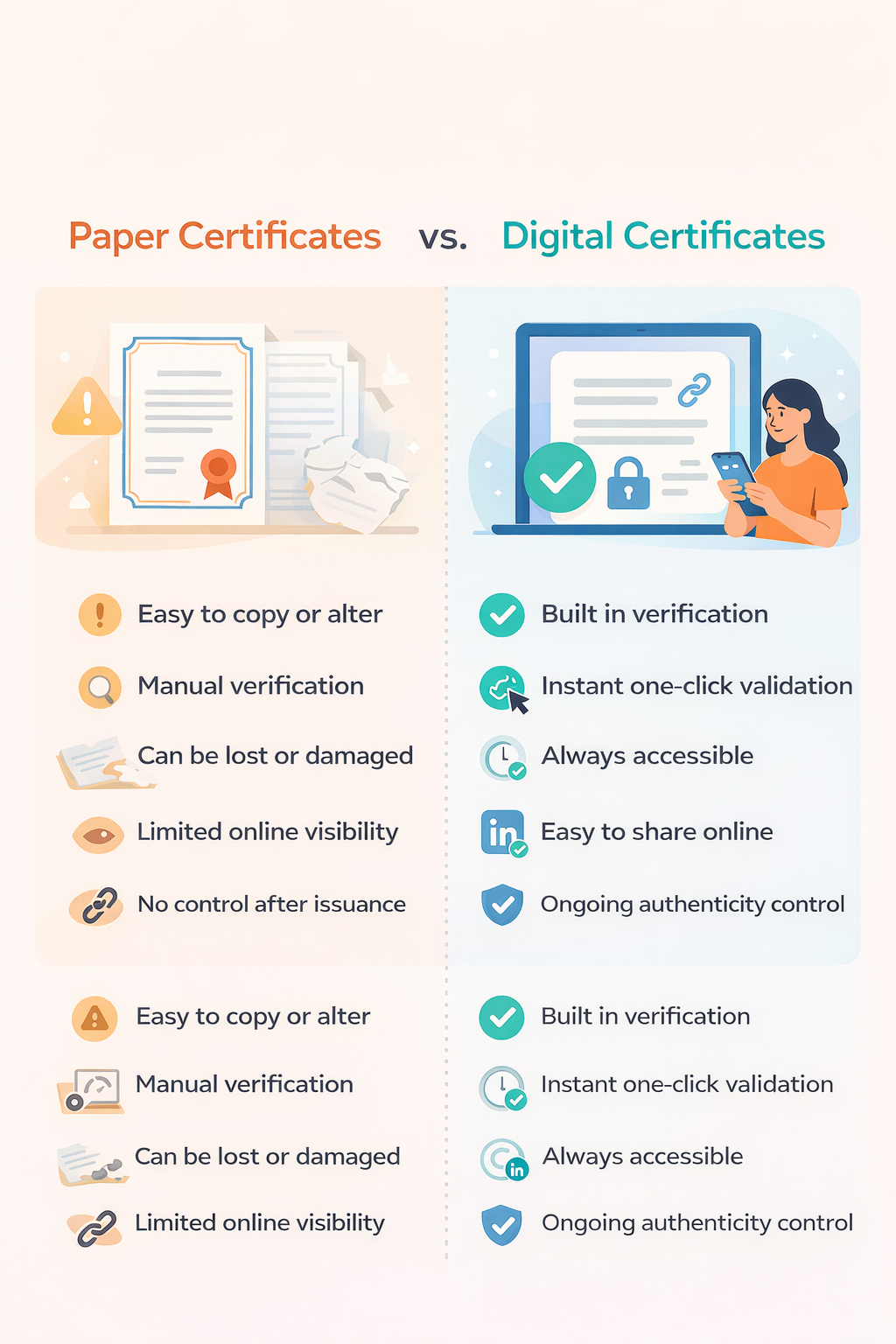
These differences show why digital certificates create a stronger foundation of trust. They reduce uncertainty, increase transparency and offer a modern, user-friendly credentialing experience. For organizations that value security, efficiency and professional visibility, digital certificates are the more dependable choice.
Real world examples clearly show how digital certificates improve trust and efficiency. A strong case is the collaboration with OMR Education, a leading provider of digital marketing training. Before switching to digital certificates, OMR Education managed credentials manually, which caused delays and made it difficult for learners to share or verify their achievements.
With the implementation of digital certificates, the process became fully automated. Each certificate now includes a secure verification link and can be shared instantly on LinkedIn or other platforms. This not only saves time but also strengthens credibility, because every credential can be validated within seconds.
You can explore the OMR success story here: OMR Education Success Story
The comparison between traditional and digital certificates shows a clear shift in how trust is built and maintained. Traditional certificates rely on physical design elements and paper-based processes. Digital certificates rely on verifiable data, security mechanisms and instant accessibility, which aligns far better with the expectations of modern learners, employers and educational institutions.
Organizations that aim to increase trust, streamline operations and present themselves professionally can follow a few practical steps to transition effectively.
Recommendations for educational providers
Digital certificates create more trust, reduce administrative burden and deliver a professional and user friendly experience. Organizations that adopt digital credentialing establish themselves as modern, transparent and future oriented providers prepared for the digital expectations of today’s education landscape.
Ready to strengthen trust in your certification process.
Schedule today a free demo with our team: Book a Free Demo
* You can find the organisation ID in the URL when you access your LinkedIn Company page as an admin.


Marketing

Jan 7, 2026

6 min

Use Virtualbadge.io to design and send digital certificates that create trust - in less than 10 minutes.
%20(1).svg)