No user accounts required for your recipients -
Start your 7-day free trial now!

How integrating digital badges into your LMS improves learner engagement, efficiency, trust, and institutional visibility


Learning management systems were once built primarily for content delivery and completion tracking. In 2026, this is no longer enough. Learners and institutions expect learning outcomes to be flexible, verifiable, and usable beyond the LMS itself.
Modern learners follow non linear learning paths. A participant in a first aid course may complete refresher modules over several years. A university student builds skills across courses, certificates, and online programs. In both cases, a static PDF certificate stored in an LMS quickly loses relevance.
Key expectations have shifted:
At the same time, operational demands continue to grow. Certificate requests, verification emails, and inconsistent formats create unnecessary administrative work. An LMS might even offer native badges or digital certificates, but... focused only on course delivery cannot address these challenges.
Digital badge integration transforms the LMS into a system that not only records learning but also validates and communicates it. Achievements become portable, trusted, and meaningful long after a course is completed.
Digital badges change how learning outcomes are represented and used. Unlike traditional LMS certificates, digital badges are designed to be verifiable, portable, and data rich. This makes them especially relevant for learning management systems that support long term skill development and external recognition.
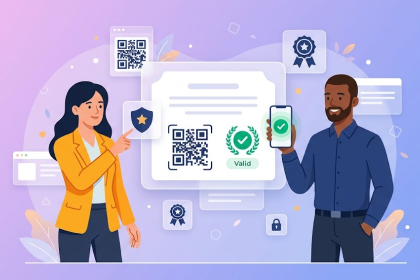
A digital badge contains embedded information about the issuer, the achievement, and the criteria required to earn it. This means anyone reviewing the badge can understand what was learned and trust that the credential is authentic. For an LMS, this adds a layer of credibility that static certificates cannot provide.

From a practical perspective, digital badges extend the value of an LMS in several ways:
For education providers, this matters because learning does not stop at course completion. Learners use their achievements in job applications, compliance checks, and professional profiles. An LMS that issues digital badges supports these real-world use cases without adding operational complexity.
For deeper research, read: Digital badges build trust.
Many modern LMS platforms offer built-in badges or digital certificates. At first glance, this seems sufficient. However, native in app solutions are usually designed for internal recognition, not for secure, externally verifiable credentialing.
In practice, these limitations become visible quickly:
For education providers, this creates friction. Learners may complete a course successfully, but the credential does not carry the level of trust or portability required in professional contexts.
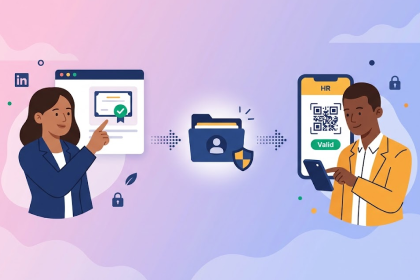
A dedicated digital badge integration solves this by separating learning delivery from credential infrastructure. The LMS tracks achievement. The badge system ensures verification, portability, and long-term usability.
For many education providers, the biggest challenge is not issuing credentials. It is managing the process efficiently at scale. Without integration, workflows often rely on manual exports, email follow-ups, and ad hoc verification requests. This quickly becomes unsustainable as learner numbers grow.
When digital badges are integrated directly into the LMS, these processes change fundamentally. Badge issuance is triggered automatically when defined learning criteria are met. Completion data flows from the LMS to the credentialing system without manual intervention.
Typical operational improvements include:
Integrations play a key role here. API connections allow deeper technical setups for complex LMS environments. No code options such as Zapier make automation accessible even for smaller training organizations. Webinar (Zoom) based providers benefit from integrations that issue badges based on attendance data.
For deeper research look at our page section: Virtualbadge.io integrations.
Beyond efficiency, digital badges directly influence learner behavior. Recognition plays a critical role in motivation, especially in online and blended learning environments where personal interaction is limited.
Badges allow education providers to recognize progress at meaningful milestones. Instead of waiting until the end of a long program, learners receive visible proof of achievement along the way. This reinforces commitment and reduces drop off rates.
From a learner perspective, badges offer tangible benefits:
In practical terms, a university might issue badges for completed modules within a degree program. A training provider could award badges for compliance updates or refresher courses.

These smaller achievements encourage continuous learning rather than one time participation.
For education providers, higher engagement leads to better completion rates and stronger learning outcomes. An LMS with digital badge integration supports this by making recognition timely, visible, and relevant to real world use cases.
Employers, partners, and regulatory bodies want clear and reliable proof of skills. Digital badges help education providers meet this expectation by combining verification, transparency, and visibility in a single credential.
When badges are issued through an integrated LMS workflow, trust is built at scale. Each badge links back to a validation page that confirms the issuer, the criteria, and the achievement. This reduces follow up questions and strengthens the credibility of the institution issuing the credential.
Learners can share achievements on professional profiles, embed them in applications, or present them during compliance checks. Every shared badge increases institutional visibility without additional marketing effort.
A practical example can be seen in Virtualbadge.io success stories, where training organizations modernize their credential processes and improve how achievements are perceived externally.
If you want to see how digital badges can be integrated into your existing LMS workflows, schedule a free demo with Virtualbadge.io and explore what credentialing can look like in 2026.
* You can find the organisation ID in the URL when you access your LinkedIn Company page as an admin.


Marketing

Feb 24, 2026

6 min
A note on how we write: we use AI tools to help with research and drafting. Every article is then reviewed, edited and fact-checked by someone on the Virtualbadge.io team before it goes live. The final word is always human.

Use Virtualbadge.io to design and send digital certificates that create trust - in less than 10 minutes.
%20(1).svg)