No user accounts required for your recipients -
Start your 7-day free trial now!

A practical overview of the budget factors higher education institutions should plan for when introducing digital certificates and badges with LMS and HR integration



With paper certificates, costs are spread across printing, shipping, storage, and the manual handling of replacement requests. With digital credentialing, the cost logic shifts: instead of many small individual line items, institutions pay a predictable, volume-based fee, and the amount depends mainly on how deeply the system is integrated into existing structures.
This is exactly the point many leaders in certification and accreditation underestimate. The actual design work on certificates and badges is usually the smallest cost block. What matters is how much effort the connection to the learning management system and to internal administrative or HR processes requires, and how many people across multiple faculties or degree programs will later work with the system. These three factors, LMS integration, HR and administrative connection, and the licensing model, determine the actual budget far more than the pure per-certificate issuance price.
A small institution with a single, centrally managed degree program often gets by with a lean setup. A larger institution with multiple faculties, its own examination offices, and a continuing education department, on the other hand, needs to plan from the outset how responsibilities, data flows, and approval processes are organized between these units. Making this distinction early leads to more realistic budgeting from the start instead of having to request additional budget later.
The first major cost factor concerns the connection to the institution's LMS. There are fundamentally three approaches available, and they differ significantly in effort:
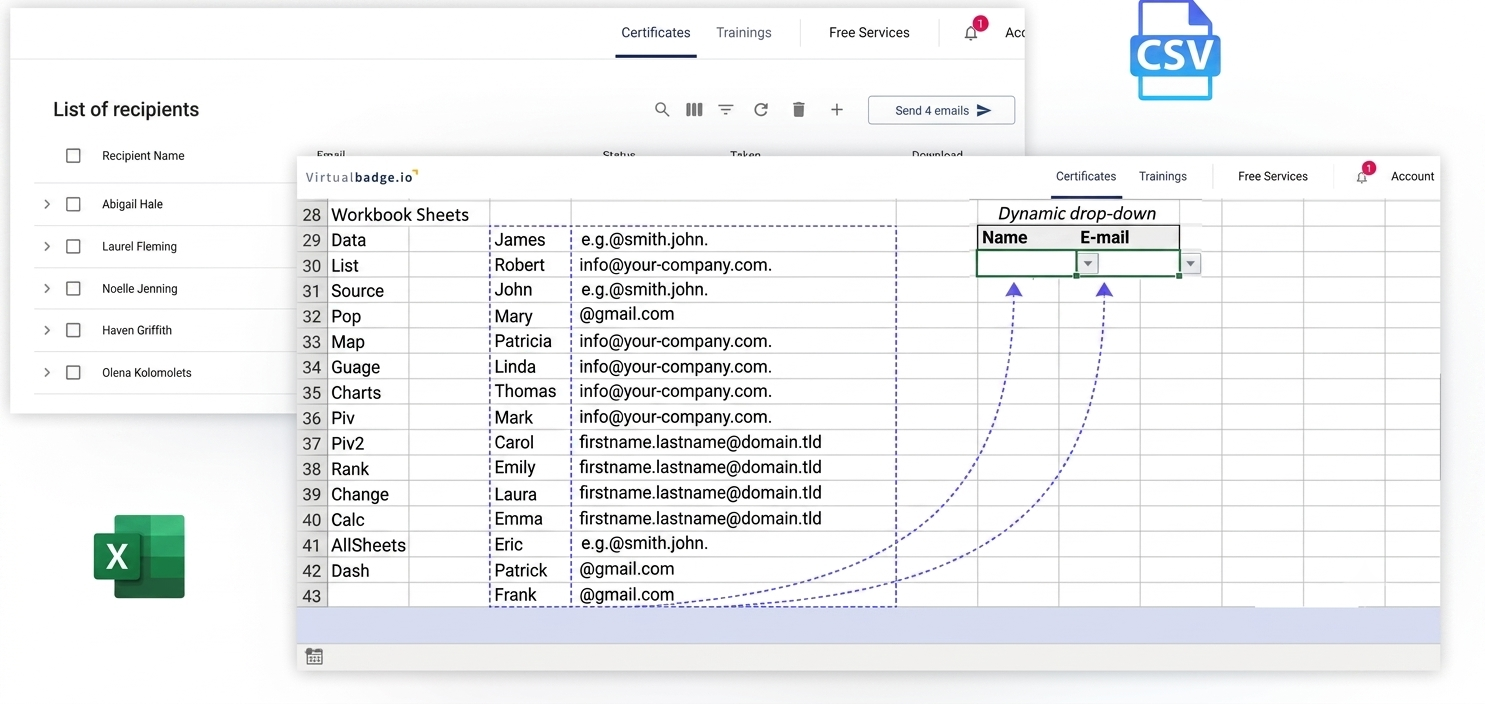
In addition, a one-time effort for migrating historical graduate data arises during setup. How much this line item weighs on the budget depends on how many graduating classes need to be captured retroactively, and whether a one-time bulk import is sufficient or an ongoing interface to the LMS needs to be built.
An often-overlooked follow-on cost factor is the ongoing maintenance of the interface. If an institution changes its LMS or updates its system landscape, the connection has to be adjusted. Institutions that rely on a general API or Zapier connection from the start, rather than a deeply intertwined custom solution, keep this adjustment effort significantly lower.
The second cost factor concerns not the students, but the internal organization. Larger institutions with multiple faculties, examination offices, or continuing education centers often need central control alongside decentralized issuance. Virtualbadge.io's Organization Hub covers exactly this scenario: templates and approval processes are managed centrally, while individual faculties or institutes can issue independently.
The following points are relevant for budget planning:
The more departments need to issue independently, and the tighter the connection to existing administrative systems needs to be, the more a higher pricing tier with the corresponding feature set pays off. Institutions managing multiple locations or partner institutes under one roof also benefit from being able to define templates and approval processes centrally once, instead of building them separately at each location.
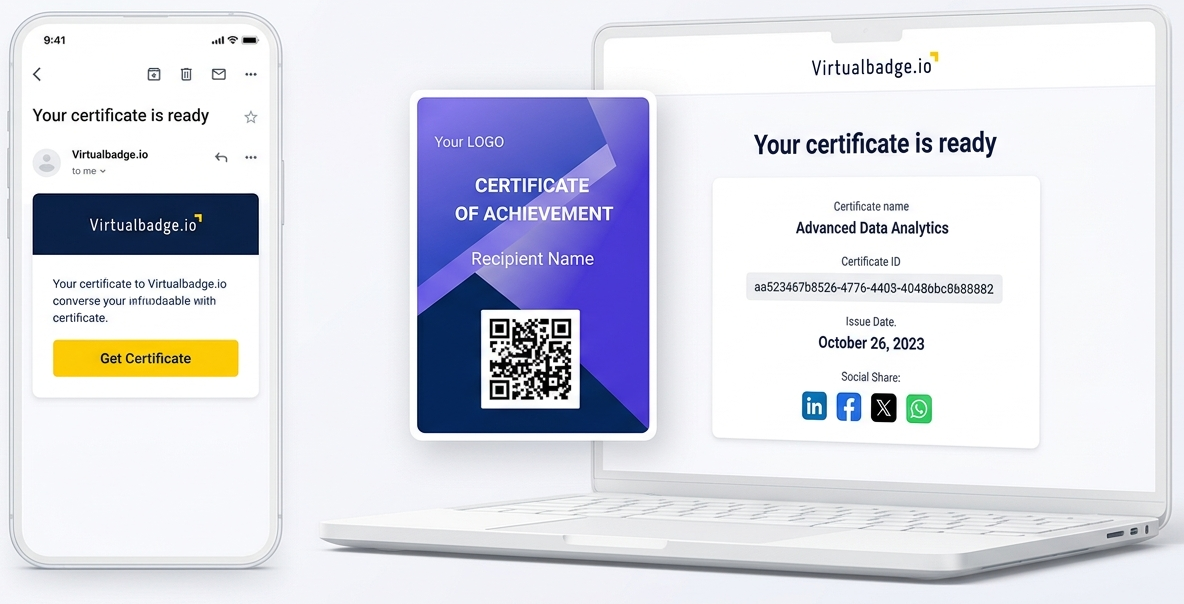
Virtualbadge.io offers several self-service pricing tiers, with costs based on monthly issuance volume. The middle tiers typically already include API access, Zapier connectivity, and expiration date management, exactly the functions needed for LMS integration. Current prices and terms can be found on the Virtualbadge.io pricing page.
What matters for budget planning is that the actual integration effort does not scale linearly with issuance volume. An institution with few but highly heterogeneous degree programs can face higher integration costs than a large institution with a uniform process.
Swiss company SIZ AG achieved a 400 percent ROI in its first year after fully digitizing its certificate issuance, as described in its success story. Effects like these show that the initial integration investment usually pays for itself quickly.
For institutional networks with particularly high security and governance requirements, Enterprise additionally offers individual SLAs as well as white-label validation on the institution's own domain, which is calculated separately and is worthwhile primarily for very large issuance volumes or complex multi-faculty structures. Lite, Growth, and Plus can also be tested free for seven days, making it possible to realistically assess the actual effort before making a decision.
The actual costs of digital credentialing rarely arise from certificate design itself, but from the depth of LMS integration, governance across multiple issuers, and the right licensing tier for your issuance volume. Working through these three factors early avoids budget surprises later.
Schedule a free demo and see which integration depth and pricing tier fits your institution's LMS and administrative systems.
* You can find the organisation ID in the URL when you access your LinkedIn Company page as an admin.


Marketing

Aug 18, 2026

5 min
A note on how we write: we use AI tools to help with research and drafting. Every article is then reviewed, edited and fact-checked by someone on the Virtualbadge.io team before it goes live. The final word is always human.

Use Virtualbadge.io to design and send digital certificates that create trust - in less than 10 minutes.
%20(1).svg)