
How can a college protect its diplomas from fraud?
Issue diplomas and certificates digitally with a seal, let employers verify them on the college's own website with live status, and keep the record current. That exposes edited and fabricated diplomas and shows revocations. Add a public page that explains the official verification route, and search for copies of it1234.
Key points
- In an AACRAO survey from 2020, 54% of institutions in the US and Canada saw credential fraud as a concern5.
- The same survey found that 89% already used at least one type of digital credential, including digitally signed PDFs5.
- A sealed digital diploma plus a verification page on the college's domain exposes edits, fabricated diplomas and revocations12.
- Open standards such as Open Badges 3.0 and the Comprehensive Learner Record let credentials travel beyond the PDF6.
Colleges carry two burdens with credential fraud. Their name appears on fakes and on diploma mills that imitate it, and their registrars answer a steady stream of verification requests.
This page shows how registrars protect diplomas and certificates, what open standards add and how a college gets started without replacing its student information system.
Where colleges are exposed
- Imitation: diploma mills choose names close to well-known colleges7.
- Editing: grades, majors and dates are changed in a PDF.
- Fake checks: a copied verification page or a phone line confirms the fake48.
- Workload: every request answered by hand costs registrar time.
In a 2020 AACRAO survey of institutions in the US and Canada, 54% saw credential fraud as a concern. 89% already used at least one type of digital credential, including digitally signed PDFs5.
Four building blocks
| Building block | What it does | What it exposes |
|---|---|---|
| Sealed digital diploma | Every PDF carries the college's seal1 | Edits and fabricated diplomas |
| Verification page on your domain | Employers check the record at your address2 | Fakes and copied pages on other domains |
| Live status | Revocations and corrections show immediately3 | Revoked and superseded credentials |
| Search for copies | Finds fake verification pages and lookalike domains4 | Fake checks that confirm forgeries |
Open standards: Open Badges 3.0 and CLR
Beyond the PDF, open standards let credentials travel into wallets, profiles and hiring systems. Open Badges 3.0 from 1EdTech is designed as a W3C Verifiable Credential and was developed alongside the Comprehensive Learner Record 2.06. Verifiable Credentials are cryptographically secure, privacy respecting and machine-verifiable9.
Virtualbadge.io issues microcredentials based on Open Badges 3.0 and issues to W3C Verifiable Credentials 2.010. For most colleges, the practical start is still the sealed PDF and the verification page, with badges for courses and modules.
What changes for the registrar
- Diplomas are issued from a template with the seal switched on1.
- Each diploma gets its own verification page on the college's website2.
- A typo is fixed with a new version, and the old page points to it3.
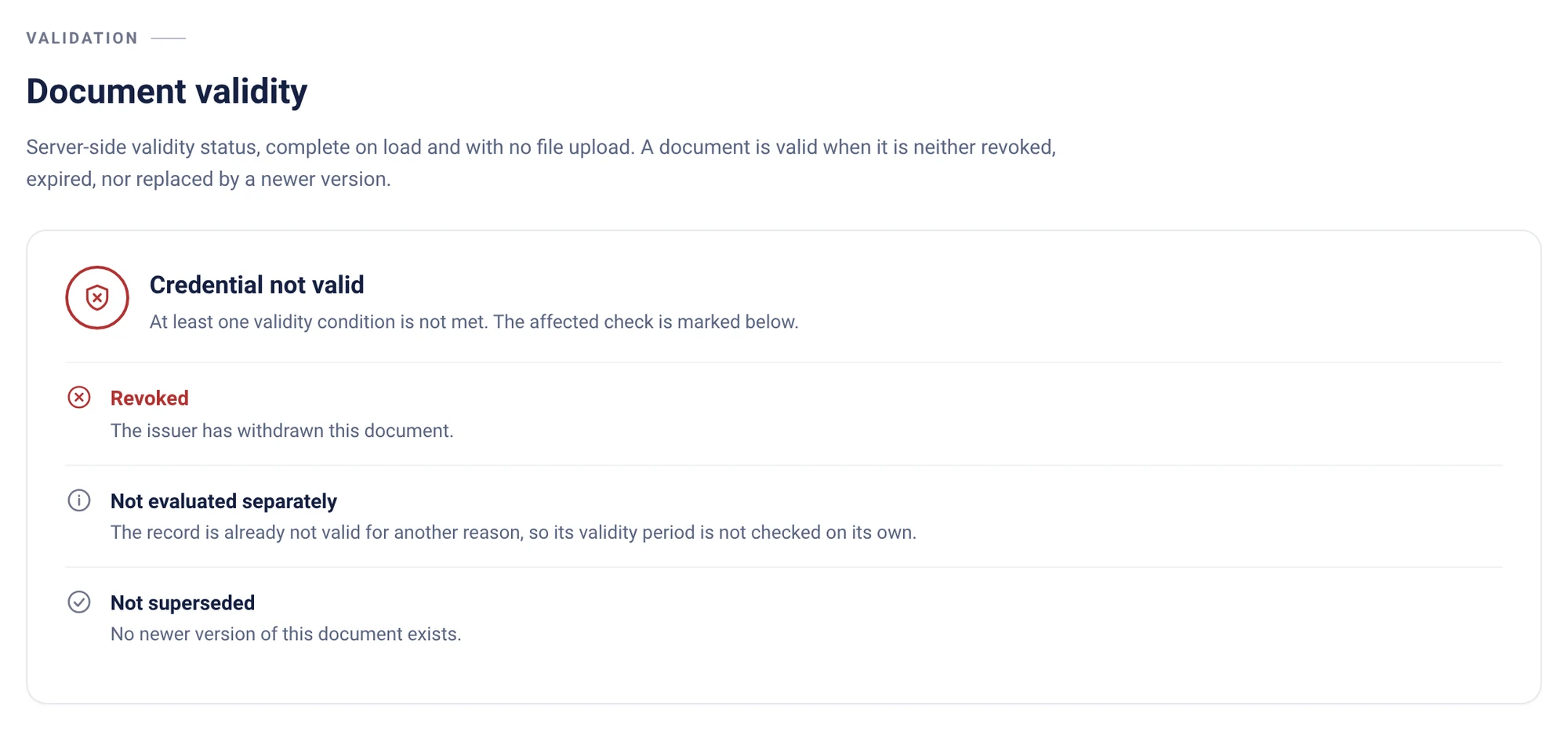
- A diploma issued in error is revoked, and the page shows the status immediately3.
- Employers verify on their own, so fewer requests reach the office.
How to get started
Start with one credential type that is checked often, such as a degree certificate or a professional certificate program. Issue it digitally with the seal, embed the verification page and explain the verification route on your website. Then extend to other programs.
Issuing can start from your existing systems. Virtualbadge.io offers a REST API and webhooks to trigger issuing from your own software11.
For colleges See a diploma verified on your own website.
Frequently asked questions
How can universities prevent diploma fraud?
Issue sealed digital diplomas, let employers verify them on the university's own website with live status, and search for copies of the verification page124.
Do digital diplomas replace paper?
They can run alongside paper. The paper diploma stays on the wall; the digital one is what employers verify.
What is the Comprehensive Learner Record?
A 1EdTech standard for a fuller digital record of learning, developed alongside Open Badges 3.06.
Do we need to replace our student information system?
No. Issuing can be triggered from existing systems through an API and webhooks11.
As of Nov 18, 2026. We check the facts regularly. Is something out of date? Tell us, and we will fix it.
Sources
- Virtualbadge.io, how-to guides: Digitally seal PDF certificates and verify the signature accessed November 18, 2026
- Virtualbadge.io, how-to guides: Embed the validation page in your own website accessed November 18, 2026
- Virtualbadge.io, how-to guides: Revoke or replace a certificate accessed November 18, 2026
- AI Fraud Protect (FutureNext GmbH): AI Fraud Protect: copies of your website, fake verification pages and phishing in your name accessed November 18, 2026
- AACRAO: Transforming the digital credentials space, March 3, 2021 (survey of institutions in the US and Canada, spring 2020) accessed November 18, 2026
- 1EdTech: New Open Badges 3.0 standard provides enhanced security and mobility, May 29, 2024 accessed November 18, 2026
- Council for Higher Education Accreditation (CHEA): Fact Sheet #6: diploma mills and accreditation mills, May 2003 accessed November 18, 2026
- Federal Trade Commission: Avoid fake-degree burns by researching academic credentials (guidance for business) accessed November 18, 2026
- World Wide Web Consortium (W3C): W3C publishes Verifiable Credentials 2.0 as a W3C Standard, May 15, 2025 accessed November 18, 2026
- Virtualbadge.io: Entity map: statements about Virtualbadge.io with their sources accessed November 18, 2026
- Virtualbadge.io, how-to guides: REST API and webhooks: trigger issuing from your own system accessed November 18, 2026