No user accounts required for your recipients -
Start your 7-day free trial now!

How secure digital certificates improve trust, efficiency, and compliance in first aid training



First aid training is a critical foundation for workplace safety and public institutions. Every issued certificate confirms that a participant has the skills required to act correctly in emergency situations. A first aid certificate represents competence, compliance, and trust.
Digitizing this process is challenging due to location specific regulations, especially in regulated markets such as Germany. Certification standards, documentation requirements, and verification rules must comply with strict legal frameworks, which has slowed digital adoption in this segment.
As a result, many providers still rely on paper certificates or static PDF files, even though training delivery and course management have become digital. This disconnect creates inefficiencies and friction across the certification process.
Employers and authorities expect certificates to be easy to access and simple to verify. Participants want long term access without managing physical documents. Traditional certificates struggle to meet these expectations, while manual processes increase administrative effort and limit scalability.
Secure digital certificates provide a compliant alternative. They enable verifiable, online credentials that improve efficiency, strengthen trust, and support modern certification requirements.
Traditional paper and PDF certificates create several challenges that make first aid certification inefficient and unreliable in modern training environments. As requirements for verification and compliance increase, these weaknesses become more visible.
These limitations show why traditional first aid certificates no longer meet modern expectations. Without secure and verifiable alternatives, certification becomes a bottleneck rather than a support for efficient training operations.
Not every digital certificate is automatically secure. Simply converting a paper certificate into a PDF does not address the core challenges of trust, verification, and long term reliability. A secure digital first aid certificate must be designed for verifiability, trust, and future proof use, not just visual appeal.
Secure digital certificates are built around a centralized validation model. Instead of relying on a static file as the source of truth, each certificate is linked to a unique online verification page that confirms authenticity instantly.
Key characteristics of secure digital first aid certificates include:
Design also matters for trust and recognition. The Virtualbadge.io blog article “How to Create Certificate Designs with Lasting Recognition” explains why certificate layout, clarity improves both participant experience and verification confidence.
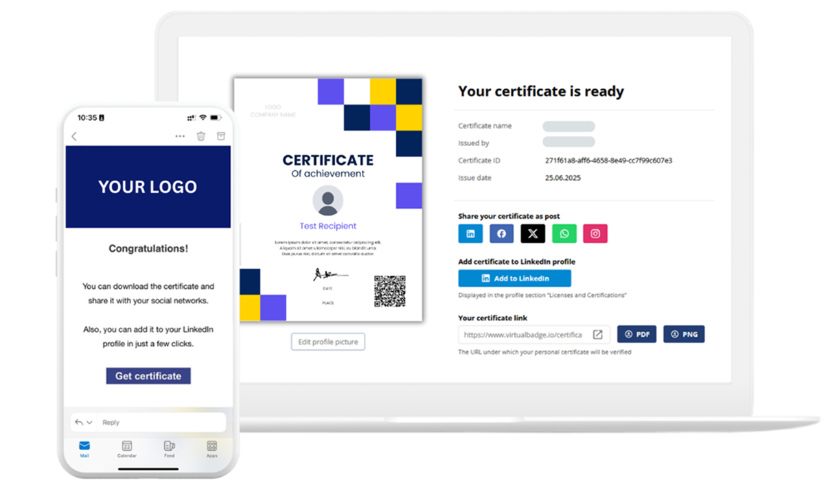
Here is an example of a secure and verifiable certificate. It is easy to confirm and manipulation is impossible because authenticity is validated through its verification page.
Secure digital certificates do not only improve verification. They also deliver measurable operational and strategic benefits for organizations issuing first aid certifications.
For first aid providers and educational institutions, secure digital certificates are not just a technical upgrade. They are a foundation for efficient operations, professional credibility, and sustainable growth.
Secure digital certificates are already used by many first aid providers to modernize their certification processes and reduce administrative overhead. In daily operations, the benefits become visible very quickly.
In practice, digital certificates are typically issued immediately after course completion. Participants receive a link to their personal verification page instead of a file attachment. Employers or authorities can confirm authenticity instantly by scanning a QR code or opening the verification link.
Common real world improvements include:
A practical example of this approach is the Fit4 Emergency case study. The organization replaced manual and PDF-based certificates with secure digital certificates and significantly reduced administrative workload while improving verification reliability for corporate clients and auditors.
Transitioning to secure digital certificates does not require a disruptive system change. Most first aid providers start with a structured, step by step approach that integrates smoothly into existing workflows.
Key success factors include:
A well-planned transition ensures that digital certificates become a long-term operational advantage rather than a short-term experiment.
If you want to modernize your first aid certification process and see how secure digital certificates work in practice, the next step is simple.
Schedule a free demo and discover how digital certificates can transform the way you issue, manage, and verify first aid certifications.
* You can find the organisation ID in the URL when you access your LinkedIn Company page as an admin.


Marketing

Jan 7, 2026

5 min
A note on how we write: we use AI tools to help with research and drafting. Every article is then reviewed, edited and fact-checked by someone on the Virtualbadge.io team before it goes live. The final word is always human.

Use Virtualbadge.io to design and send digital certificates that create trust - in less than 10 minutes.
%20(1).svg)