No user accounts required for your recipients -
Start your 7-day free trial now!

A Practical Framework to Quantify Business Value, Engagement, and Growth from Digital Certificates and Badges



Digital certificates and badges are an important touchpoint between educational providers and their participants. They are no longer just a confirmation of attendance, but a signal of quality, trust, and professionalism.
However, many organizations still treat credentials as a final administrative step. Certificates are issued, but their impact is not evaluated. Measuring the ROI of digital credentials helps organizations understand whether their efforts actually create value.
ROI measurement is important because it provides answers to practical and strategic questions:
For training providers and universities, digital credentials often represent compliance, qualification, or career relevance. When ROI is measured, organizations gain insight into how these credentials support broader goals such as visibility, reputation, and participant satisfaction.
Key benefits of measuring ROI include:
Measuring ROI turns digital credentials into a strategic and measurable asset rather than a passive output.
ROI in the context of digital credentials goes beyond financial return alone. While cost savings play a role, the true value lies in efficiency, engagement, and visibility combined.
Direct ROI is often the easiest to quantify and includes:
These improvements already create clear advantages over traditional certificate processes.
Indirect ROI, however, is where digital credentials create long term impact:
Instead of asking only how much money is saved, organizations should ask:
ROI should therefore be understood as the overall value created by issuing digital certificates and badges. When both direct and indirect returns are considered, digital credentials become a strategic investment that supports operational efficiency, marketing impact, and institutional credibility.
To measure the ROI of digital certificates and badges effectively, organizations need to focus on meaningful metrics rather than assumptions. These metrics help translate engagement and visibility into measurable outcomes.
One of the most important indicators is certificate claim rate. It shows how many recipients actively access their credential after receiving it. A high claim rate indicates relevance and perceived value.
Additional key metrics include:
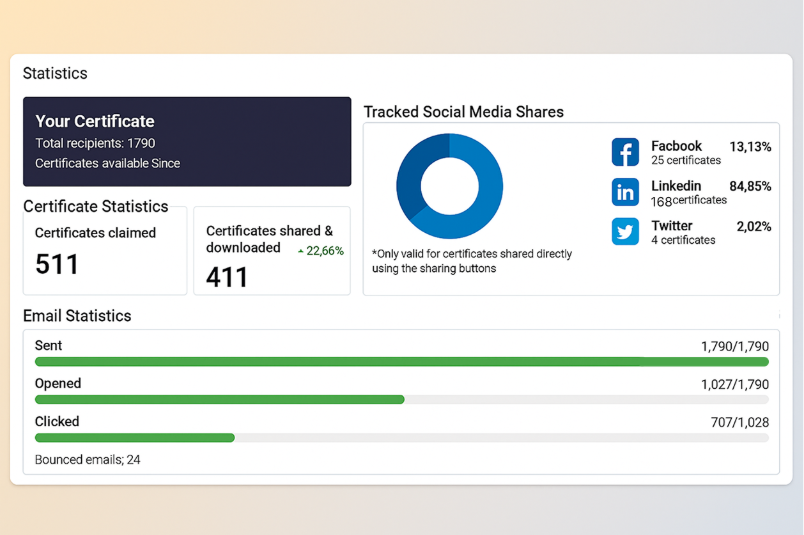
A credential analytics dashboard typically provides real-time insights into claims, downloads, shares, and email engagement, making ROI immediately measurable.
Each metric contributes to a broader understanding of how digital credentials perform beyond the moment of issuance. When combined, they create a clear picture of engagement, reach, and business relevance.
Measuring ROI requires access to reliable data and the ability to interpret it correctly. Many organizations underestimate how much information digital credentials already generate.
A structured approach to data collection helps ensure consistency and comparability over time.
Key data sources include:
To analyze ROI effectively, organizations should:
The goal is not to collect as much data as possible, but to identify patterns that support better decisions. When analytics are used consistently, digital credentials become a measurable asset that supports continuous improvement.
To make ROI more tangible, a simple example helps translate metrics into measurable value.
Assume a training provider issues digital certificates to 500 participants after completing a course.
Observed metrics:
This results in:

In addition to visibility, operational efficiency plays a role:
If an organization were to generate a similar number of impressions through paid advertising, this would typically require additional marketing budget. With digital credentials, this reach is created as a byproduct of course completion.
At the same time, staff time previously spent on certificate handling is saved and can be reallocated to higher value activities.
This example shows how digital credentials create ROI on multiple levels:
Rather than relying on assumptions, organizations can use real usage data to evaluate impact and continuously improve their credential strategy.
Measuring ROI is only valuable if insights lead to action. Digital credentials offer continuous feedback that organizations can use to improve results over time.
Based on ROI data, organizations can take targeted steps such as:
When ROI insights are used consistently, digital certificates and badges become more than proof of completion. They evolve into a strategic tool that supports efficiency, engagement, and long term growth.
If you want to understand how digital certificates and badges work and can deliver measurable ROI for your organization, schedule a free demo to explore how credential analytics, engagement tracking, and automation work in practice.
* You can find the organisation ID in the URL when you access your LinkedIn Company page as an admin.


Marketing

Jan 8, 2026

5 min
A note on how we write: we use AI tools to help with research and drafting. Every article is then reviewed, edited and fact-checked by someone on the Virtualbadge.io team before it goes live. The final word is always human.

Use Virtualbadge.io to design and send digital certificates that create trust - in less than 10 minutes.
%20(1).svg)