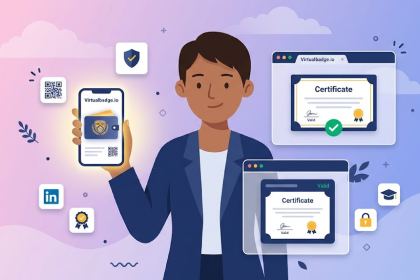
No user accounts required for your recipients -
Start your 7-day free trial now!

How automated issuance, cryptographic signatures, and European standards make digital competency credentials practical for universities.


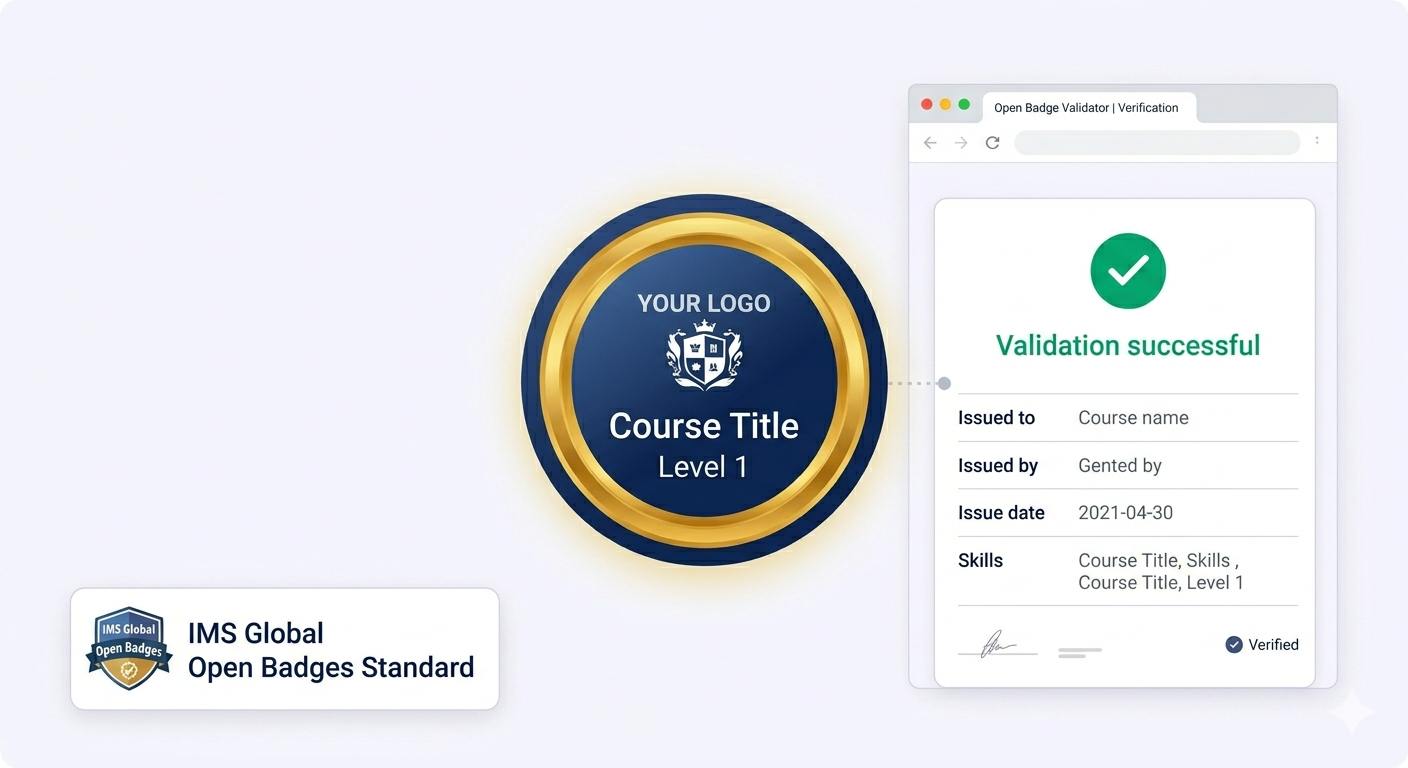
Open Badges are digital badges that function as an image file with embedded metadata. This metadata documents the issuing institution, the competencies achieved, and the award criteria in structured form, so that each badge is, in itself, a complete, verifiable credential.
For universities, they are a modern alternative to paper certificates. Students can share their badges on LinkedIn, in job applications, or on personal websites, making their qualifications visible. Over time, this creates a digital portfolio documenting individual courses, modules, and additional qualifications, far beyond the traditional degree certificate.
Most modern learning management systems support Open Badges natively or via plugins. After a course is completed or an exam is passed, the LMS sends the performance data to the badge system, which automatically creates a digital certificate with all relevant metadata and sends it to the recipient by email.
Each badge stores this information in a structured JSON-LD format, including the recipient's name, the issuing organization, the issue date, and the award criteria met. The Open Badges 3.0 standard from 1EdTech defines this data structure in a binding way, so that badges from different issuers remain mutually readable and verifiable, regardless of which platform issued them.
A REST API or a CSV import also makes it possible to issue badges to larger cohorts, such as entire graduating classes, in a single batch. Recipients do not need their own user account for this, they simply receive a link to download and share their certificate.
Open Badges significantly simplify administrative processes in exam administration. Instead of manual certificate issuance, badges are awarded automatically once exam results are approved, giving exam offices less paperwork and considerably faster processing times. This makes a noticeable difference especially with large exam volumes, such as in continuing education or language testing.
Validation itself is based on cryptographic signatures. The issuer digitally seals each badge, so that any subsequent changes are immediately detectable. Employers or other universities can verify authenticity via a verification link or QR code with a single click, without needing to contact the issuing exam office.

Virtualbadge.io adds a permanent validation page where certificates remain verifiable years after issuance, independent of any ongoing platform contract. For universities, this means long-term legal certainty, even if systems or providers change later on.
At the EU level, the European Digital Credentials for Learning are emerging as an additional standard built on the Open Badges format, intended to make learning outcomes comparable across Europe. For universities with international partnerships or exchange programs, this will become relevant in the medium term, because employers and institutions in other EU countries are increasingly verifying digital credentials directly instead of translating them manually.
Several criteria therefore matter when choosing a platform:
Lisbon Digital School, for example, uses Virtualbadge.io for the automated issuance and sharing of course certificates. Read more in the Lisbon Digital School case study.
Open Badges automate competency documentation, reduce administrative workload in exam offices, and make certificate fraud practically impossible. At the same time, they increase the mobility of qualifications within Europe and beyond, because employers and partner institutions can verify credentials directly online.
See how Open Badges can integrate into your university LMS: Schedule a free demo
What Distinguishes Open Badges from Traditional Certificates?
Open Badges are PNG or SVG files that follow the Open Badges standard and contain verifiable metadata about the issuer, criteria, and competencies, so they can be verified with a single click. Traditional certificates, by contrast, are usually encrypted PDF files without this standardized data structure.
Are Open Badges Also Suitable for Continuing Academic Education?
Yes, Open Badges are particularly well suited for certificate courses and micro-credentials, since they document individual competencies without requiring a full degree.
* You can find the organisation ID in the URL when you access your LinkedIn Company page as an admin.


Marketing

Jul 8, 2026

4 min
A note on how we write: we use AI tools to help with research and drafting. Every article is then reviewed, edited and fact-checked by someone on the Virtualbadge.io team before it goes live. The final word is always human.

Use Virtualbadge.io to design and send digital certificates that create trust - in less than 10 minutes.
%20(1).svg)