No user accounts required for your recipients -
Start your 7-day free trial now!

Why visible, shareable learning achievements increase the completion rate of your training programs.


Employee training rarely fails because of the content. Many participants start out motivated, but lose interest once they realize there is no tangible proof of their learning achievement waiting at the end. Digital certificates close exactly this gap: they make skills visible, shareable, and valuable for one's own career.
The effect is measurable. According to a joint study by Gallup and Workhuman, employees who see recognition as a core part of their organization's culture are 3.7 times more likely to be engaged than colleagues without this experience. Digital certificates are one of the simplest ways to make this recognition visible.
The following seven steps show how to build a certificate program that creates real motivation:
Not every training course needs a certificate, but for compliance training, onboarding programs, and professional development courses, a credential makes a clear difference. Decide in advance which training courses should be certified.
Also consider which audience you want to reach: new employees acquiring their first qualifications, or experienced professionals looking to grow further. Define, too, exactly which skill the certificate should confirm. A clear skills profile significantly increases the perceived value for recipients.
When choosing a platform, what matters most is how easily certificates can be issued, designed, and verified. Look for integrations with your existing learning management system or HR system so that no manual steps are required.
User friendliness for your workforce is just as important. Recipients should be able to receive and redeem their certificate without their own user account, so that no technical hurdle slows down motivation.
A certificate featuring a company logo, brand colors, and a clear description of the skill learned signals appreciation. It shows that a company takes professional development seriously.
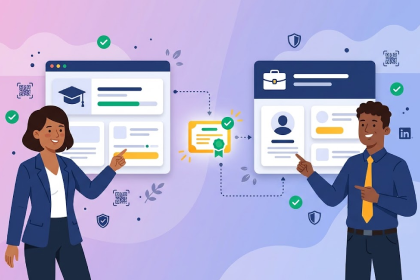
Every certificate should also include a unique ID and a QR code for verification, so third parties, such as future employers, can check its authenticity. For different types of training, such as a compliance course or a leadership program, it is worth using a dedicated design for each.
Manual certificate creation costs time and is prone to errors. With automated workflows, participants receive their certificate immediately after completing a training course, with no waiting time.
Virtualbadge.io can be connected through its own API or Zapier. As soon as someone completes a training course, the certificate is generated automatically and sent by email.
Long training programs often lose momentum. Milestone certificates solve this problem by rewarding intermediate achievements: after completing each module, participants receive their own badge.

These small moments of success keep motivation high and show progress. Logistics provider 4flow relies on exactly this approach to make internal skills visible, as shown in this case study.
Certificates only become motivating once they are visible. With Virtualbadge.io's LinkedIn Badges feature, recipients add their certificate to the "Licenses & Certifications" section of their profile with a single click, including suggested hashtags and post copy.

This public sharing motivates the individual, because their achievement is recognized, while also positioning the company as an employer that invests in professional development.
A successful certificate program keeps evolving. Regularly check how many employees complete their training courses and how often certificates are shared.
Compare completion rates before and after introducing digital certificates. Also gather feedback from participants to continuously refine the program.
Virtualbadge.io was built to simplify exactly this process. With the drag and drop designer, you create on brand certificates without any design skills, while CSV or Excel import enables bulk sending to entire teams. Automated workflows through the API, Zapier, or LMS integrations handle the issuance, every certificate includes a QR code for validation, and all data is stored GDPR compliant on European servers. The built in dashboard shows how often certificates are claimed, shared, and downloaded, so you can develop your program based on real data.
Try Virtualbadge.io for free and see how digital certificates boost training motivation in your organization.
* You can find the organisation ID in the URL when you access your LinkedIn Company page as an admin.


Marketing

Jul 8, 2026

4 min
A note on how we write: we use AI tools to help with research and drafting. Every article is then reviewed, edited and fact-checked by someone on the Virtualbadge.io team before it goes live. The final word is always human.

Use Virtualbadge.io to design and send digital certificates that create trust - in less than 10 minutes.
%20(1).svg)