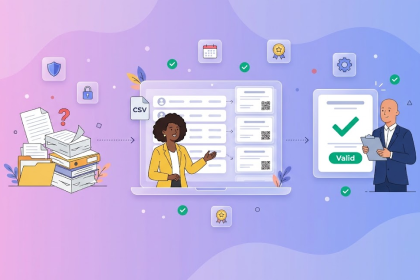
No user accounts required for your recipients -
Start your 7-day free trial now!

How digital certificates make issuing and verifying university credentials noticeably easier and more secure.


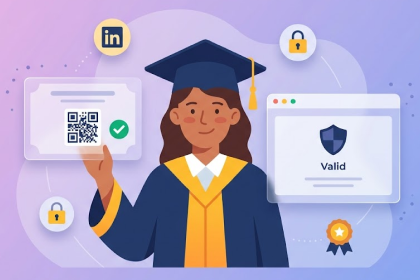
At every university, the same task repeats year after year: thousands of graduation credentials have to be issued, managed, and, when in doubt, checked for authenticity. Paper certificates make exactly that cumbersome, they cost time to process and are comparatively easy to forge. Digital certificates address this directly and make credentialing both faster and more secure. The following looks at how digital certificates work at universities in detail, what benefits they bring for administration and HR departments, and what education providers should pay attention to when introducing them.
At its core, a digital certificate is an electronic record of learning outcomes, degrees, or acquired competencies. At universities, it is increasingly replacing the classic paper certificate and can do considerably more in the process. Issue date, institution name, and qualification details are stored directly as metadata within the certificate, along with a unique validation link or QR code that confirms authenticity at any time.
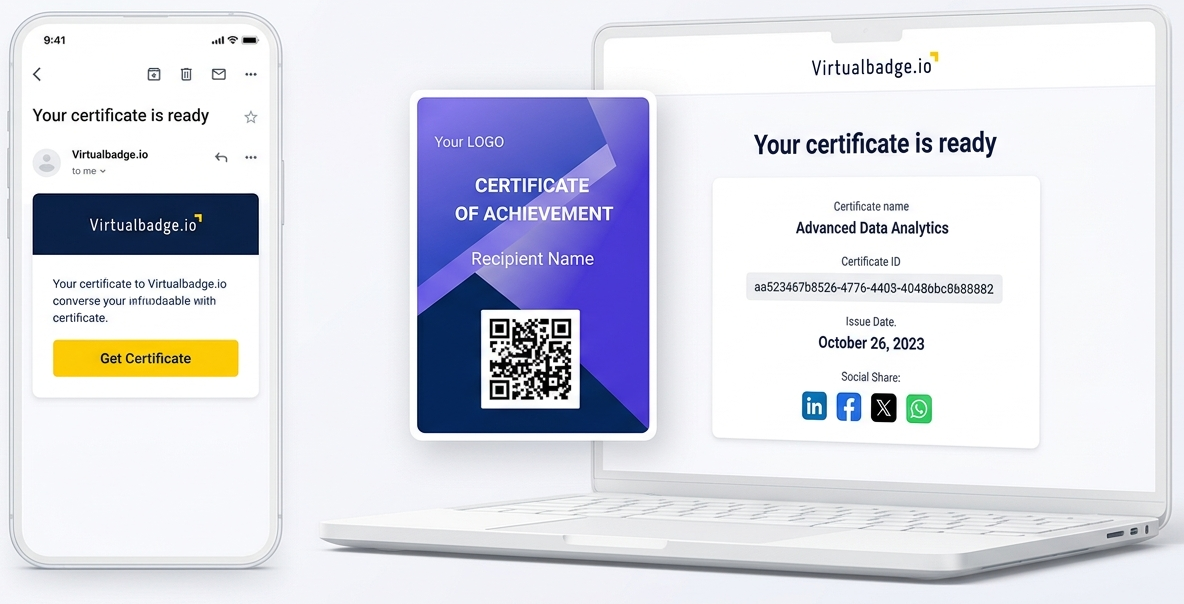
A simple scanned PDF cannot achieve that: a digital certificate remains clearly traceable to its issuing university, no matter where it is later shared or stored.
At the European level, the European Commission has created a unified standard with the European Digital Credentials for Learning, which facilitates Europe wide recognition of digital education credentials. It ensures that such certificates remain forgery proof and carry the same legal status as a paper certificate.
For university administrations, switching to digital certificates pays off in measurable efficiency, without security falling short. Cryptographic signatures and electronic seals make manipulation visible, while all certificates are hosted GDPR compliant on secure European servers.
Education provider Lisbon Digital School has digitized its certificate issuance in exactly this way and now issues credentials to students automatically and verifiably through Virtualbadge.io, more on that in the case study. Standards such as eIDAS 2.0 additionally help ensure that digital certificates remain legally recognized even in regulated sectors.
For employers and HR departments, verifying the authenticity of a digital graduation credential takes only a few seconds. A QR code or a direct link leads to the validation page, where all the relevant details are listed: the issuing institution, the graduate's name, the type of degree, and the issue date.
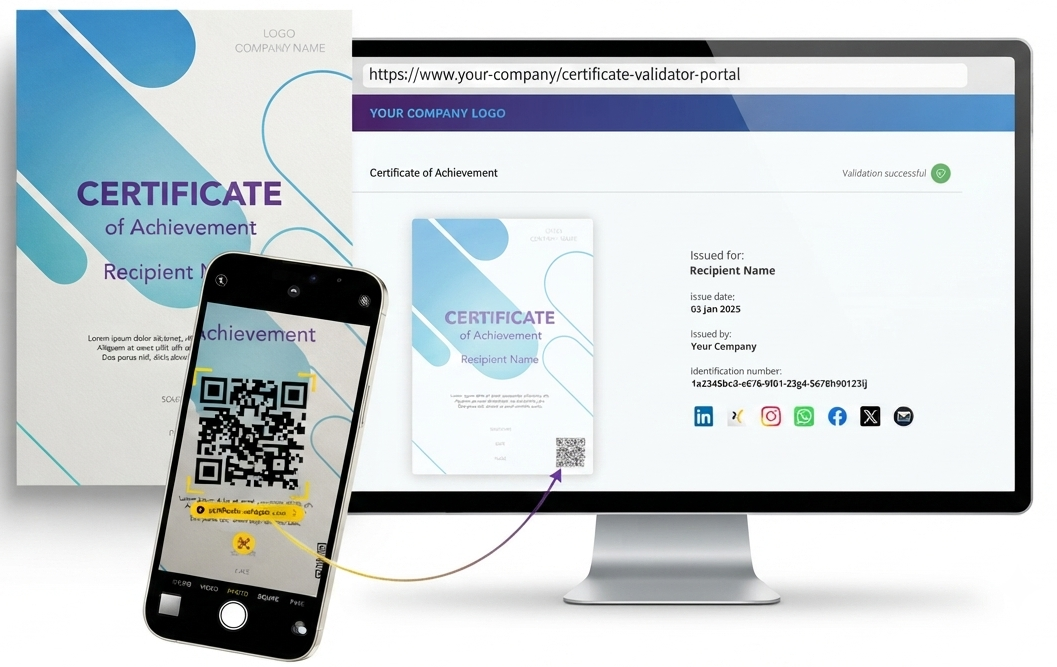
If this page is hosted on the university's own domain, it further strengthens the trust of those verifying it.
Digital certificates save HR departments the manual verification of education credentials, and that alone is already a noticeable relief. Applicants share their certificate directly or embed it in their LinkedIn profile, so recruiters can see and verify the qualification immediately. Because the metadata is structured, competencies can also be captured automatically in HR systems, which simplifies talent search and matching against open positions, without anyone having to go through individual certificates by hand.
On the university side, the introduction works best step by step:
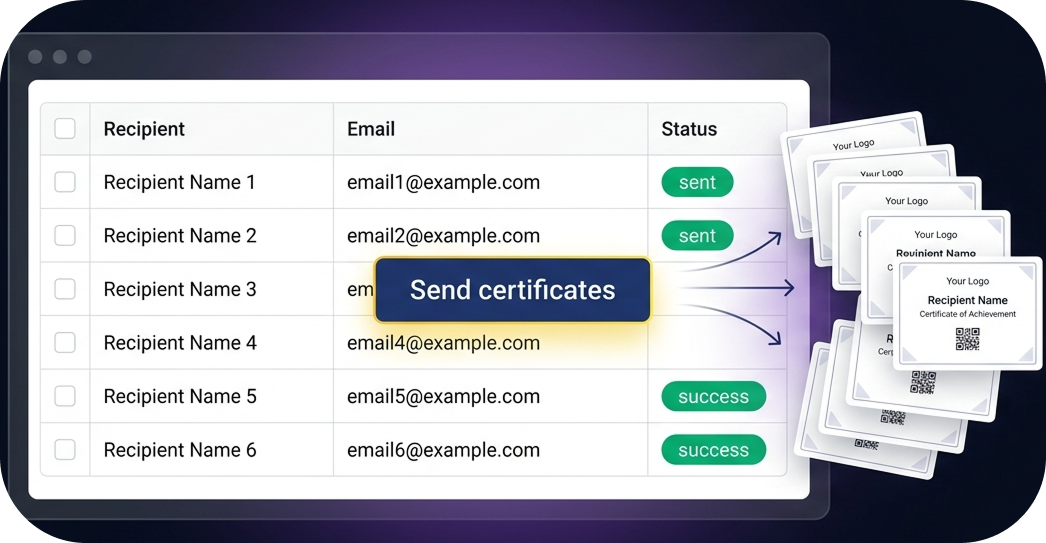
Digital certificates fundamentally change how universities issue and manage graduation credentials, from noticeable time savings to better forgery protection to verification that takes employers only seconds. Virtualbadge.io provides the right building blocks for this: automated issuance, standard compliant formats, and seamless integration with existing systems. Book a free demo and see how your exam administration can be modernized starting today.
How do students get their digital certificates?
They receive an email with a link to their personal certificate, which they can download, share, or add to their LinkedIn profile, with no user account required.
Can Virtualbadge.io be integrated into existing learning management systems?
Yes, via a REST API. This allows the university's campus management or learning management system to be connected, so that certificates are issued automatically as soon as students successfully complete a course or exam.
* You can find the organisation ID in the URL when you access your LinkedIn Company page as an admin.


Marketing

Aug 26, 2026

5 min
A note on how we write: we use AI tools to help with research and drafting. Every article is then reviewed, edited and fact-checked by someone on the Virtualbadge.io team before it goes live. The final word is always human.

Use Virtualbadge.io to design and send digital certificates that create trust - in less than 10 minutes.
%20(1).svg)