No user accounts required for your recipients -
Start your 7-day free trial now!

How universities issue degrees in a tamper-proof, efficient, and Europe-wide recognized digital format.


Universities face a challenge: paper certificates are vulnerable to forgery, difficult to verify, and require significant administrative effort. Digital certificates offer a solution that combines security, efficiency, and Europe-wide transparency.
In this article, you will learn what digital certificates are, what benefits they offer to universities and students, and how Virtualbadge.io makes their adoption easier.
Digital certificates are electronic documents that certify learning outcomes, degrees, or qualifications. They contain the same information as a printed certificate, supplemented by technical security features.
A digital certificate typically includes information about the issuing institution, the recipient, the degree obtained, and its validity. This data is provided with a cryptographic signature, so any subsequent changes are immediately detectable.
Unlike paper documents, digital certificates can be verified within seconds via QR code or link. Employers and other universities can check the authenticity without having to request certified copies.
Digitizing the awarding of degrees solves several problems at once:
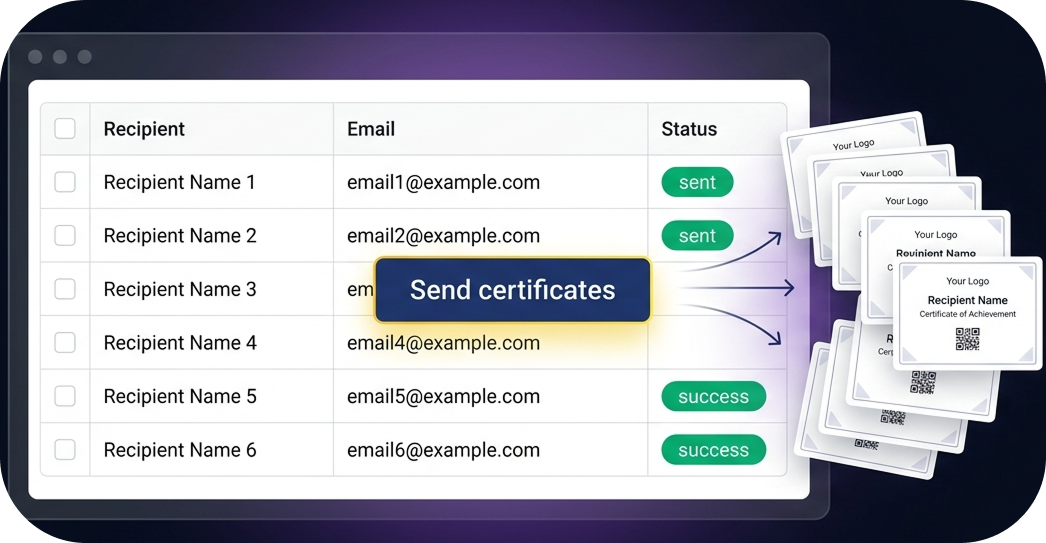
Virtualbadge.io supports universities with the mass issuance of certificates and provides validation pages that can be embedded directly on the institution's own website. This strengthens trust in the university and makes the verification process easy for all parties involved. Lost or expiring certificates can also be tracked centrally and resent without administrative staff having to search through files.
For students, digital certificates mean greater control over their educational credentials. They can access their degrees at any time, share them, or store them in digital wallets such as Apple Wallet and Google Wallet.
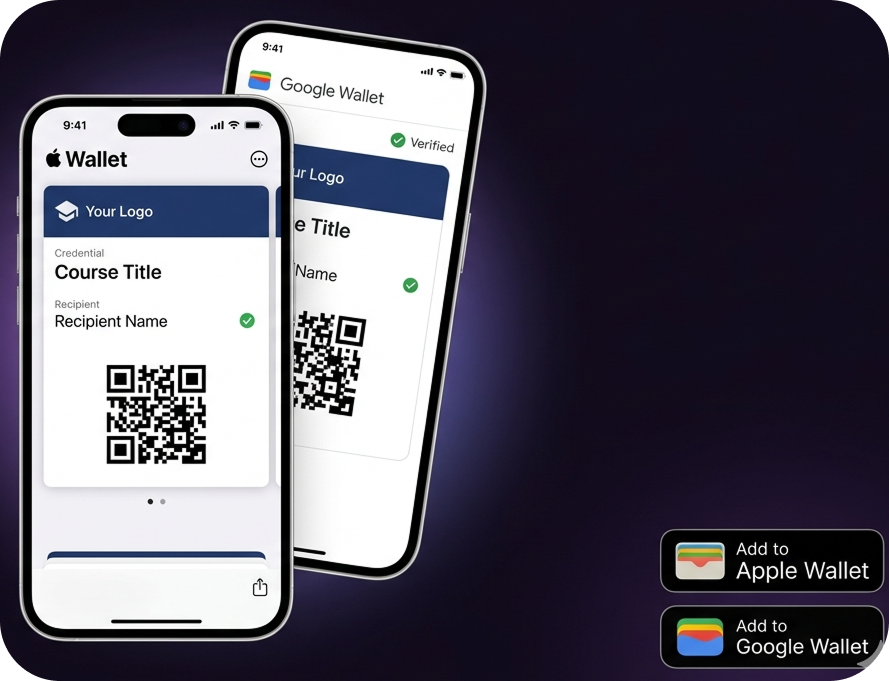
When applying for jobs, there is no need to scan and certify paper documents. A link or QR code is enough to give employers immediate access to the verified version. This significantly speeds up application processes.
Visibility in professional networks also benefits. Digital certificates can be shared on LinkedIn with a single click. There, they showcase qualifications earned and increase the chances of being found by recruiters.
The EU is actively driving the standardization of digital educational credentials. Under the eIDAS 2.0 Regulation (EU 2024/1183), all member states must provide an EU Digital Identity Wallet by December 31, 2026, in which digital credentials can be stored and shared.
In addition, Open Badges 3.0 and the W3C Verifiable Credentials Data Model create a technical framework for cryptographically signed, portable credentials. The European Commission's Europass portal also supports unified, tamper-proof educational credentials. For German universities, investing in digital certificates pays off twice: they meet European standards and are already prepared for future wallet-based workflows.
For more information, read: Open Badges 3.0: What is the status in 2026
Introducing digital certificates starts with choosing a suitable platform. Important criteria are security standards, the ability to integrate with existing systems, and user-friendliness for administrative staff. A pilot project with one faculty or a single degree program helps to test processes and gather feedback before rolling out the solution across the entire university.
Virtualbadge.io offers universities:
Digital certificates are changing the way German universities issue, manage, and verify degrees. They provide protection against forgery, reduce administrative effort, and facilitate Europe-wide recognition. For students, they mean greater flexibility and visibility. With Virtualbadge.io, universities can transition step by step and benefit from proven solutions for security, scalability, and integration.
Would you like to see how this could work at your university? Book a free demo and find out how you can issue degrees and certificates digitally in a secure, scalable, and Europe-wide recognized way.
What is the difference between digital certificates and scanned paper documents?
A scanned document is merely an image of the original without security features. Digital certificates contain cryptographic signatures that make any subsequent change detectable. Certificates issued with Virtualbadge.io additionally provide QR codes for instant verification.
How secure are digital certificates against forgery?
Digital certificates use cryptographic methods that make manipulation nearly impossible. Any change to the document invalidates the signature. Virtualbadge.io stores the data in encrypted form and enables verification around the clock.
Can students share their degrees when applying for jobs?
Yes, students simply send a link or QR code to employers. With Virtualbadge.io, certificates can also be shared directly on LinkedIn or integrated into digital wallets.
What costs are involved in introducing digital certificates?
The costs vary depending on the platform and volume. In the long term, however, universities save significantly through the elimination of printing, mailing, and archiving costs. Virtualbadge.io offers scalable plans that grow with the certificate volume and contain no hidden fees.
* You can find the organisation ID in the URL when you access your LinkedIn Company page as an admin.


Marketing

Jul 7, 2026

5 min
A note on how we write: we use AI tools to help with research and drafting. Every article is then reviewed, edited and fact-checked by someone on the Virtualbadge.io team before it goes live. The final word is always human.

Use Virtualbadge.io to design and send digital certificates that create trust - in less than 10 minutes.
%20(1).svg)