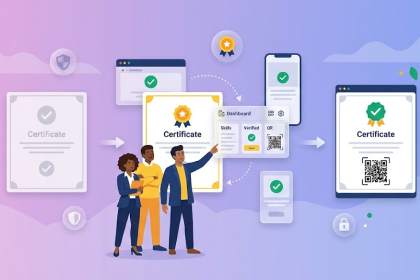
No user accounts required for your recipients -
Start your 7-day free trial now!

How Safety Training Providers Can Issue Mobile Wallet Credentials that Improve Verification, Reduce Administrative Work, and Support Compliance


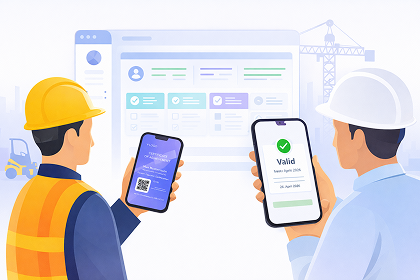
Digital credential cards for safety trainings are secure, mobile-ready certifications that participants can store in Apple Wallet or Google Wallet. Instead of carrying a plastic card or printed certificate, a forklift operator or heavy machinery trainee can present proof of qualification directly from a smartphone.
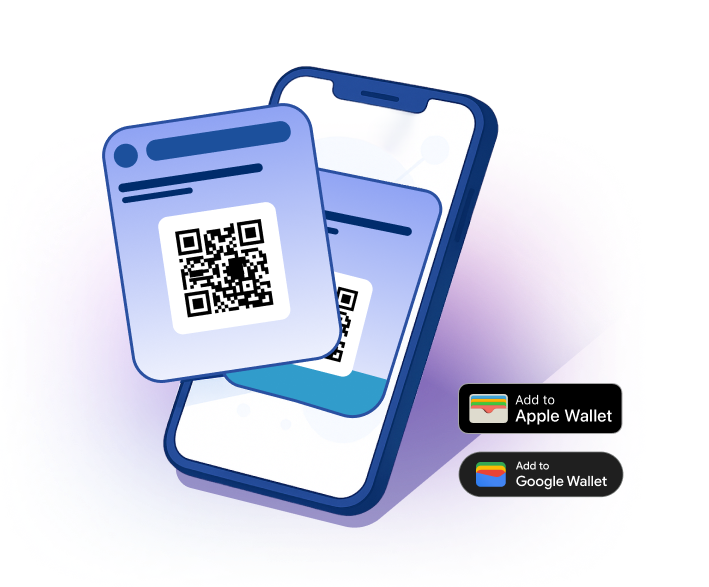
Unlike static PDFs, digital credential cards are connected to a live verification record. Each credential typically includes:
For safety training companies, this is not about social media visibility. It is about operational reliability. Supervisors on a construction site can scan a QR code and instantly confirm whether a credential is valid and up to date. Scanning the QR code leads directly to the credential’s validation page, which displays detailed certification information and can include the recipient’s profile picture for additional identity verification. Administrators can track issued certifications in a central system, rather than relying on spreadsheets or manual filing.
In short, digital credential cards turn safety certifications into verifiable, manageable, and mobile proof of competence.
Many safety training providers still rely on printed cards or PDF certificates. While this approach has worked for years, it creates recurring operational challenges.
Physical cards are easily lost, damaged, or forgotten. When a worker shows up on site without proof of training, supervisors must either delay work or make phone calls to verify credentials. This costs time and increases compliance risk.
PDF certificates present a different problem. They can be forwarded, altered, or reused without proper validation. Without a live verification page, it is difficult to confirm authenticity or check whether the credential has expired.
Common challenges include:
For safety and heavy machinery training providers, these inefficiencies create administrative burden and potential liability. As training volumes grow, managing credentials manually becomes increasingly difficult to scale.
Wallet-ready certifications, such as those offered through Virtualbadge.io’s Digital Wallet Cards feature, are designed to support operational reliability, compliance control, and efficient credential management in safety and heavy machinery training
These digital wallet cards can be added directly to Apple Wallet or Google Wallet, allowing trainees to present their certification instantly on site. At the same time, each card is connected to a live verification record controlled by the issuing organization.
This creates clear business advantages:
For example, when a forklift operator presents a wallet credential on a construction site, a supervisor can scan the QR code and immediately confirm its validity and expiration date. No phone calls, no manual lookup, no uncertainty.
By implementing wallet-ready digital credential cards, safety training providers strengthen compliance processes while reducing administrative overhead and scaling their operations more efficiently.
Implementing digital credential cards does not require a complete overhaul of your training process. In most cases, it starts with structuring your credentials and defining clear issuance workflows.
First, identify your credential types. For example:
Next, define what information each credential must include. This typically covers training scope, validity period, instructor details, and compliance notes.
Once the structure is defined, you can:
After each course completion, credentials are issued digitally. Participants receive a secure link and can add the card to their wallet in seconds.

Internally, your team gains access to a live database. If a participant loses access, you resend the credential with one click. If regulations change, you update the credential structure moving forward.
The result is a streamlined, scalable system that supports both operational efficiency and regulatory accountability.
Consider a regional forklift and heavy machinery training provider that issues several thousand certifications per year. Participants receive laminated plastic cards. When a card is lost, the provider has to manually verify training records, print a replacement, and send it by mail. Expiration tracking is handled in spreadsheets, which makes audit preparation time consuming.
After introducing wallet-ready digital credentials, the process changes significantly. Participants receive a secure digital credential that can be added directly to Apple Wallet or Google Wallet.
Internally, the provider benefits from:
Virtualbadge.io has already helped organizations digitize complex training certificate workflows by centralizing data collection, approval, and issuance processes. Applying the same structured approach to wallet-ready credentials allows safety training providers to eliminate manual steps and gain full visibility across their certification operations. For more information, visit our Virtualbadge.io success story page
For safety training providers, digital credential cards are a practical upgrade, not a marketing feature. They replace plastic cards and static PDFs with secure, wallet-ready credentials that can be verified instantly on site.
Instead of managing spreadsheets and reprinting lost cards, your team works from a centralized system that tracks validity, supports renewals, and documents compliance.
If you want to modernize your certification process and reduce administrative overhead, schedule a free demo with Virtualbadge.io.
See how digital wallet credentials can fit into your existing training workflow and give you full control over issuance, validation, and expiration management.
Book your free demo to see how your training credential process can become more efficient and compliant with modern digital credential technology.
* You can find the organisation ID in the URL when you access your LinkedIn Company page as an admin.


Marketing

Mar 3, 2026

6 min
A note on how we write: we use AI tools to help with research and drafting. Every article is then reviewed, edited and fact-checked by someone on the Virtualbadge.io team before it goes live. The final word is always human.

Use Virtualbadge.io to design and send digital certificates that create trust - in less than 10 minutes.
%20(1).svg)