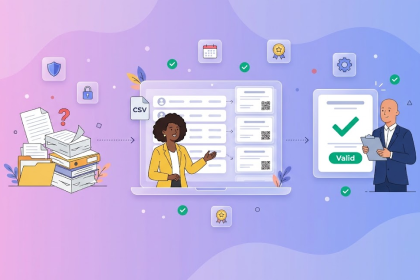
No user accounts required for your recipients -
Start your 7-day free trial now!

How Training Departments Use Virtualbadge.io to Make Certificates Verifiable, GDPR-Compliant, and Visible for Employees



Enterprise training departments face a clear task. Employee certificates must be issued quickly, verifiable beyond doubt, and attractive enough for recipients that they actually get shared. At the same time, compliance requirements need to be met and the administrative effort for the training department should stay as low as possible. Virtualbadge.io combines these requirements in a single platform and replaces manual PDF workflows and Excel lists with automated, secure processes. This guide shows four key building blocks that those responsible for certification and corporate training should pay attention to in 2026, from verification to automating large volumes of certificates.
Every certificate issued through Virtualbadge.io receives a unique QR code and its own validation page. Auditors, customers, or future employers can confirm authenticity in seconds, without having to contact the HR department. Cryptographic signatures ensure that any subsequent change to the certificate is immediately detectable.
For companies with high compliance requirements, the validation page can also be hosted in the company's own corporate design on its own domain. This strengthens trust in internal training programs and makes the company's own brand visible at every check. A practical example: if a new employer inquires about a compliance certificate, the training department no longer has to search manually through archives. The link to the validation page is enough to provide full confirmation.
%201.png)
Benefits of digital verification:
When employees share their certificate on LinkedIn, the training department automatically reaches their entire professional network. Virtualbadge.io optimizes this step with ready-made post texts and matching hashtags, so recipients can publish their certificate in two clicks without having to write anything themselves. No separate user account is required for this.
Consultant Richard van der Blom uses exactly this mechanism to make his LinkedIn certificates measurably more visible and to introduce his training programs to a wider audience. More details are available in the case study.
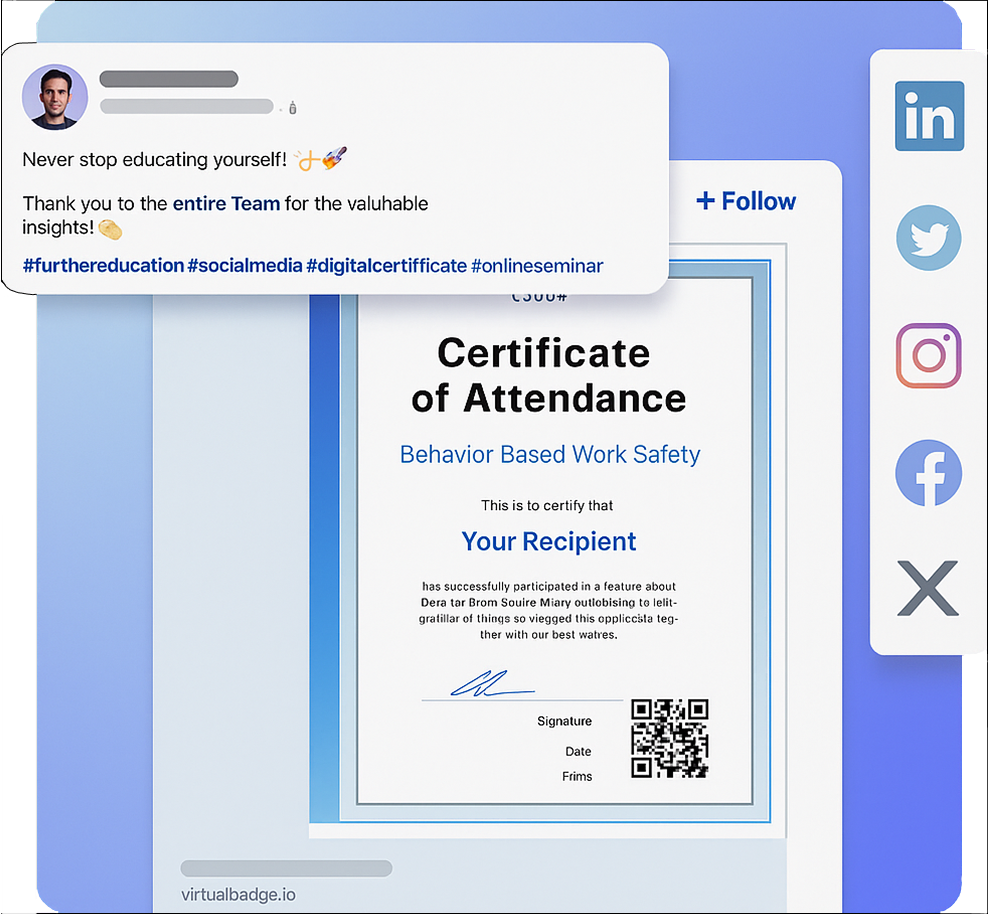
Why LinkedIn sharing matters for training departments:
For European companies, data protection is a basic requirement, not an optional extra. Virtualbadge.io stores data on European servers and evaluates usage statistics exclusively in anonymized form, GDPR-compliant from the ground up.
At the same time, the regulatory framework for digital credentials is changing noticeably. The eIDAS 2.0 regulation requires EU member states to provide at least one compliant EU Digital Identity Wallet by the end of 2026. Details on this are published by the European Commission.
What compliance managers should keep in mind in 2026:
Manually filling out certificates costs training departments unnecessary time when employee numbers are high. Through CSV import, hundreds or thousands of certificates can be issued in a single process.
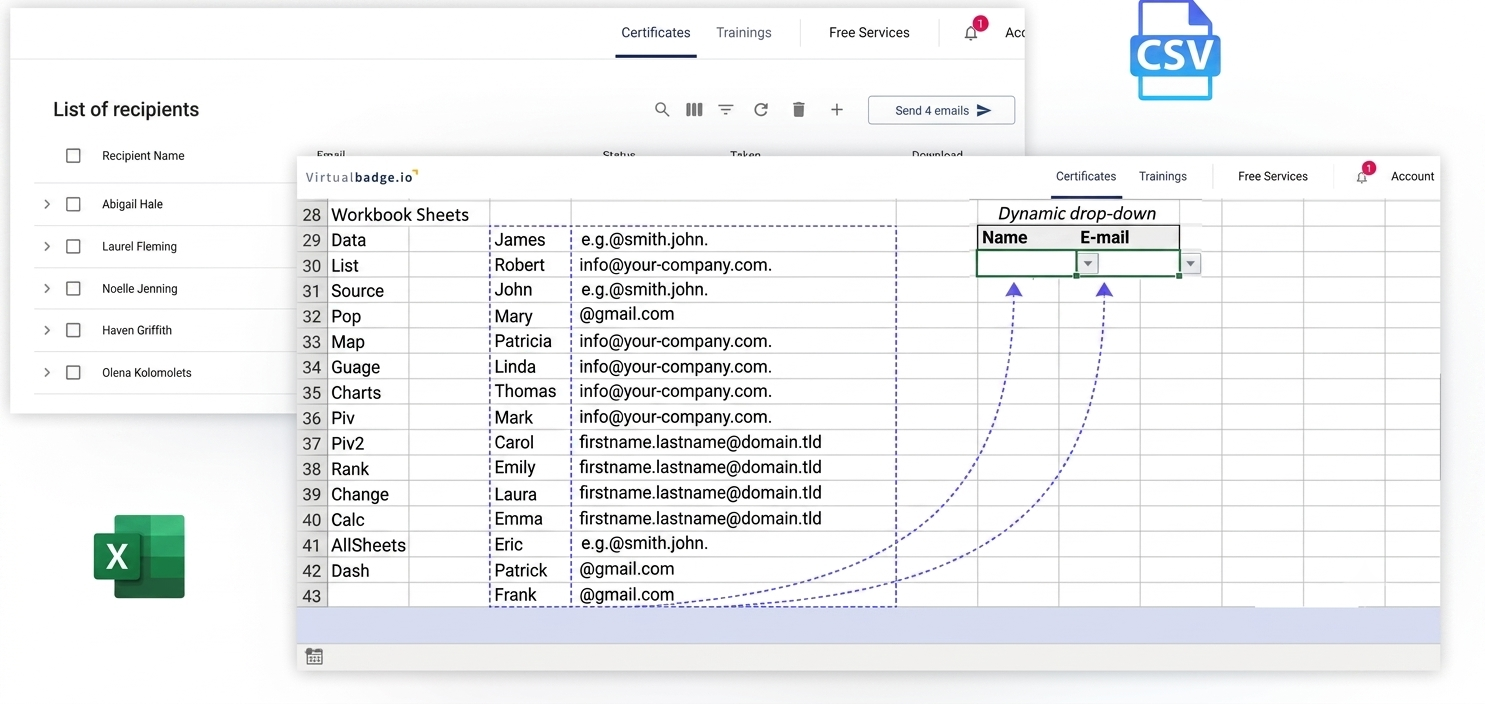
The REST API and a Zapier connection to several thousand apps additionally make it possible to automatically send certificates directly after a training course is completed.
For in-person training sessions, the trainer module offers a QR-code-based attendee list. Participants scan the code, enter their own data, and after approval by the trainer, the certificate is sent automatically, with no manual follow-up work needed after the training. Especially for recurring mandatory training such as workplace safety or first aid, this saves several hours of administrative work every week.
Automation features at a glance:
For enterprise training departments, digital certificates have long been more than just a digital PDF. They are a credential that can be verified, shared, and managed automatically, without HR or trainers having to intervene manually at every step. Virtualbadge.io combines verification, compliance, social media visibility, and automation in a single platform that can be set up in just a few hours and grows along with the company's certificate volume.
Test Virtualbadge.io for your training program and schedule a free demo to see how quickly your certificate processes can be digitized.
* You can find the organisation ID in the URL when you access your LinkedIn Company page as an admin.


Marketing

Aug 26, 2026

4 min
A note on how we write: we use AI tools to help with research and drafting. Every article is then reviewed, edited and fact-checked by someone on the Virtualbadge.io team before it goes live. The final word is always human.

Use Virtualbadge.io to design and send digital certificates that create trust - in less than 10 minutes.
%20(1).svg)