No user accounts required for your recipients -
Start your 7-day free trial now!

How education providers reduce administrative work and build trust with automated issuance, QR validation, and wallet integration



Automated certificate issuance describes a digital process in which certificates are created and sent based on predefined rules, for example after a successful course completion, a passed exam, or confirmed attendance at a webinar. Instead of manual review and individual sending, issuance happens automatically as soon as the criteria are met.
Manual processes work well with small numbers of participants, but quickly become a bottleneck once an education provider grows. Lists must be checked, names transferred correctly, and emails sent individually, which encourages typos, delays, and inconsistent design. At the same time, participants today expect immediate access to verifiable digital credentials that they can share directly on LinkedIn or present to employers, not days after the course ends.
An automated certificate process follows a clear structure and, after a one time setup, runs without manual intervention:
Depending on the technical infrastructure, a REST API is available for custom integrations, no code automation via Zapier, or a simple CSV import for bulk issuance. With Virtualbadge.io's integrations, completion data can be transferred directly from existing systems into the certificate process, so names, dates, and course titles are transferred correctly and the process scales without additional effort.
A digital certificate is only trustworthy if its authenticity can be verified. Every certificate is given a unique QR code that, when scanned, opens a validation page showing the name, course title, issuing organization, and validity.
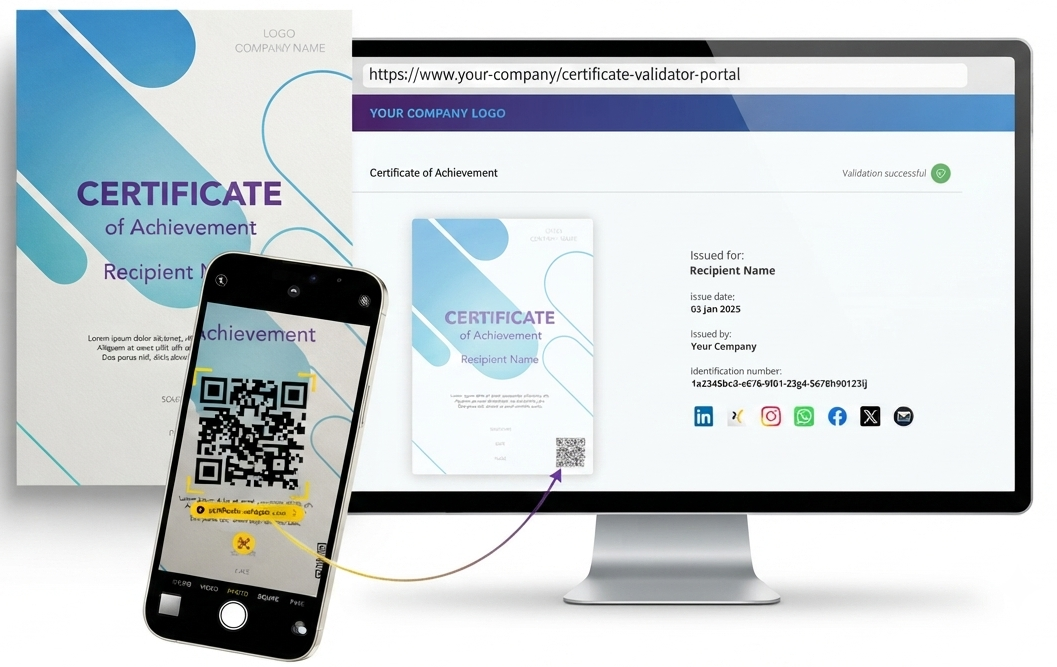
For a fully white label experience, these pages can be hosted directly on the education provider's own domain, including logo, colors, and fonts in their own corporate design. This strengthens brand perception and builds additional trust with employers and examining bodies.
Regulated areas such as first aid training or language certificates are also subject to special requirements for documentation. The GDPR requires that only necessary data is collected, validation pages are protected from search engine indexing, and recipients have the right to have their data deleted. In Germany, digital certificates are already officially recognized in several of these areas, provided their authenticity can be demonstrated through QR codes and validation pages.
A certificate stored on a smartphone gets used more often than a PDF sitting in an email archive. After completing a course, participants receive a download link, which opens the wallet app on iPhone or Android, and they add their certificate with a single tap. If needed, they can show the QR code directly from the wallet for verification.
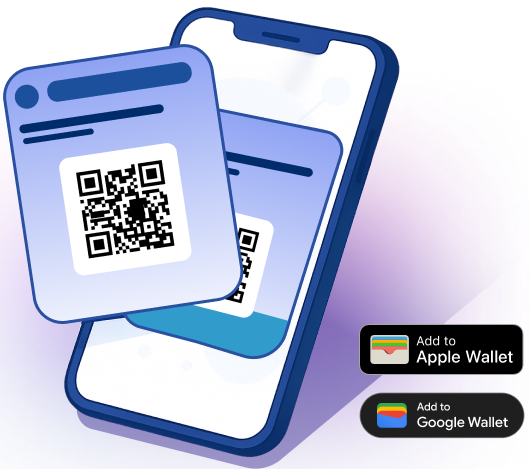
This reduces support requests, since credentials no longer get lost, and expiration dates can trigger automatic renewal reminders. Virtualbadge.io supports issuing certificates for Apple Wallet and Google Wallet directly from the platform.
The success of a certificate strategy can be measured using concrete metrics:
Automated certificate issuance is more than a technical upgrade, it is a strategic decision for efficient processes, satisfied participants, and stronger brand perception. Education providers benefit from reduced administrative work, immediate delivery of credentials, verifiable certificates, and wallet integration for mobile availability.
The first step is analyzing your current processes: Where does manual work occur, and which integrations fit your infrastructure?
Book a free demo and automate your certificate process with Virtualbadge.io within a few days.
What does it cost to introduce automated certificate issuance?
Costs depend on the scope of features and the number of certificates issued. Virtualbadge.io makes it easy to get started with a free trial.
Can existing paper certificates be digitized?
Yes, by capturing the relevant data and using suitable templates. Virtualbadge.io supports CSV import for bulk digitization of existing credentials.
Are digital certificates recognized by employers and authorities in Germany?
Increasingly, yes, particularly in areas such as first aid training and language exams. For questions about recognition by a specific authority, the Virtualbadge.io team can be contacted directly to clarify this for the relevant use case.
What data is needed to issue a certificate?
At minimum, the recipient's name and email address, along with the course title. Depending on requirements, fields such as exam date or expiration date can be added, in line with data minimization under GDPR.
* You can find the organisation ID in the URL when you access your LinkedIn Company page as an admin.


Marketing

Aug 18, 2026

5 min
A note on how we write: we use AI tools to help with research and drafting. Every article is then reviewed, edited and fact-checked by someone on the Virtualbadge.io team before it goes live. The final word is always human.

Use Virtualbadge.io to design and send digital certificates that create trust - in less than 10 minutes.
%20(1).svg)