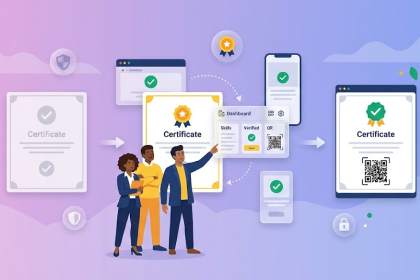
No user accounts required for your recipients -
Start your 7-day free trial now!

How Digital Badges Transform Learning Achievements into Verifiable, Career-Ready Credentials


Education and professional training are changing rapidly. Skills are updated faster, learning formats are becoming shorter, and employers expect clear proof of competencies. In this context, digital badges have become a practical and credible alternative to traditional certificates.
Unlike paper documents or static PDFs, digital badges are built for online use. They are issued digitally, contain verifiable data, and can be shared easily across professional platforms. Each badge explains who issued it, what was achieved, and under which criteria. This transparency makes achievements easier to understand and trust.
For training providers, universities, and certification bodies, digital badges offer clear advantages:
For learners, badges turn completed courses into visible proof of skills. For employers, they reduce uncertainty when evaluating qualifications.
To explore the fundamentals of digital badges and why they are becoming a standard in modern education, read: Digital Badges Explained
Every digital badge starts with a clear definition of value. A badge is only as strong as the meaning behind it. If it is unclear what a badge represents, it quickly loses relevance.
Effective badge creation focuses on clarity and structure. A well-designed badge includes:

Specificity matters. A badge that highlights concrete skills or competencies is far more useful than a generic participation badge. Learners benefit because they can communicate their abilities clearly. Employers benefit because they can quickly assess what someone is capable of.
When created thoughtfully, a digital badge becomes a reliable signal of competence. It sets the foundation for issuance, sharing, and long-term career impact later in the badge lifecycle.
Once a digital badge is created, the next step in its lifecycle is issuance. This is the moment when learning outcomes are transformed into an official, personal credential for the recipient. A smooth and reliable issuance process is critical, because it directly shapes how learners perceive the value of their achievement.
Digital badges are typically issued after clearly defined milestones, for example course completion, passing an exam, or demonstrating a practical skill. Modern credentialing platforms allow organizations to issue badges both individually and in bulk, which is especially important for training providers working with large groups.
Key aspects of effective badge issuance include:
Distribution usually happens via email, where recipients receive a personal link to their badge. From there, they can store it, manage it, and decide how they want to use it. A positive user experience at this stage increases acceptance and encourages sharing.
A digital badge reaches its full potential when it is shared and verified. This is where it becomes more than a certificate. It becomes a visible and trusted signal of competence.
Recipients can share their badges on platforms such as LinkedIn, in digital resumes, email signatures, or personal portfolios. Each shared badge links back to a verification page that displays the embedded metadata. This allows employers and other third parties to instantly confirm authenticity.
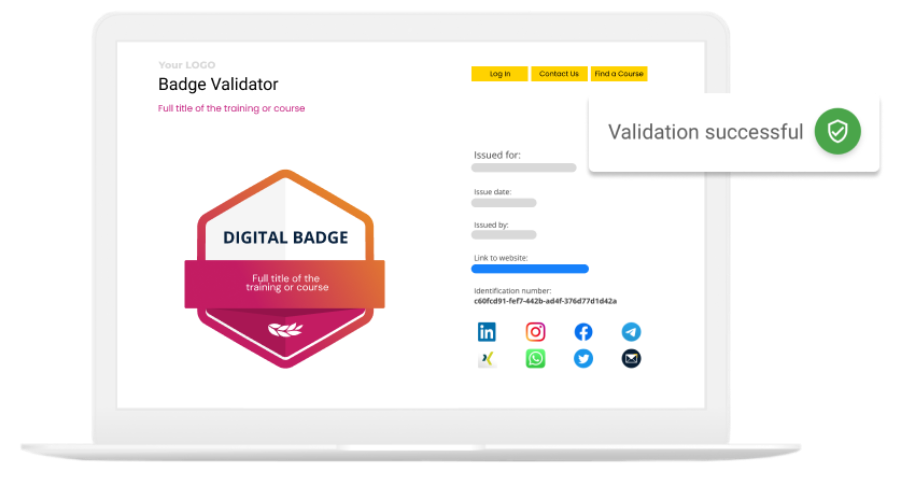
Verification is essential for trust. Digital badges provide:
For employers, this simplifies recruitment and skill assessment. For issuers, it strengthens credibility and brand presence. Every shared badge acts as a digital reference to the organization that issued it.
To take a closer look at how verification and embedded data build trust in digital credentials, read: Digital Badges Build Trust: Verifiable Credentials Explained
The final stage in the lifecycle of a digital badge is its impact over time. This is where digital credentials show their true value. A badge is not just a record of past learning. It becomes an active asset that supports professional development and career progression.
Digital badges help learners present their skills in a clear and modern way. Instead of listing course titles, they can showcase verified competencies. This is especially relevant in job markets where employers focus on practical skills rather than formal degrees alone.
Key long-term benefits for learners include:
For employers, digital badges simplify evaluation. Verified credentials reduce uncertainty and make it easier to compare candidates based on real skills. For education and training providers, badges strengthen relationships with learners even after a course ends.
To read more about how digital badges support long-term learning, read: Digital Badges for Continuing Education: How to Certify and Showcase Lifelong Learning
If you want to explore how digital badges and certificates can work for your organization, the next step is simple.
Schedule a free demo and see how Virtualbadge.io helps you create, issue, and manage digital credentials efficiently and at scale.
* You can find the organisation ID in the URL when you access your LinkedIn Company page as an admin.


Marketing

Feb 18, 2026

5 min
A note on how we write: we use AI tools to help with research and drafting. Every article is then reviewed, edited and fact-checked by someone on the Virtualbadge.io team before it goes live. The final word is always human.

Use Virtualbadge.io to design and send digital certificates that create trust - in less than 10 minutes.
%20(1).svg)