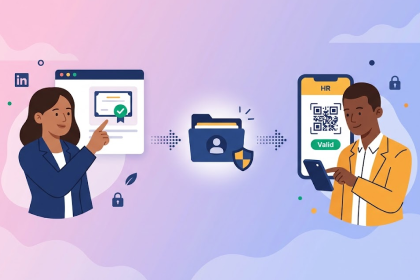
No user accounts required for your recipients -
Start your 7-day free trial now!

How education providers digitize continuing education certificates to make them tamper proof, from choosing a provider to automation and scaling across multiple locations.


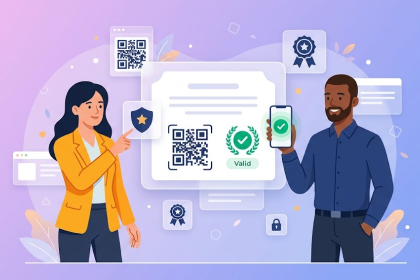
Paper certificates can be copied, altered, and verified only with considerable effort, a problem that directly affects accredited continuing education programs. Anyone responsible for accreditation or quality management risks the credibility of the entire organization as a result. This is exactly where digital certificates for continuing education programs come in: they are issued tamper proof and can be verified in real time. Virtualbadge.io gives education providers the right tools to approach this shift in a structured way. This article shows what matters when it comes to selection, implementation, and scaling.
Clarity about your own starting point comes at the beginning of every transition. This includes taking stock of all certificate types issued, from language certificates to CPD records to professional qualifications, as well as a look at regulatory frameworks such as GDPR requirements and industry specific accreditation guidelines.
On this basis, the market for digital credentials can be narrowed down in a targeted way. Four criteria are decisive here:
Virtualbadge.io offers a free 7-day trial for this.
For more information, read: What Is Digital Accreditation in Certification?
A certificate conveys the identity of the issuing organization, which is why logo, brand colors, and accreditation information belong directly in the template. Dynamic fields automatically populate participant name, course date, and certificate ID, and Virtualbadge.io's drag and drop editor requires no design skills to do so.
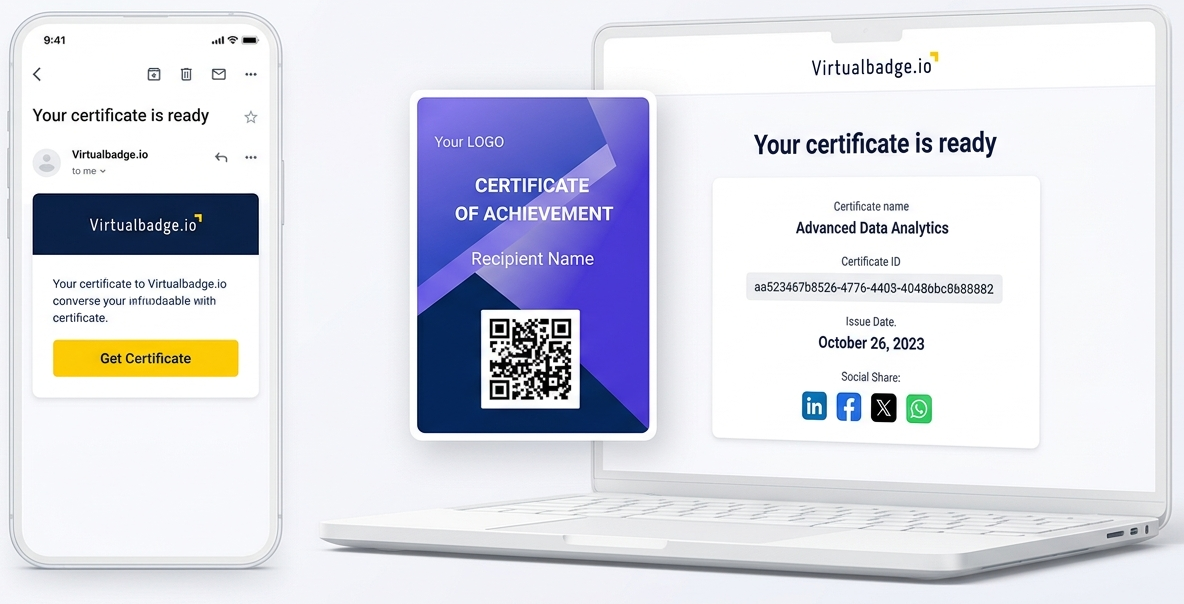
Separate templates for each program type also ensure that every certificate contains the right information.
Manual data entry costs time and produces errors, which is why connecting existing systems pays off:
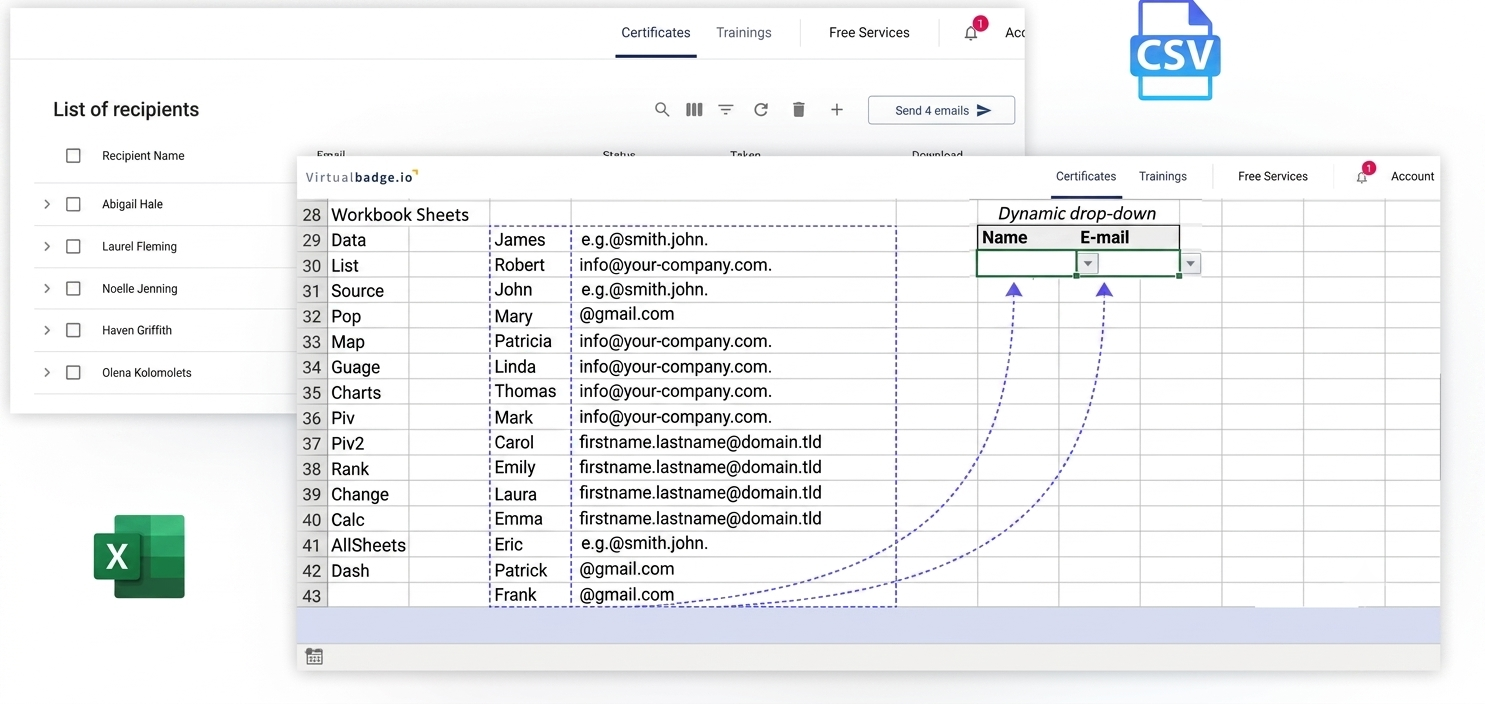
As soon as a course is completed, certificates are generated automatically and sent to participants by email, with no manual steps in between.
A tamper proof certificate needs a way to be checked that anyone can use, whether through a QR code, a link, or an embedded verification form on your own website. Virtualbadge.io secures every certificate with a cryptographic signature for this purpose.

QR code validation checks a certificate against a central database in real time and is straightforward to set up. Blockchain based validation, by contrast, stores data in a decentralized way, which makes subsequent changes technically almost impossible, though at higher cost and with a longer setup time. For most education organizations, QR code validation combined with cryptographic signatures therefore remains the more practical choice.
With the European eIDAS 2.0 regulation, a uniform legal framework for digital identities and verifiable credentials is emerging, which means certificates based on open standards such as W3C Verifiable Credentials will be more easily recognized across the EU.
A single continuing education program works well as a starting point, allowing you to follow issuance live and observe how participants receive, share, and have their certificates verified. Three groups provide the most important insights:
Metrics such as certificates claimed, LinkedIn shares, and visits to the validation page provide a solid basis for the next step. If the pilot project runs successfully, digital certificate issuance expands to all programs, with a dedicated template for each certificate type and automated assignment. Organizations with multiple locations benefit from central control combined with decentralized issuance, for example through the Organization Hub, which connects central templates and branding guidelines with independent issuance at individual locations. Regular audits keep the quality of the templates and the function of the validation page secure over the long term.
Virtualbadge.io was built specifically for the secure issuance and validation of accredited certificates. Every certificate is cryptographically signed and can be checked via QR code, link, or verification form on your own validation page. The platform supports W3C Verifiable Credentials and Open Badges 2.0 or 3.0, stores data on European servers, operates in compliance with GDPR, and is prepared for eIDAS 2.0.
Try Virtualbadge.io free for 7 days or book a personal demo to discuss your requirements in detail.
What does tamper proof certificate issuance mean?Every certificate receives a cryptographic signature, so any subsequent change is immediately detectable.
How does real time validation of a digital certificate work?The verifier scans the QR code or opens the validation page, the system compares the data in real time, and immediately shows whether the certificate is valid.
* You can find the organisation ID in the URL when you access your LinkedIn Company page as an admin.


Marketing

Sep 28, 2026

5 min
A note on how we write: we use AI tools to help with research and drafting. Every article is then reviewed, edited and fact-checked by someone on the Virtualbadge.io team before it goes live. The final word is always human.

Use Virtualbadge.io to design and send digital certificates that create trust - in less than 10 minutes.
%20(1).svg)