No user accounts required for your recipients -
Start your 7-day free trial now!

A practical guide to how compliance records land automatically in the personnel file, stay verifiable, and hold up to audits


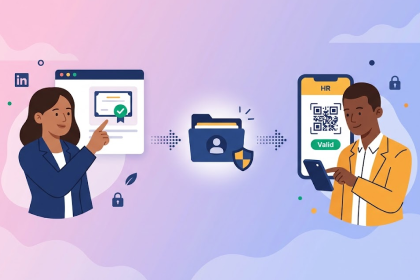
A compliance training course has been completed, the participant has passed, and then the record usually disappears as a PDF attachment in an inbox or as a single line in a spreadsheet. The personnel file quietly goes out of date, and by the time an audit comes around, there is no quick overview. Virtualbadge.io closes exactly this gap: the platform connects digital certificates directly to your HR system, so qualification data arrives where personnel decisions are actually made. The guide below shows step by step how this connection works in practice.
Before any system is connected to another, it pays to take stock: which trainings actually need a digital record? These usually include mandatory courses on workplace safety, data protection, or industry-specific requirements. Just as important is the question of which data fields a certificate should ultimately carry.
The more precisely these rules are defined from the start, the less manual rework is needed later once automation is running in production.
Between the learning management system and the HR software, there needs to be a connecting layer, and this is exactly the role the certificate platform plays. When choosing one, what matters most is REST API access, a working Zapier integration, GDPR-compliant data storage, and customizable validation pages.
The next step is creating a certificate template in your own corporate design with dynamic fields that are automatically populated from participant data at every issuance, such as name, course, date, and a unique certificate ID.
For more information, read: Integrating Digital Accreditation into HR and LMS
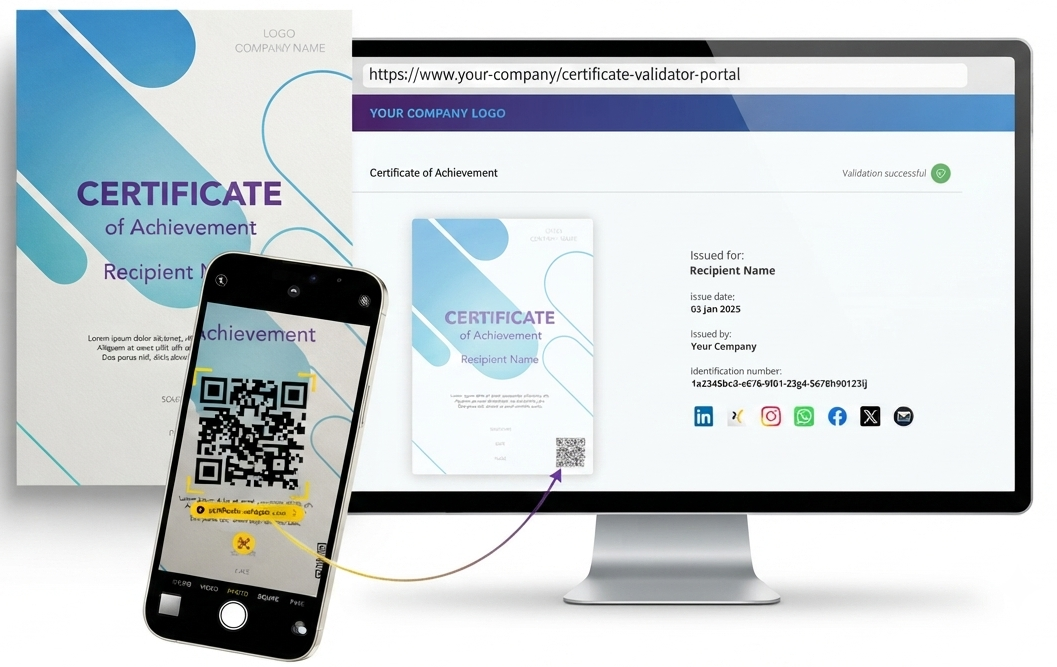
Whether a certificate is genuine should be clear within seconds, for example through a QR code or a dedicated validation page. This lets supervisors, auditors, or external partners confirm authenticity themselves at any time. In addition, an audit trail should log every issuance, every access, and every status change without gaps.
Because certificates contain personal data such as names and employee IDs, GDPR applies here. It must therefore be documented which data is collected, how long it is stored, and who has access to it.
How relevant this topic is shows in the 2025 Continuing Education Study by Bitkom Akademie: 86% of employees see continuing education as a natural part of their working life, but only 49% of companies have a clear strategy for it. This is exactly where audit-ready digital records provide the necessary structure.
The best way to start is with a single training course or department, where the entire process can be observed: course completion, certificate creation, delivery, and personnel file updates. Feedback from HR, IT, and participants usually leads to adjustments in field labels or email templates.
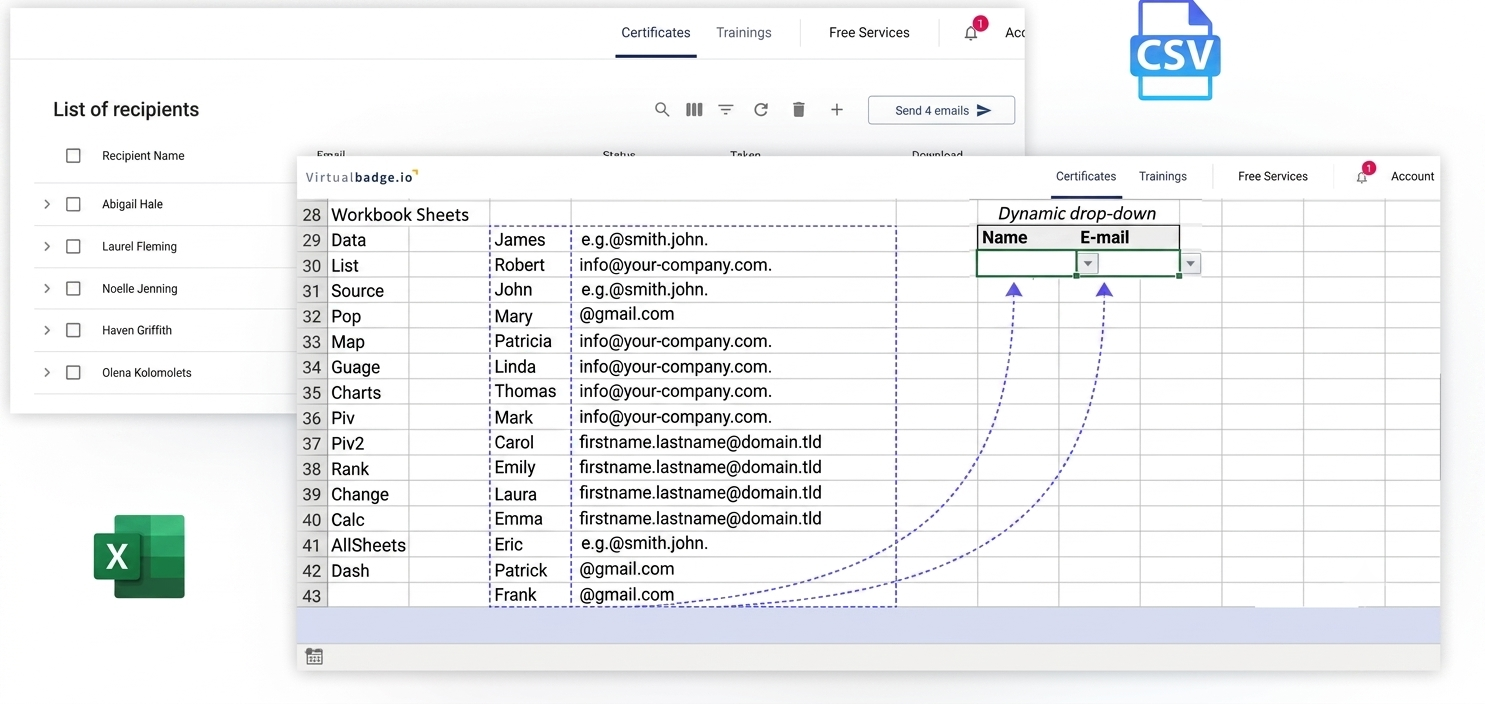
Once the pilot is in place, the real challenge shifts toward scaling. A CSV export that still works smoothly with 50 participants quickly becomes a source of errors at 500 or 5,000.
This keeps the workforce's qualification status current without every single expiration date having to be monitored manually.
Virtualbadge.io is a platform for tamper-proof digital certificates and Open Badges that can be integrated into an existing system landscape via REST API or Zapier.
More than 1,000 organizations already rely on Virtualbadge.io and have issued over 10 million certificates together. How strongly automated issuance makes itself felt in everyday work can be seen across various success stories. Read our success stories here.
Schedule your free demo now and see for yourself how easily Virtualbadge.io connects digital certificates with your HR system.
How long does it take to integrate a certificate platform with an HR system?
A Zapier connection is often set up within a few hours, while individual API integrations tend to take a few days depending on the system landscape. Since Virtualbadge.io offers both REST API access and a Zapier connection, getting started is possible even without your own development team.
Is the personal data being transferred protected in a GDPR-compliant way?
Yes, provided the platform processes data on EU servers, encrypts transmission, and offers a data processing agreement. Virtualbadge.io meets these criteria.
Can already completed trainings be digitized retroactively?
Yes, a CSV import lets you upload recipient lists for past courses as well, so digital certificates with a unique ID and validation link can be created retroactively.
* You can find the organisation ID in the URL when you access your LinkedIn Company page as an admin.


Marketing

Sep 28, 2026

6 min
A note on how we write: we use AI tools to help with research and drafting. Every article is then reviewed, edited and fact-checked by someone on the Virtualbadge.io team before it goes live. The final word is always human.

Use Virtualbadge.io to design and send digital certificates that create trust - in less than 10 minutes.
%20(1).svg)