No user accounts required for your recipients -
Start your 7-day free trial now!

Why instant verification and white-label validation decisively shape trust in digital certificates.


Real-time validation refers to the immediate verification of a digital certificate at the very moment of the request. Recipients or third parties scan a QR code or enter a unique certificate ID on a validation page. Within seconds, the system checks whether the certificate is authentic, valid, and unaltered.
For education providers, this process solves a central problem. Paper certificates are difficult to verify for authenticity. Employers, authorities, or partners have to make time-consuming inquiries or request copies. With real-time validation, this effort disappears. The result is a transparent proof that builds trust, both with the recipients and with any third party who wants to verify the qualification.
The technical flow of real-time validation is based on three components:
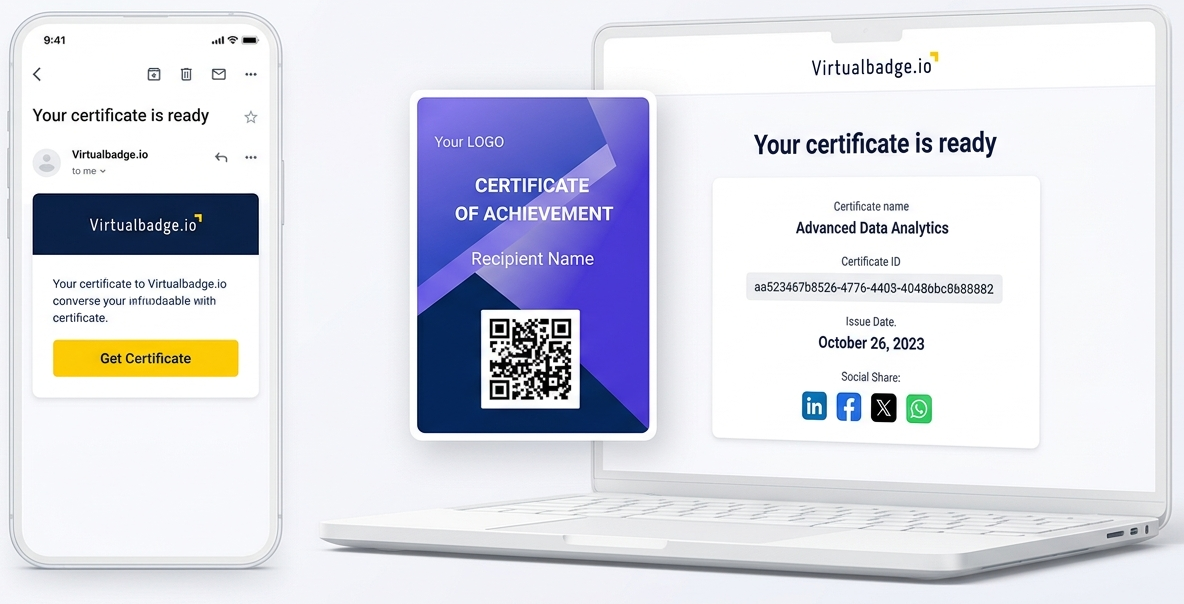
This architecture is future-proof and compatible with the upcoming EU Digital Identity Wallet.
White-label verification describes an approach where the validation page appears entirely in the education provider's own branding. Logo, colors, fonts, and even the domain remain consistent with the overall brand identity. The opposite would be validation on an external platform with foreign branding, which can undermine trust.
Trust is built through consistency. When a recipient validates a document and lands on a professionally designed page in the familiar design, it confirms legitimacy. Employers who verify a qualification immediately see that the institution takes security seriously.
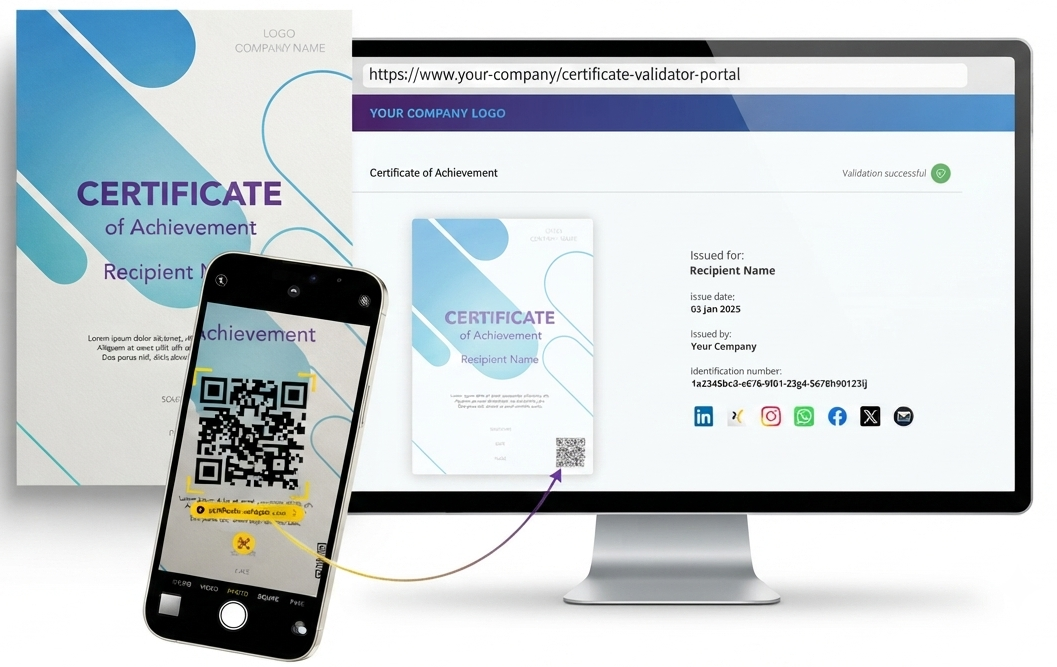
With the tamper-proof certificates from Virtualbadge.io, the validation page can be hosted directly on your own domain, so that every verification becomes a brand-consistent experience.
Certificate fraud is on the rise, especially since generative AI can produce deceptively realistic documents. Real-time validation makes fraud visible. Every legitimate certificate is stored in the system, a forged document is instantly identified as invalid. Additionally, the cryptographic signatures detect every subsequent alteration. This double layer of protection reliably safeguards education providers and their reputation.
At the same time, regulatory requirements are growing. The eIDAS 2.0 regulation obliges every EU member state to provide at least one EU Digital Identity Wallet by the end of 2026. Certificates must be machine-readable, verifiable, and recognized across Europe. Platforms that support the W3C standard and process data in a GDPR-compliant way on European servers are prepared for these developments.
For more information, read: eIDAS 2.0: What is coming for organizations in Europe
Virtualbadge.io enables education providers to introduce real-time validation without extensive IT projects. Certificates are designed in your own branding, automatically issued via CSV import, Zapier, or the API, and verified on a white-label validation page in the issuer's branding. Every certificate is ECDSA-signed, GDPR-compliant, and built on W3C Verifiable Credentials. The result is a secure, verifiable certificate that is at the same time a brand asset.
Request a free demo now and experience real-time validation in your own organization.
What is the difference between real-time validation and traditional verification?
Traditional verification requires manual inquiries with the issuer, often via email or telephone. Real-time validation enables instant verification via QR code or ID without any waiting time. Virtualbadge.io fully automates this process, so employers and authorities can confirm the authenticity of a certificate in seconds.
How secure are digitally signed certificates?
Digitally signed certificates use cryptographic methods that make any manipulation detectable. If the document is altered afterwards, validation fails. Virtualbadge.io automatically signs every certificate with ECDSA and thereby ensures that its integrity remains protected in the long term.
Can white-label validation pages be hosted on your own domain?
Yes. At Virtualbadge.io, the white-label option is part of the standard offering, so that the validation page can appear entirely in your own branding and on your own domain or subdomain.
Which certificate types are suitable for real-time validation?
All of them, in principle. Certificates of participation, qualification records, accreditations, and officially regulated documents such as first-aid certifications can all be covered, from Open Badges to regulated credentials.
How can education providers prepare for the EU Digital Identity Wallet?
The EU Digital Identity Wallet will require machine-readable, verifiable credentials. Education providers should rely on platforms that support W3C Verifiable Credentials. Virtualbadge.io is prepared for this development and ensures that certificates will continue to be recognized across Europe.
* You can find the organisation ID in the URL when you access your LinkedIn Company page as an admin.


Marketing

Jul 7, 2026

5 min
A note on how we write: we use AI tools to help with research and drafting. Every article is then reviewed, edited and fact-checked by someone on the Virtualbadge.io team before it goes live. The final word is always human.

Use Virtualbadge.io to design and send digital certificates that create trust - in less than 10 minutes.
%20(1).svg)