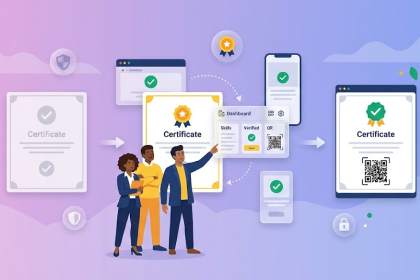
No user accounts required for your recipients -
Start your 7-day free trial now!

Why the dual structure of academic and practical phases increases the administrative burden of certificates and records even further, and how digital, tamper-proof certificates can offset that.


Dual-study universities combine academic theory phases with practical training periods at partner companies. This structure is pedagogically valuable, but it brings a double chain of records for administration. In addition to exam results and final transcripts from the examination office, practical confirmations, attendance records, and evaluations from practice partners must also be documented and archived.
In addition, many dual-study universities are organized across multiple campuses or locations, while numerous partner companies are involved in the training at the same time. Each location and each company often follows its own, historically grown procedures for certifications, which further fragments administration. Specifically, this affects:
This combination of decentralization and high issuance frequency makes paper based or purely manual processes particularly demanding at dual-study universities. Unlike at traditional universities, it is not enough to digitize a single internal system. The solution must also remain usable and traceable for practice partners outside the university, without requiring them to have their own accounts or training.
In everyday life, this additional burden shows up in several places. Examination offices must bring together records from theory and practice phases before a final transcript can be issued. This requires coordination with practice partners and can lead to delays. At the same time, the administration repeatedly receives requests for certified copies of lost records or records needed for job applications.
Typical friction points are:
For students, this often means waiting time until all records are available and a final document can be issued. For administration, it ties up capacity that is missing elsewhere, for example in managing new cooperation agreements with companies or developing dual-study programs further. The more partner companies and student cohorts run in parallel, the stronger this bottleneck affects the entire examination operation.
Digital certificate management addresses exactly this fragmentation. With Organization Hub by Virtualbadge.io, templates and approval processes can be defined centrally, while individual campuses or departments can issue certificates independently. This keeps governance with university leadership, without every location having to build its own procedures.
As soon as grades are recorded at the examination office or practical confirmations are approved, issuance can be automated:
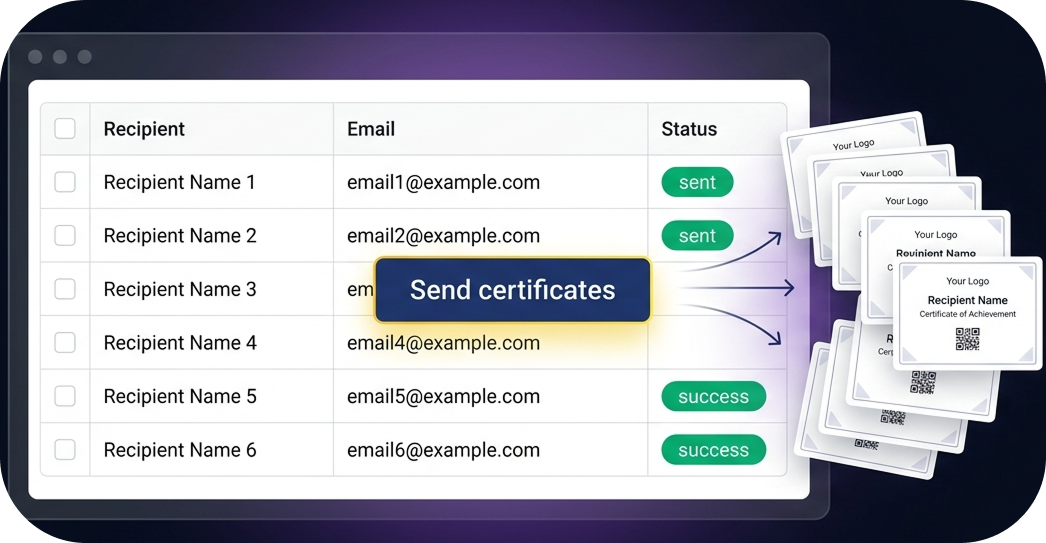
A practical example of automated certificate workflows is provided by a medical device manufacturer that fully automated the issuance of training records for on-site training, which you can read about in the success story of IMN Training. The same principle can be applied directly to the collaboration between the examination office and practice partners at dual-study universities.
For individual campuses or departments, this specifically means that they continue working with the templates and procedures they are familiar with, while university leadership simultaneously retains an overview of all issued certificates. This noticeably reduces coordination loops between central administration and decentralized locations.
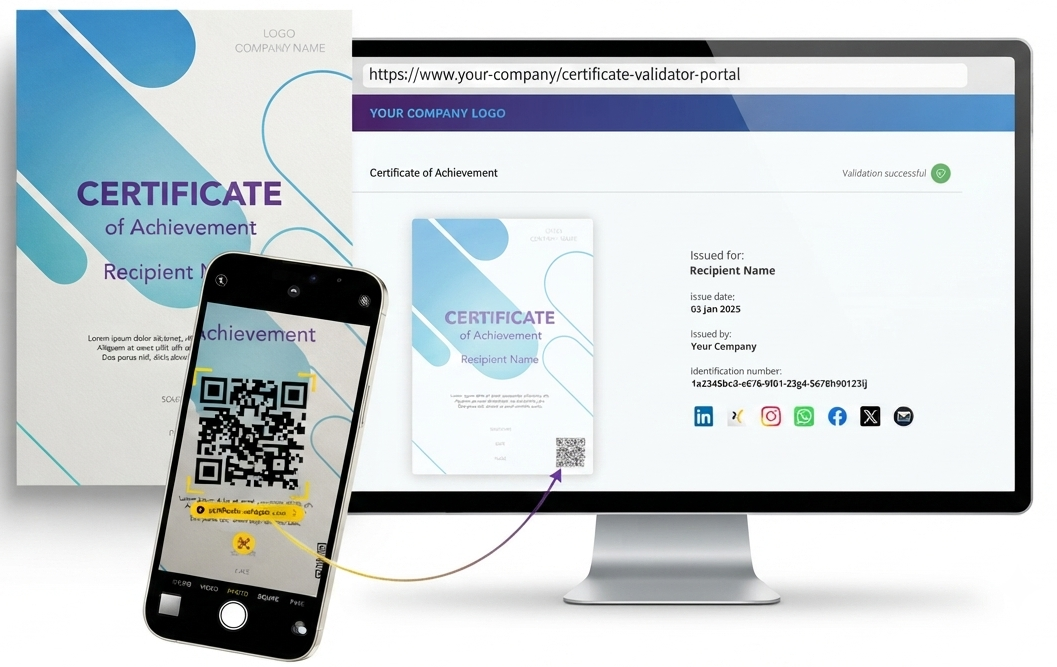
Trust in the authenticity of a record is particularly important for dual degrees, since both academic institutions and employers review the documents. Cryptographically signed certificates can be verified at any time via a dedicated validation page. Any subsequent alteration of the document invalidates the signature, which reliably reveals attempts at manipulation.
The validation page can be hosted on the university's own domain and does not require a user account for recipients. Anyone who wants to verify the completion of a dual-study program, such as a future employer, accesses the page via a QR code or link and immediately sees whether and by whom the document was issued. This is also an advantage for the practice partners themselves, since they no longer need to separately archive their own confirmations and search for them again upon request.
Legally, this approach is gaining additional significance through the eIDAS Regulation 2.0, which establishes the framework for qualified electronic signatures and the EU Digital Identity Wallet. How this specifically affects digital records is described in the article eIDAS 2.0: What Is Coming for Organizations in Europe.
The dual administrative structure of dual-study universities cannot be simplified, but it can be significantly relieved. Central template governance combined with decentralized issuance, automated workflows for grades and practical records, and tamper-proof validation all take workload off examination offices and partner companies alike.
Virtualbadge.io supports dual-study universities with cryptographically signed certificates, central management for multiple locations, and a validation page on their own domain. Schedule a free demo and see how the collaboration between the examination office and practice partners can be noticeably simplified.
* You can find the organisation ID in the URL when you access your LinkedIn Company page as an admin.


Marketing

Sep 17, 2026

5 min
A note on how we write: we use AI tools to help with research and drafting. Every article is then reviewed, edited and fact-checked by someone on the Virtualbadge.io team before it goes live. The final word is always human.

Use Virtualbadge.io to design and send digital certificates that create trust - in less than 10 minutes.
%20(1).svg)