No user accounts required for your recipients -
Start your 7-day free trial now!

What awarding bodies should look for in governance, multi-issuer workflows, and white-label options to make certification processes secure and scalable.


Awarding bodies rarely issue certificates on their own. They coordinate with examination centers, accredited training providers, external assessors, and regional branches. Each of these units may require issuing rights but must adhere to central standards. A pure PDF solution is not enough.
On top of that come regulatory requirements. In Germany, GDPR compliance is mandatory, and internationally, additional standards such as, for example, ISO 17024 often apply. Awarding bodies need audit trails, European data storage, and the ability to revoke certificates when necessary. The European Commission references verifiable digital credentials under eIDAS 2.0 as a central building block of the EU Digital Identity Wallet.
A suitable platform must reflect governance, support multi-issuer workflows, and place the issuing organization's brand at the center.
Good governance is not a bureaucratic hurdle but the foundation for quality assurance and scaling. A robust framework includes:
Multi-issuer workflows allow several units to issue certificates while the parent organization retains control over templates, design guidelines, and quality. This is precisely what the Organization Hub by Virtualbadge.io was built for: the central entity manages all designs, authorized issuers see only the templates assigned to them and can enrich them with their own text fields, seals, or images. A consistent look, many trustworthy variants, full oversight for the parent organization.
telc GmbH uses exactly this model: more than 3,000 authorized issuers are connected, more than 1,500 exam participants per day receive their officially recognized language certificates digitally, and paper distribution is eliminated entirely. Sybille Plassmann, Deputy Managing Director at telc, demonstrated how this journey can be put into practice in her keynote at the eIDAS Summit 2026 in Berlin. She describes how an international awarding body moves from paper to EUDI Wallet compatibility without overwhelming its examination centers.
White label means that every touchpoint carries your brand, not that of the platform provider. Anyone who sees a certificate on LinkedIn should immediately recognize the awarding body, not the software vendor in the background. A complete solution covers four components:
Virtualbadge.io allows the validation page to be hosted directly on the awarding body's website. When a QR code is scanned, the verifier lands on a page that strengthens your brand and builds trust. This turns every issued certificate into a brand ambassador for your organization.
Many awarding bodies work with physical examination centers or training locations. This is where typical friction points emerge: handwritten participant lists, manual data transfer, incorrect names, and long waiting times for delivery. The Trainer Module by Virtualbadge.io addresses this with QR code forms. At the end of an exam or training session, participants scan the code, enter their own details, and the examination center releases the certificates after an approval step. Data stays clean, centers retain control, and the parent organization has the audit trail.
For example, IMN Training was able to reduce processing time from 60 to 10 minutes and significantly improve data quality. Read the full case study here
Verifiability is the true value of a digital certificate. Virtualbadge.io issues every credential cryptographically signed as a W3C Verifiable Credential and Open Badge 2.0. Any manipulation is immediately visible during QR code validation. Certificates remain verifiable indefinitely, even after a contract has ended.
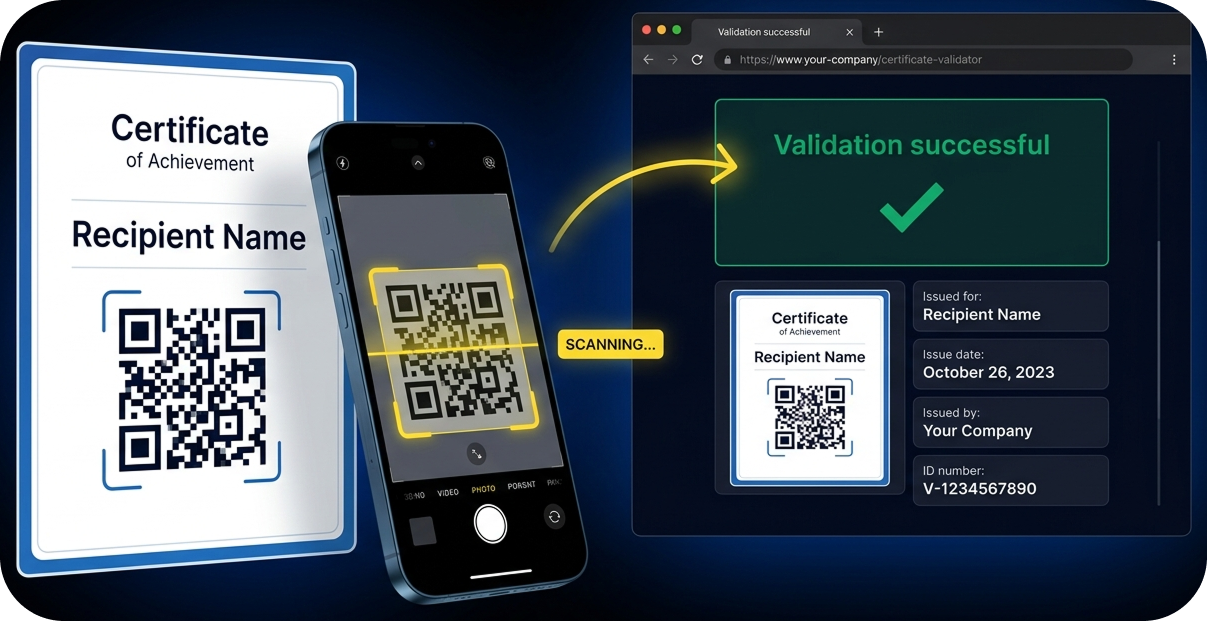
Key functions for awarding bodies at a glance:
Just as important as the technology is the recipient experience. With Virtualbadge.io, certificate holders do not need a user account. One click to retrieve, two clicks to share on LinkedIn. The industry benchmark sits between 20 and 30 percent share rate, which turns your certificate into an effective marketing instrument. More than 1,000 organizations with over 10 million issued certificates already rely on the platform, including telc, OMR Education, SRH, SGD, and others.
When choosing a platform as an awarding body, five things should be examined: Does it support multi-issuer workflows with clean data separation? Does it offer role-based access rights and multi-step approvals? Is white label including validation page and email sender possible? Does it meet GDPR requirements? Do certificates remain verifiable in the long term?
Virtualbadge.io fulfills all five criteria and combines them with intuitive operation that allows teams to become productive within minutes. Book a free demo with Virtualbadge.io and see how you can centralize your certification processes while keeping them flexible.
What sets platforms for awarding bodies apart from standard solutions?
Awarding bodies need multi-issuer workflows, approval structures, and strict governance. Standard solutions often only offer simple issuance without data separation between different issuers or role-based rights.
Can multiple issuers share a single platform?
Yes. The Organization Hub by Virtualbadge.io enables decentralized issuance with centralized quality control. Each issuer sees only their own data and templates, while the parent organization retains the overall view.
How secure are digital certificates against forgery?
Virtualbadge.io issues every credential cryptographically signed as a W3C Verifiable Credential and Open Badge 2.0.
Which integrations are relevant?
REST API, CSV import, Zapier with more than 4,000 apps, the Zoom app, as well as Apple and Google Wallet are particularly valuable for awarding bodies.
* You can find the organisation ID in the URL when you access your LinkedIn Company page as an admin.


Marketing

Jul 7, 2026

5 min
A note on how we write: we use AI tools to help with research and drafting. Every article is then reviewed, edited and fact-checked by someone on the Virtualbadge.io team before it goes live. The final word is always human.

Use Virtualbadge.io to design and send digital certificates that create trust - in less than 10 minutes.
%20(1).svg)