No user accounts required for your recipients -
Start your 7-day free trial now!

How Education and Training Organizations Choose a Digital Certification and Badging Platform.


Digital certificates and badges are electronic credentials for competencies, qualifications or completed training programs. Unlike paper documents, they can be shared online, verified and integrated into digital wallets.
The key advantage lies in verifiability. Each certificate contains metadata about the issuer, the issue date and the skills acquired. Employers and institutions can verify authenticity with a single click.
Certificates typically document the completion of an entire course or program. Badges, on the other hand, confirm specific competencies or milestones and are ideal for micro-credentials or individual modules. In practice, many organizations use both formats. Virtualbadge.io makes it possible to create and manage both digital certificates and Open Badges through a single platform.
Digitizing training credentials brings tangible benefits for providers and participants. Digital badges increase motivation. The result: higher completion rates, better reviews and more referrals.
For training providers, additional benefits include:
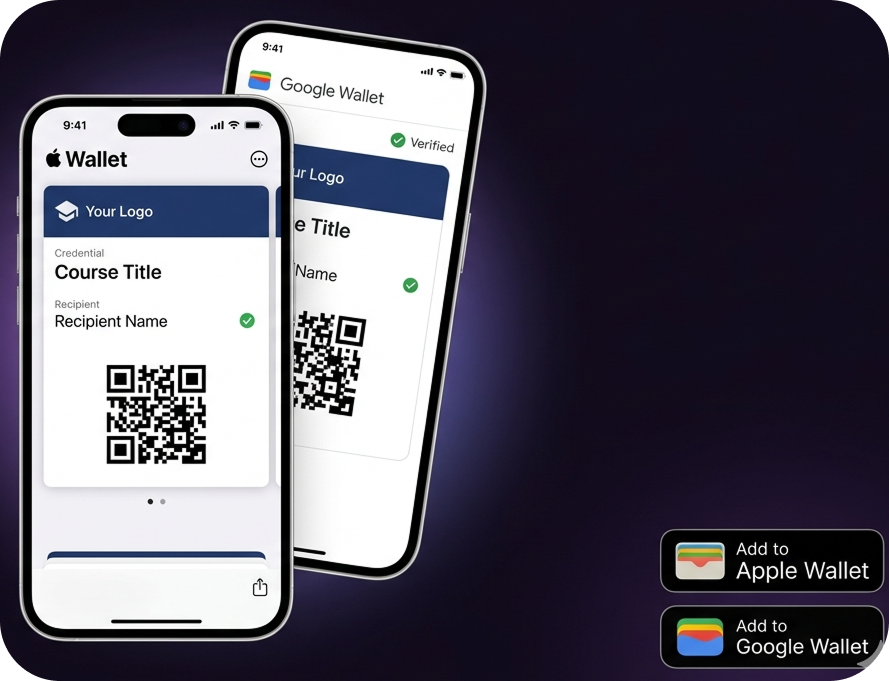
Participants benefit from instantly available, verifiable credentials.
Choosing the right badging platform depends on several factors. Here are the most important criteria at a glance:
LMS Integration: Connecting to your Learning Management System is often the most critical criterion. When certificates are created automatically upon course completion, you save considerable time. Virtualbadge.io can be connected to your existing LMS via an open API, optionally also through Zapier without any programming knowledge. For the technical integration into running systems, the Virtualbadge.io team also supports you directly with IT support.
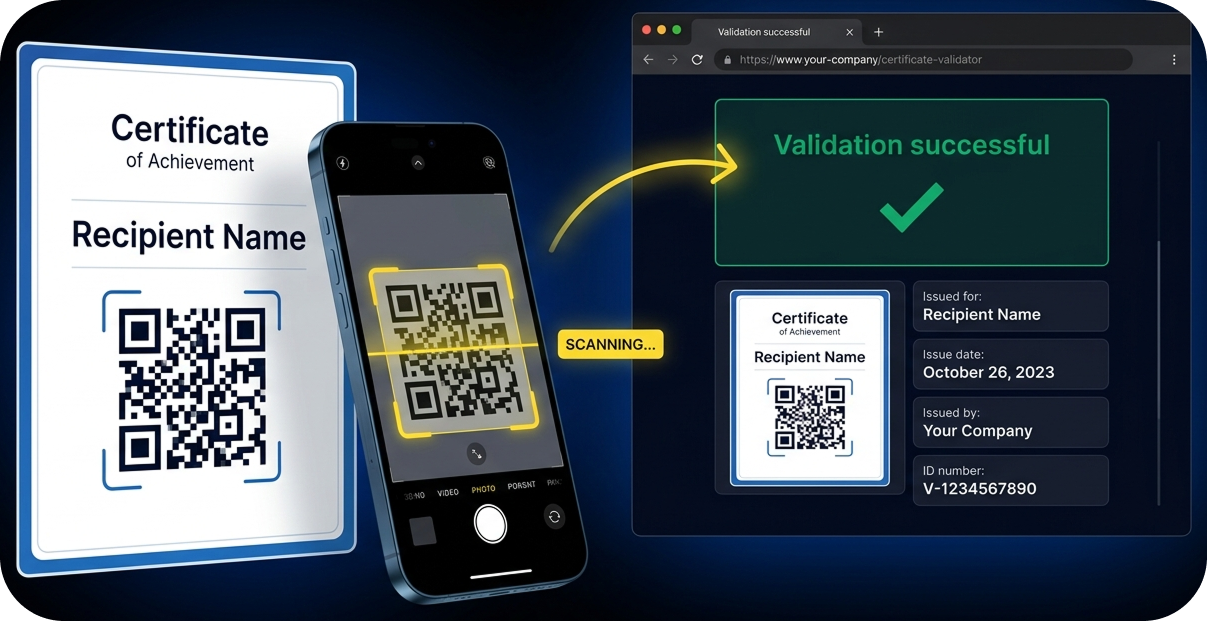
Verifiability: Digital certificates are only valuable when their authenticity can be verified beyond doubt. With Virtualbadge.io, every QR code leads to an individual validation page that is available around the clock and displays all relevant information: issuer, date, competencies and validity status.
White-Labeling and Branding: Your certificates should reflect your brand. Look for customization options for logos, colors, fonts and email templates.
Reporting: Meaningful data shows you how many certificates have been issued and on which platforms they are being shared. This helps demonstrate the ROI of your training programs.
When processing participant data, strict data protection rules apply. The GDPR in Europe sets the framework. Check whether the platform operates in compliance with GDPR, where data is stored and what security measures are implemented.
Virtualbadge.io relies on the W3C Verifiable Credentials Standard, which cryptographically secures the authenticity and integrity of digital credentials. This makes your credentials future-proof and interoperable. Another relevant standard is the eIDAS regulation for electronic identification within the EU. Virtualbadge.io is an official partner of the Bitkom eIDAS Summit 2026 and is actively committed to secure digital identities.
Choosing a digital badging platform is an investment in the future of your training organization. Pay particular attention to LMS integration, verifiability and compliance conformity. These three factors determine whether the platform truly simplifies your processes.
Virtualbadge.io combines all essential features in a user-friendly platform: automated certificate creation, white-labeling, QR code validation and GDPR-compliant data storage.
Start today with a free demo and see for yourself.
What is the difference between digital certificates and Open Badges?Digital certificates are PDF files in A4 or US Letter format that document formal completions. Open Badges are SVG files with embedded metadata that serve as standardized micro-credentials for individual competencies. Virtualbadge.io enables the creation of both formats through a single platform.
For more details, read here: Open Badges vs. Verifiable Credentials
How does the verification of digital badges work?Each badge contains a QR code or a unique URL. When scanning or accessing it, verifiers reach the validation page with all relevant information. Virtualbadge.io offers validation pages that are available around the clock.
Why is eIDAS compliance important for digital credential providers?The eIDAS regulation governs electronic identification and trust services in the EU. An eIDAS-compliant provider ensures that digital certificates are legally recognized and valid across borders. This is particularly relevant for organizations that certify participants in multiple EU countries.
How long does it take to set up a digital badging solution?The basic setup takes most platforms a few hours to days. More complex integrations with LMS or ERP systems can take several weeks. Virtualbadge.io offers intuitive no-code tools that accelerate getting started.
What happens to digital certificates when they expire?When certificates expire, the validation page displays the status as invalid. You can set up automatic reminders before expiration so that participants can renew their qualification in time.
* You can find the organisation ID in the URL when you access your LinkedIn Company page as an admin.


Marketing

Jun 26, 2026

5 min
A note on how we write: we use AI tools to help with research and drafting. Every article is then reviewed, edited and fact-checked by someone on the Virtualbadge.io team before it goes live. The final word is always human.

Use Virtualbadge.io to design and send digital certificates that create trust - in less than 10 minutes.
%20(1).svg)