No user accounts required for your recipients -
Start your 7-day free trial now!

Two similar-sounding terms with different levels of significance, and why issuers should know the difference.



In everyday training and continuing education, the terms "certificate of attendance" and "confirmation of attendance" are frequently used interchangeably. Anyone attending a seminar, workshop, or training course expects some form of proof at the end, and in practice, little distinction is made about which document is actually meant. For participants, this rarely stands out in daily life. For education providers, HR departments, and compliance officers, however, a closer look is worthwhile, since both documents serve different purposes and carry different weight once proof needs to be presented to employers, regulatory authorities, or clients.
Providers who regularly issue proof of participation should therefore know when each document makes sense, what information is expected for each, and how both forms can be represented cleanly in digital form, without creating confusion or follow-up questions down the line. This clarity pays off especially as participant numbers grow, since processes can be set up properly once and then repeated reliably.
A confirmation of attendance is usually the simplest and fastest proof document in everyday training. It merely confirms that a person attended an event, a webinar, or a training session, often sent automatically right after registration, check-in, or the end of the event, without anyone having to create the document manually.
Typical characteristics:
For many use cases, a confirmation of attendance is entirely sufficient, for example when an employee wants to document internally that they attended a kickoff or an informational event, or when a conference organizer wants to send a simple confirmation to everyone who attended a talk. However, as soon as the proof needs to hold up with third parties, such as regulatory authorities, clients, or funding programs, a simple confirmation is often no longer enough, since important mandatory information may be missing.
The certificate of attendance is the more formal of the two documents. It provides binding documentation of participation in a professional training course and is usually issued with a higher standard of completeness and traceability, often explicitly designed as an official document that can be kept and presented over a longer period of time.
A proper certificate of attendance typically includes:
%201.png)
Unlike the confirmation of attendance, the certificate of attendance is often deliberately designed as a document that participants can present to employers, funding bodies, or include in their own competency portfolio. However, this does not automatically involve a content-based evaluation of learning performance, that is handled by a certificate involving an exam or proof of achievement. Providers who regularly issue certificates of attendance for funding programs or regulated training courses should therefore consistently comply with mandatory information requirements from the outset and document uniformly which requirements apply to which course type.
For education providers, this distinction is more than just semantics. Choosing the wrong document format risks either unnecessary administrative effort or a document that falls short at a critical moment.
Reasons why a closer look pays off:
Medical technology training provider IMN Training focused on exactly this point and significantly simplified the management of proof for in-person training sessions, from the attendance list to automated dispatch after approval. Read more in the success story of IMN Training.
Whether it is a confirmation of attendance or a certificate of attendance, both documents appear more credible when they are consistently designed, verifiable at any time, and easy to share. With Virtualbadge.io, both forms of proof can be designed using the drag-and-drop designer, made tamper-proof with a QR code and validation page, and sent automatically to large numbers of participants via CSV import, all without recipients needing an account of their own.
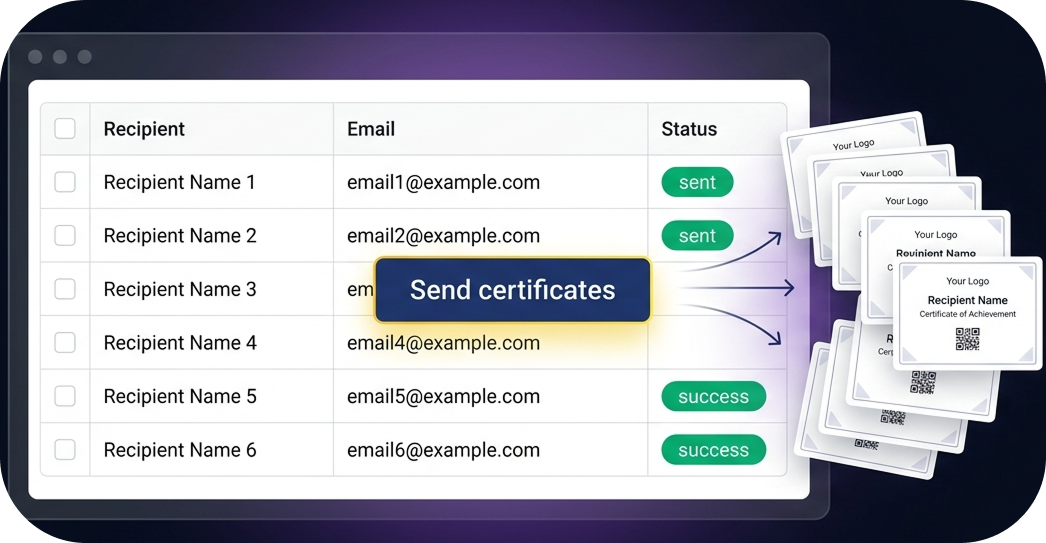
This makes it possible to define from the moment of issuance which format is intended, what mandatory information must be included, and how the document can later be verified, regardless of whether it is a simple confirmation or a complete certificate of attendance. Lost proof documents can also be resent at any time, without participants having to contact the provider.
Anyone looking to digitize their proof of participation and make it legally sound can book a free demo with our team here.
* You can find the organisation ID in the URL when you access your LinkedIn Company page as an admin.


Marketing

Aug 5, 2026

5 min
A note on how we write: we use AI tools to help with research and drafting. Every article is then reviewed, edited and fact-checked by someone on the Virtualbadge.io team before it goes live. The final word is always human.

Use Virtualbadge.io to design and send digital certificates that create trust - in less than 10 minutes.
%20(1).svg)